
By: Yu Yan PuiEdited by: CHAN Wing Yiu

Reviving Yim Tin Tsai heritage: Arts festival rekindles traditional values at Sai Kung
- 2025-11-10
- Society
- By: Yu Yan PuiEdited by: CHAN Wing Yiu
- 2025-11-10
With just a short ferry ride away from Sai Kung pier, visitors get to hop onto a small island rich in diverse culture as it seeks to rekindle heritage with a grassroots arts festival despite government funding having dried up. This community-powered event emerged after the government’s three-year “Sai Kung Hoi Arts Festival” pilot programme ended this year. This has prompted local villagers of Yim Tin Tsai to initiate a self-financed arts festival in the hope that they could pass on the heritage by drawing continuous attention to their homeland of 300 years. According to the Tourism Commission, the recently concluded Sai Kung Hoi Arts Festival was an expanded version of the earlier Yim Tin Tsai Arts Festival, which began in 2019. The project was estimated to have cost HK$47 million, and brought in at least 230,000 visitors over the years. These festivals integrated local arts, cultural heritage and natural scenery to promote Yim Tin Tsai as a green tourism spot. Wong Chi-cho, former commissioner for Tourism, said in a government statement that the project introduced Yim Tin Tsai as the ‘back garden of Hong Kong’, showcasing its unique blend of Chinese Hakka culture, Western Catholic tradition, and rich ecology. Actress Emma Chan Chung-yan, 28, is a ninth-generation Yim Tin Tsai villager and is driving this new grassroots art festival. “It’s a beautiful place grown alongside Hong Kong with nine generations of locals, it deserves to be preserved,” Chan said. Chan said she was driven by a vision to see the island once again immersed in performances as she worried that her hometown could be otherwise forgotten. “As an artist, hosting this arts festival feels like I can combine my passion and my mission,” Chan said. “Our festival uses ‘hope’ as the main theme, which expresses villagers' wishes for cultural …
Hong Kong’s port battles to stay afloat amid green and digital shift
- 2025-11-10
- Society
- By: QIN ZiyangEdited by: NG Natasha Goa Sheng
- 2025-11-10
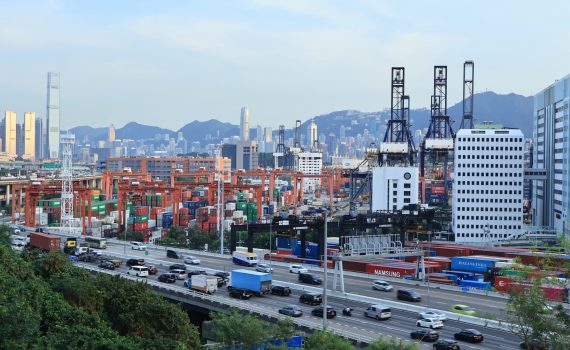
The Kwai Tsing Container Terminal was once the world’s busiest port and a symbol of Hong Kong’s economic boom. In 2023, for the first time in history, it fell off the list of the top 10, marking the end of a five-decade maritime dominance. Shipping data provider Alphaliner ranked Hong Kong in11th place that year. In 2024, it fell again to the 13th. According to Lloyd's List, in the top 10 global freight ports in 2024, mainland Chinese ports account for 7 of the largest ports, with Shanghai topping the list. In 2023, its throughput reached 49 million standard containers, 34 million more than Hong Kong. “Initially, Hong Kong's container throughput has fallen mainly because manufacturing has shifted away from China, reducing goods routed through Hong Kong," said Henry Ko Hok-han, professor at the School of Business of City University of Hong Kong. "Then, mainland ports like Shanghai and Ningbo have become more technologically advanced and handle more cargo directly, and rising operating costs have weakened Hong Kong’s competitiveness," he added. The government has introduced new policies to enhance port competitiveness, including connecting the port to shipping lines in the mainland and promising to push its green transformation and digital technologies, said Chief Executive John Lee Ka-chiu in the 2025 Policy Address. “The mainland government subsidises its ports, which has created unfair competition for Hong Kong,” said Ryan Chan, Secretary General of the Hong Kong Container Terminal Operators Association. “The relocation of manufacturing industries from Hong Kong to cities in the Greater Bay Area and the competition from other ports in the GBA, like Shenzhen and Nansha, are the key factors in the transit port of cargo shifting from Hong Kong to mainland ports,” said Chan. “Mainland ports are being supported by advancing the sharing of railway and port facilities, …
Lantern display paired with traditional chinese costume records the ever largest scale
- 2025-10-03
- Culture & Leisure
- By: MAO Anqi、QIN ZiyangEdited by: NG Natasha Goa Sheng
- 2025-10-03
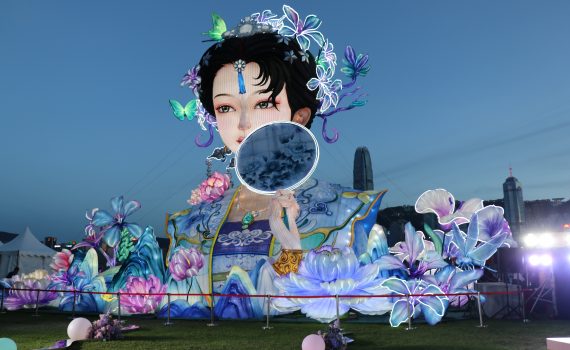
Thousands turned up in West Kowloon on Wednesday night to see a giant outdoor lantern exhibition as part of a series of events across Hong Kong to celebrate National Day. A 12.8-metre Hong Kong fairy lantern is the largest ever to be displayed in Hong Kong and is based on the character Zixian Fairy from a Hong Kong film. It is one of four in the Art Park designed to look like fictional fairies dressed in traditional Chinese clothing. The lanterns are made in Zigong style, a national heritage from Sichuan province known for its complexity, craftsmanship and large scale. The lantern features a fairy in traditional Chinese attire as its central motif, complemented by bouquets of Bauhinia and peonies. This symbolises national prosperity and the flourishing of wealth, embodying heartfelt wishes for both the motherland and Hong Kong. Many residents were impressed by the scale and craftsmanship. “The lanterns show Chinese traditional culture in an innovative way. It gives greater value to costumes when they are presented together with intangible heritage,” said Cheng Heng-tai, 35, who travelled from Macau after knowing the event through social media. “The current lantern designs are just large figures. I would like to see more different styles, with a greater artistic feel,” said Pauline Mak, 66, a local resident. She added that she found the blinking lantern figures quite frightening in the beginning. “But later, when all the lights along the road were turned on, I got used to it,” she said. “I hope the carnival can include booths that sell local street foods, such as fishball and siu mai, instead of only selling creative handmade crafts. Because we spend a long time here, having snacks available helps pass the time pleasantly,” said Elsa Chow, 52. “Many children also come to this event, so …

Hong Kong celebrates 76th Chinese National Day
- 2025-10-01
- Society
- The Young Reporter
- By: AO Wei Ying Vinci、MA Tsz Chiu OscarEdited by: NG Natasha Goa Sheng
- 2025-10-01
Flags and banners are displayed around Hong Kong while celebrating China's 76th National Day on October 1, 2025. Hong Kong’s regional flag and Chinese national flag were raised at the ceremony held in Wan Chai’s Golden Bauhinia Square at 8am today to celebrate the 76th anniversary of the founding of the People's Republic of China. Ceremony attendees including Chief Executive John Lee Ka-chiu and other government officials. The public watched the ceremony at a distance from Wan Chai Ferry Pier, as the government announced no public viewing area for the ceremony. Lee Ka-chun, 16, who is a local student, said he secured a spot with his friends at the Wan Chai Ferry Pier observation deck at around 7am. He said it is a pity that he can only view the ceremony through his telephoto lens on a camera today, citing his past flag-raising viewing at the Tiananmen Square allowed him to be nearer to the ceremony, after passing through security checks. During the national anthem, two helicopters hanging a Chinese national flag flew over Victoria Harbour, while ships under the Police and the Fire Services Department sailed along the harbour. It is the first time Kai Tak Sports Park hosted a flag-raising ceremony, outside the city’s largest stadium at 11am. Free ice cream and beverages were distributed near the venue by the park’s authorities. Leah Zhang, 27, travelled from Jiangmen to Hong Kong for two days during the National Day Golden Week. She said she came across a social media post on RedNote about the flag-raising ceremony at Kai Tak. “I thought more people would be here to see the flag-raising ceremony. There are only limited promotions from the Kai Tak Sports Park, which could be the reason,” said Zhang. A firework display is held at 8pm on the same …
Policy Address 2025: Government to support low-altitude economy with new action plan
- 2025-09-17
- By: LAU Ka Yan、CHAN Hiu YingEdited by: NG Natasha Goa Sheng
- 2025-09-17
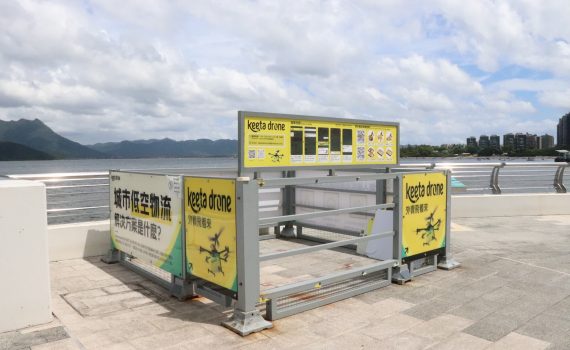
Hong Kong will create more legislation promoting the low-altitude economy, mostly focused on drone activities, said Chief Executive John Lee Ka-chiu in the policy address this morning. Potential activities in airspace under 1,000 metres include drone rescues, surveys and deliveries. Food delivery platform Keeta launched drone food delivery in a small area in the New Territories in June. Keeta, along with SF Express and Lalamove, were some of the first applicants to apply for drone activities in March. Improving civil aviation legislation and regulatory framework, promoting infrastructure facilities, organising more talent trainings, enhancing the application system and developing low-altitude economy insurance products were all mentioned in the policy address this year. More complex government plans will establish air route networks, satellite positioning, three-dimensional spatial data systems and a smart and traffic-management system for low-altitude passenger aircrafts, Lee said. “With countless islands in the city, it is a perfect scenario to apply passenger-carrying aircraft,” said Huang Hailong, assistant professor in the Department of Aeronautical and Aviation Engineering at the Hong Kong Polytechnic University and leader of the university research group on autonomous technology. “For people living on the islands who have urgent medical needs, using drones to access hospitals is more convenient and cost-effective than ships and helicopters.” “In the meantime, the government should establish clear regulations including administrative penalties to curb illegal flights, considering safety should be the first priority in developing the low-altitude economy,” said Huang. He said third-party insurance similar to car insurance can be introduced. “Low-altitude technology can also be applied to sectors including express delivery, emergency rescue and construction monitoring in the future,” said Zhang Feiyang, Research Manager of Our Hong Kong Foundation and one of the authors of the organisation’s policy recommendation report to the government regarding low-altitude economy. “To serve as a global role …

Shift in news consumption habits gives rise to donation-based revenue model
- 2025-02-19
- Society
- The Young Reporter
- By: AU YEUNG Jim、YAM Long Hei JamieEdited by: NG Natasha Goa Sheng
- 2025-02-19
Tang Ho-wing, 36, is an independent journalist running the news outlet, “boomheadhk”, on social media platforms such as Facebook and Instagram. The page mostly covers local and international political issues, and has attracted over 22,700 followers. “Hongkongers' news consumption habits have shifted. Increasingly, they want to consume content not covered by the mainstream media or specialised content that features unique views,” Tang said. The main purpose of his outlet is to supplement the mainstream media and offer readers new insights on social issues. Tang’s outlet relies on readers’ donations to cover the cost of his reporting work. “When people want to read more specialised and unique reporting, or lesser-known content, they are willing to pay,” Tang said. According to Reuters Institute Digital News Report, in an online survey of 2,000 respondents in Hong Kong, only 18% said they pay to access news online in 2024, down from the peak of 29% in 2020. The report added that because the public’s news consumption habits have changed and advertising revenue has declined, media organisations that struggle in adapting to the rapid change have reported financial losses. Hong Kong Free Press, an independent non-profit news media that relies on readers’ donations, reported a HK$1.4 million loss in 2023, according to its annual report. HKFP has 895 regular monthly donors as of 2023. Damon Wong Chun-pong, Chief Editor of InMedia, a local online independent news outlet, said his outlet did not experience significant financial losses. “The drop in paid readership following 2020 is a full picture that includes the closure of mainstream media outlets, such as Apple Daily and Stand News,” said Wong. “By comparison, our readership didn’t drop a lot.” He said some readers follow other small and new news outlets after some closure of some of the mainstream outlets. The newcomers include …