
By: Cheuk Chi Maggie YEUNG、MAO AnqiEdited by: CHAN Wing Yiu

Local organic agriculture thrives with support from government and consumers
- 2025-04-28
- Culture & Leisure
- The Young Reporter
- By: Cheuk Chi Maggie YEUNG、MAO AnqiEdited by: CHAN Wing Yiu
- 2025-04-28
At 5am, Tsang Hing-yi, a 65-year-old farmer starts his daily routine by exercising. After some aerobics, he heads to the Hong Kong Federation of Youth Groups Organic Farm, where he has worked as an employee for the past 14 years. “Work is not just harvesting but fertilising, weeding and digging,” he said. “During summertime, I need to have at least five outfits ready to change into because the heat is intense.” Nestled in the mountains in Yuen Long, the farm provides fresh organic vegetables to local customers, and adapts to seasonal changes tailored to the time of year, yielding an annual harvest of 20 tons, according to its website. “People need agriculture and cannot survive without it. This is very practical because all food is grown on farms,” Tsang said. “I will definitely keep doing it with motivation.” The Rural Sustainability Programme, a collaborative project by the University of Hong Kong, addresses the importance of local farms, aims to diversify the food supply, reduces carbon emissions and focuses on rural conservation. Government data shows that in 2024, local farms produced an average of 42 tons of vegetables daily, contributing 1.8% of Hong Kong’s fresh vegetable supply. Hong Kong's agriculture relies heavily on intensive land use and production. Out of the total 1,104 square kilometres of land, only 7.3 square kilometres are dedicated to crop cultivation, according to the government. Despite the limited land available for farming, some people, including Tsang, still insist on doing it. Founded in 2010, HKFYG Organic Farm is the only organisation that is certified by the US Department of Agriculture and Hong Kong Organic Resource Centre Certification Limited. According to the latter, 122 local farms have received accreditations from the International Federation of Organic Agriculture Movements, a worldwide organisation advocating organic agriculture that sets standards of …

Snap Back in Time: The Film Photography Craze Sweeping Hong Kong
- 2025-04-16
- Culture & Leisure
- The Young Reporter
- By: LEUNG Chi Ngai、CHEN ZiyuEdited by: CHAN Wing Yiu、CHEN Yik Nam
- 2025-04-16
Old fashioned roll film cameras are the new craze among young people in Hong Kong. Social Media Posts that carried the hashtag of “film photography” reached over 86,000 in total. Film cameras, first sold and popularised by the American company, Eastman-Kodak Co. In 1888, images captured by a roll film camera needed to be processed in a dark room. The process is called albumen print, papers need to be printed with a layer with egg white and salt to ensure the smoothness of the surface. After the chemical reaction between silver nitrate and salt is exposed to the sun, a print is finally complete. Tang Pik-san has been using film photography since 2022 . It costs him HK$500 every month. “The biggest difference between film and digital cameras is that you can’t check the photo result immediately, which makes the photograph process mindful to me. I can simply focus on the composition of the photograph,” Tang said. The cheapest digital camera is around HK$3,000, while a disposable film camera costs around HK$100. Developing the film costs around HK$50, Tang said starting film photography is relatively cheaper. College student, Stephen Fu, 20, tried film photography for the first time four years ago. “At first it was just for fun, then I realized that film photography is completely different from digital photography. It was slower, quieter, which I love,” Fu said. For Fu, the biggest charm of the film camera is the connection between the user and the camera. “Film cameras make me think carefully every time when I press the shutter, making the time of shooting more precious,” he said. The sale of film cameras in the Chinese market increased by 3.6% over the past two years, according to The Film Camera Report 2025. The sale of products related to photographic …
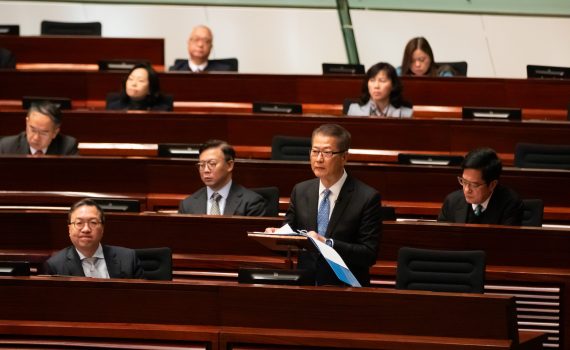
Budget 2025: Government proposes fiscal consolidation measures to cut expenses
- 2025-02-26
- The Young Reporter
- By: NG Natasha Goa Sheng、MAO AnqiEdited by: CHAN Wing Yiu
- 2025-02-26
The government has proposed to cut 7% of government recurrent expenditure from now to the 2027-2028 fiscal year, Financial Secretary Paul Chan Mo-po said in the budget address this morning. A “reinforced version” of the financial consolidation programme is coming soon, with the purpose of restoring HK$6.2 billion of expenditure over the next five years. “Strictly containing public expenditure is a must, but we should proceed in a steady and prudent manner and be careful to find a balance among the various impacts that may arise in the process,” Chan said. In the 2024-2025 fiscal year, Hong Kong recorded a deficit of HK$87.2 billion, 60% higher than the forecasted deficit of HK$54.4 billion last year, according to the government. In this year’s budget, the total estimated expenditure stands at HK$639.7 billion, an increase of 2% from the previous year. Terence Chong Tai-leung, Professor of economics at the Chinese University of Hong Kong, said Hong Kong’s economic performance is not as bad as widely perceived. “Hong Kong’s financial expenses have always been stable. It is normal to observe deficit fluctuation throughout the business cycle,” he said. To reduce the deficit, Chong suggested the government can work on land sales and budget upper limits. “I suggest further dividing large areas of land into smaller ones, and then selling more of them to small- and medium-sized enterprises and overseas companies, instead of strengthening the local monopoly,” he said. Other proposals to reduce expenditure include increasing the rate of reduction of recurrent government expenditure from 1% to 2% in 2025-2026, under the premise of not affecting Comprehensive Social Security Assistance, Social Security Allowance and other statutory expenditures. The policy will be extended to 2027-2028 and is expected to save the government around HK$3.9 billion, HK$11.7 billion and HK$19.5 billion in the following three financial …