
By: LAU Ka YanEdited by: LI Sin Tung
From street to stall: How Kwun Tong’s evicted hawkers fight for survival
- 2025-11-05
- Society
- The Young Reporter
- By: LAU Ka YanEdited by: LI Sin Tung
- 2025-11-05
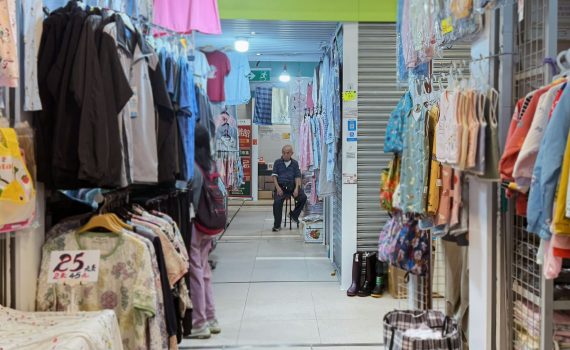
Beneath Kwun Tong's gentrified Yue Man Square lies a descending escalator that leads one to a ghost market. Despite bright lighting and air conditioning, the Yue Man Hawker Bazaar is drawing only a handful of visitors each day to the basement market selling household supplies. Off-seasoned pyjamas and bath towels are seen hanging on store fronts where shop owners idled by, barely making any sales. This is a stark contrast to the former street vendors who used to huddle up in the heart of Kwun Tong’s hustle and bustle while making a living to sustain their families. Since 2021, more than 100 stalls have been relocated to the Yue Man Hawker Bazaar, which was designed to support hawkers’ livelihood. But they complained that its hidden basement location and a surging popularity with online sales have made their businesses no longer sustainable. Although there are efforts to revive the market, its once-vibrant atmosphere was killed in the process. Fung Kwong-wai, 88, is a stall owner in Kwun Tong who has been selling mostly pyjamas for all ages for over 50 years. “I can only make a hundred dollars a day. It is not enough, as even lunch now costs at least HK$40,” said Fung. Many hawkers, like Fung, face a similar situation at Yue Man Hawker Bazaar. “No one comes here except for some neighbours occasionally,” said Janet Chan, 50, another old stall owner who sells daily items including combs, hair ties and pouches at the bazaar. Lau Sze-ying, 80, has been an owner who sells Chinese New Year couplets and red pockets for over 50 years. “Half of the day goes by, and only two to three people out of every 10 people who take the escalators down may buy things here. Most of the people who come are usually …
Key Highlights from Policy Address 2025
- 2025-09-17
- Politics
- The Young Reporter
- By: LI Sin Tung、ZHENG XinyiEdited by: CHEN Yik Nam
- 2025-09-17
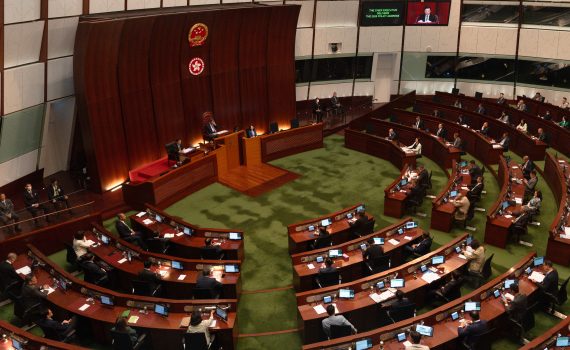
Chief Executive John Lee Ka-chiu delivered his fourth Policy Address on Wednesday morning, pledging to deepen reform and prioritise public livelihood. The following are the key takeaways. New action plan for the low-altitude economy More legislation to promote the low-altitude economy, mostly about drone activities. Including the improvement of civil aviation legislation and regulatory framework, promotion of infrastructure facilities, organisation of more talent training, enhancement of the application system and development of low-altitude economy insurance products Potential activities in airspace under 1,000 metres include drone rescues, surveys and deliveries Satellite positioning, three-dimensional spatial data systems and a smart traffic-management system for low-altitude passenger aircraft will be established Patriotic Education Collaboration with Shenzhen to promote a red education route and patriotic education venues in the mainland A series of activities called "Love Our Home, Treasure Our Country" by the Education Bureau will be organised and the Constitution and Basic Law Student Ambassadors Training Scheme will be strengthened Arts and Culture A premium arts trading hub will be built An arts ecosystem in the Airport City with studios, galleries, and trading facilities will be established Large-scale art storage and arts plaza buildings will be constructed to attract galleries and family offices West Kowloon Quay will be opened and a cultural district academy will be set up The Hong Kong Fashion Fest will be launched, and the government will further support the local cultural and creative industries Education Cap on self-financing non-local students' enrolment will be increased from 40% of available spots to 50% The over-enrolment ceiling of self-financing places of funded research postgraduate programs will be increased from 100% to 120% Task Force on Study in Hong Kong to be established to step up promotion of higher education in Hong Kong Eight supported universities will be given HK$40 million to improve their …

Gender-neutral toilets, Hello Kitty and Gundam highlights at the Osaka Expo
- 2025-05-29
- The Young Reporter
- By: LI Sin Tung、CHEN Yik NamEdited by: Jenny Lam
- 2025-05-29
What is the Osaka Expo? The Osaka World Expo opened on April 13, and it is the first post-COVID Expo. Over 160 countries, regions, and organizations are exhibiting their futuristic displays in over 80 pavilions, each with distinctive architectural designs. It is the second Expo in Osaka. The last one was in 1970. This year, it is in Yumeshima, or “dream island”, a reclaimed industrial waste burial site in Osaka Bay. The theme is “designing future society for our lives”. Each pavilion is divided into four zones: Connecting Lives, Saving Lives, Empowering Lives and Future Life. Osaka Expo will run for 184 days until 13 October, 2025. What is the Grand Ring? The Grand Ring, designed by Fujimoto Sou, is the largest wooden architectural structure in the world, measuring 20 metres high and having a 2-kilometre circumference. It is constructed using a fusion of modern construction methods and traditional Nuki joints, such as those used in the construction of Japanese shrines and temples. The Grand Ring cost about 35 billion yen (HK$1.9 million) to build and used around 27,000 cubic metres of wood. “You can get such a great view of so many pavilions from the Grand Ring,” said Asa, a 30-year-old visitor from Saga, Japan. Asked about the “waste of money” discussion of the Grand Ring, Asa said she does not think there is anything wrong with the spending. “It is a big international event, so these expenses are necessary,” she said. A Hong Kong visitor, Steven Gong, 40, said the cost of the architecture is not worth it. “It is beautiful, but it is also a waste of resources and money if it cannot be reused,” he said. The Japan Association for the 2025 World Exposition will consider recommendations from private enterprises and public organisations on how to …

Navigating Hong Kong malls with sight impairment
- 2025-05-07
- Society
- The Young Reporter
- By: CHEN Yik Nam、LI Sin Tung、CHAN Wing Yiu、Cheuk Chi Maggie YEUNGEdited by: Jenny Lam
- 2025-05-07
Accessible facilities, especially tactile paths for the blind are either inadequate or improper in most of the malls, no matter in Hong Kong or Shenzhen. Despite the government regulations on accessibility for people with sight impairment, related malls’ respondents and government departments avoid replying directly. https://youtu.be/fd-s8XZiR78

Buskers bring rhythm to public regardless of restrictions
- 2025-04-14
- Culture & Leisure
- The Young Reporter
- By: CHENG Tsz Sen Sean、XU JingyiEdited by: LI Sin Tung、CHEN Yik Nam
- 2025-04-14
Contrary to the definition, buskers in Hong Kong are not as free as their occupation, which requires them to apply for permission before performing in public. But with the delayed approval from the police, most of the buskers have chosen to bear the risks of charges and voicing for themselves. https://youtu.be/chErIc-eDqc

Budget 2025: One-year civil servants pay freeze
- 2025-02-26
- Politics
- The Young Reporter
- By: Fu Rong、Chun Hei LUKEdited by: Wing Chi HO
- 2025-02-26
More than 170,000 civil servants and all members of the executive, legislative and judicial branches of the government will not see a pay rise for a year. Up to 10,000 civil service posts will be axed. (February 26, 2025).

Budget 2025: Hong Kong Tourism Board to receive funds to boost local art and culture development
- 2025-02-26
- Society
- The Young Reporter
- By: CHAN Hiu Ying、LAU Ka YanEdited by: CHEN Yik Nam、LI Sin Tung
- 2025-02-26
The government will inject HK$1.235 billion into the Hong Kong Tourism Board to promote a series of distinctive tourism products, Financial Secretary Paul Chan Mo-po announced in the budget speech on Wednesday. The Board signed a three-year partnership agreement with international art fair Art Basel to establish immersive experience zones of Hong Kong culture at all four of their shows around the world, strengthening Hong Kong's connection with the global art scene, said Chan. Hundreds of thousands attended Art Basel last year in Europe, the US and Hong Kong. “Art Basel will attract foreign tourists or celebrities, which will bring economic benefit to Hong Kong,” said Kwok Wai-keung, 46, a member of the Legislative Council and Hong Kong Federation of Trade Unions. “I am pretty surprised that the Hong Kong government would put so much support for cultural activities, such as holding Art Basel and developing different types of tourism,” said Carmen Chan, 33, a Canadian tourist. “But I am glad because these activities can help us get to know Hong Kong better, especially to allow my daughter to be exposed to a more diverse culture,” Carmen Chan said. Kwok said that Hong Kong needs to improve technology for tourists. “Hong Kong does not have a special app to facilitate tourists and locals to search for related tourism, such as ‘dianping.com’ [a public review app] from the mainland,” Kwok said. “So Hong Kong needs to work harder to create a platform for visitors to see comprehensive feedback from attractions and restaurants.” “The distinctive tourism projects that the government aims to promote in 2025, including panda, horse-racing and eco‑tourism, must incorporate local cultures that are difficult for other regions to replicate, in order to attract more tourists effectively,” Kwok said. Some have criticised the West Kowloon Cultural District, which is designed …

Kai Tak Stadium Debuts with Full-house Trial of U22 Football Match
- 2025-02-05
- The Young Reporter
- By: CHAN Wing Yiu、WANG LudanEdited by: AO Wei Ying Vinci
- 2025-02-05
Local football club Kitchee beat the North District team in Kai Tak stadium’s first youth football match yesterday with 50,000 in attendance. The Hong Kong Premier League Under-22 football match was a stress test for the stadium’s sports park set to open March 1,according to the government press conference. The Kai Tak Sports Park is the largest sports infrastructure in Hong Kong, including the 50,000-seat stadium, a 10,000-seat indoor sports center, a 5,000-seat public sports ground, and about 14 hectares of landscaped open space. “It is a once-in-a-lifetime opportunity for the players. I have never experienced such an impressive game with this amount of audience in my whole career as a football player,” said Chan Chi-hong, the head coach of the North District team. Chan said he was disappointed that the football field is artificial grass. “The grass matters a lot to football players. It could affect their overall performance,” he added. Dai Tsz-hin, a player of the North District team, said he was excited to kick off the match. “Even though most of the audience might not be football fans, I still heard them cheer for us, which makes me want to perform better,” he said. It is expected to enhance sports development and stimulate growth in various sectors, including recreation, entertainment, tourism, and the mega-event economy, according to the policy address 2024. Dan Tsang, 43, has been a local football fan for more than 30 years. When Tsang first heard about the plan to build this stadium, he doubted the need to spend this huge amount of money on a venue. “I am worried whether local football development in Hong Kong can make good use of a 50,000-seat stadium, as usually only around 2,000 people attend local matches,” said Tsang. The average number of audience members at local …