
By: YANG ShuyiEdited by: WANG Jing

Wong Tai Sin's human oracle: how fortune-tellers endure the challenge posed by AI
- 2025-11-07
- Culture & Leisure
- The Young Reporter
- By: YANG ShuyiEdited by: WANG Jing
- 2025-11-07
The 73-year-old Frankie Chan Wang-yuen is not your average fortune teller at Wong Tai Sin Temple, especially in an age where AI can decode insights into your destiny in just seconds using traditional Chinese fortune-telling concepts. Below the large, dark green Chinese shop sign – founded in 1940 – is a small, lime-green, A4-size paper with four lines of English in Arial font that reads: Frankie Chan, spiritual therapist, M.A. (Social Work), English and Putonghua. That is about all one needs to know how Chan’s fortune-stick reading service would differ from his peers at Wong Tai Sin Temple. Chan inherited the fortune-telling store from his mother and ran it for 15 years after retiring from a lifelong career in social work focusing on children and mental health. In the face of pervasive anxiety in a post-pandemic era and demand for insights to control uncertain life circumstances, Chan said he could offer a bit more than just straightforward fortune-telling. Most of his early life revolved around the proximity of Wong Tai Sin, a Taoist temple offering worship and fortune-stick reading service. It remains one of Hong Kong’s most popular tourist destinations and also a place where he discovered the connections between traditional Chinese fortune-telling concepts and spiritual guidance via building connections with his customers. "Many of my customers have been coming since my mother's time," said Chan."They keep returning because of the deep connections we've built over the years." Like many, Chan too was faced with the impact of technological advancement, where traditional fortune-telling was outsourced to large artificial reasoning models that could generate insights using a wide range of Chinese astrological models. According to a report published by the Chinese online media outlet 36 Kr on Aug. 25, about 60% of respondents, who are mostly aged under 35, have used …

Starting salaries of Hong Kong bachelor’s graduates end five-year upward trend
- 2025-10-26
- Society
- The Young Reporter
- By: YANG ShuyiEdited by: WANG Jing
- 2025-10-26
The average starting salary for university graduates of bachelor’s degrees in Hong Kong remained at HK$19,500 this year, marking the end of a five-year upward trend amid the US-China trade war, a survey has found. The “2025 Guangdong–Hong Kong–Macau Greater Bay Area Pay and Benefits Survey” published on Oct. 23, also reported that the production, sales, and customer service sectors face the highest declines in the starting salary. "Due to Hong Kong's poor economic conditions and uncertain future outlook, some employers tend to lower the starting salary for fresh graduates," said Huang Xu, director of the Centre for Human Resources Strategy and Development at Hong Kong Baptist University, who led this survey. Huang said Hong Kong’s current economic situation is significantly impacted by the new round of the US-China trade war that began in April this year, and that is one of the reasons why the average starting salary for university graduates has not increased as expected. "In our long-term tracking of employee salaries offered by 2,000 Hong Kong companies, we observed a significant decline following the outbreak of the trade war in April," said Huang. The average salary increase rate in Hong Kong is 2.5%, and it is below last year's figures of 3.5%. This year’s survey was conducted from July to September, with a total of 258 participating companies that represent over 240,000 employees. Gou Jyun-lung, 20, who studies interactive design at the Chinese University of Hong Kong, said the average starting salary meets his expectations for his first job in the future. "With many universities in Hong Kong expanding enrollment, competition for jobs is becoming more intense,” Gou said. “So, if my future salary can reach HK$19,500, I would be satisfied." Zhang Que, 21, is a final-year social science student who is currently looking for a job, …
Policy Address 2025: Hong Kong to take further actions for land management in Northern Metropolis
- 2025-09-17
- Politics
- The Young Reporter
- By: CHEN Xiyun、CHEN ZiyuEdited by: CAO Jiawen
- 2025-09-17
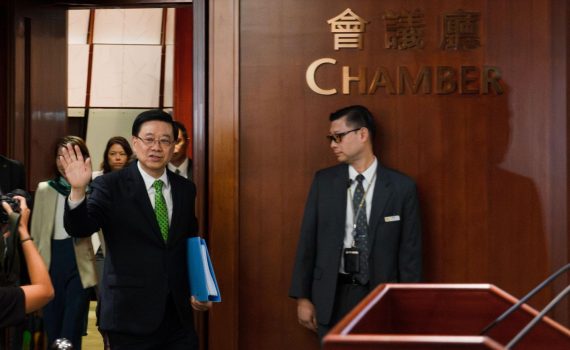
A land use review over the Sha Po area, as part of the Northern Metropolis, a development priority proposed four years ago, will be established to discuss its development potential and the feasibility of constructing more private housing in the region, Chief Executive John Lee Ka-chiu said in his policy address on Wednesday. According to the Planning Department, Hong Kong will build 500,000 housing units in the coming decade in the Northern Metropolis for 2.5 million people. Mak Sui-choi, Associate Professor who researches finance and investment at Hong Kong Baptist University, said the Northern Metropolis may attract labour to the local industry. “The increase in Hong Kong's population is a good thing, driving the development of other local industries,” Mak said. “But the construction of the Northern Metropolis should first address the conflicting land status,” he added. According to the commissioned Farm Land Survey Report by the Chinese University of Hong Kong, most farmland in San Tin and Ngau Tam Mei has been rebranded as non-arable fields. “The first step for the government is to reacquire the land and adjust its current land status,” Mak said. “This is going to be a long and cumbersome process, but it is doable,” he added. Lee said the government will arrange three sites for the Urban Renewal Authority to build new housing in Kwu Tung North and Fanling North, areas that are part of the Northern Metropolis. While the Northern Metropolis area presented certain property development potential, a 28-year-old two-time mainland home buyer Cissy Chen opted for Kai Tak instead. “The Northern Metropolis is far away from Hong Kong Island as compared to Kai Tak, location is my main consideration when it comes to real estate investment," Chen said. She added that it would be long before infrastructures in the northern metropolis would …
Policy Address 2025: Hong Kong extends tax allowance for parents with newborns in its latest fertility push
- 2025-09-17
- The Young Reporter
- By: YANG Shuyi、Lou ZhengzhengEdited by: WANG Jing
- 2025-09-17
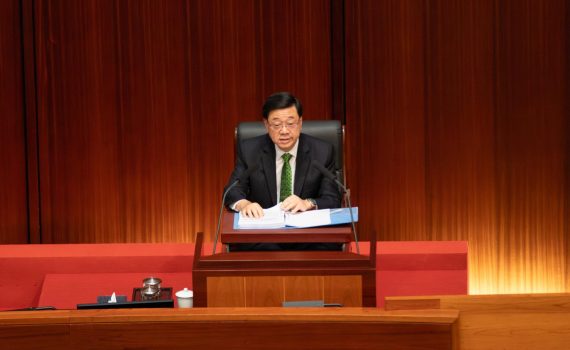
Hong Kong parents with newborns are set to get more tax allowance as the city strives to boost its birth rate. Currently, parents receive a HK$260,000 tax exemption in the baby’s first year, but this is going to be extended for another year, said Chief Executive John Lee Ka-chiu in 2025 Policy Address. Those with older children will continue to get HK$130,000 of their taxable income exempted. Hong Kong has been struggling with a declining birth rate, with the number of babies born dropping from 60,900 in 2016 to a low of 32,500 in 2022. In 2024, there was a slight improvement to 36,700 babies. A 36-year-old mother of a toddler from Kowloon welcomed the additional tax break. “As someone from the 80s generation, I really want to have children, this policy will help us to relieve some financial pressure,” said Ruby Tse, who is trying for a second child. Lawmaker Chan Wing-kwong, who specializes in medicine, said the allowances are a welcome addition for families trying for more children, but it would be an unlikely fertility boost for those who don’t. “The additional newborn allowance is merely a drop in the bucket when it comes to the cost of raising a child in Hong Kong,” said Lin Sen, who has been married for six years but has remained reluctant to have a baby. Lin said the intensifying competition for schools and jobs a child might face in the future deters him from giving birth. Lee also pledged more childcare resources for babies and schoolchildren. Chan said that although the direction of the current encouraging policies is right, a series of supporting measures must keep pace. The lawmaker called on the government to provide more measures for schools and job placements. “Only when the social environment can let people ‘live …
Number of visitors at the Osaka Expo hits record high
- 2025-05-29
- Society
- The Young Reporter
- By: ZHANG Yiping、CAO JiawenEdited by: CAO Jiawen、ZHANG Yiping
- 2025-05-29
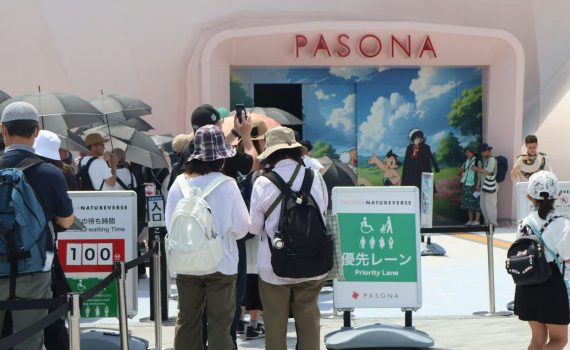
The Osaka Expo drew approximately 139,000 visitors on May 23rd, breaking the record for the highest number of visitors on a single day, despite ongoing complaints over confusing booking systems and long waiting times. The total number of visitors exceeded 5 million on May 26th, 44 days into the six-month event, according to the Japan Association for the 2025 World Exposition. But that still falls short of expectations, as the Expo is projected by the association to have a total of 28.2 million visitors (150,000 daily). “The waiting time for each pavilion is very long,” said a Japanese couple, Kayo Aoshima and Yoshiaki Aoshima, aged 82 and 78. “We went to the Arab Pavilion, where we had to wait for more than 30 minutes.” Kayo added. Pavilions at the Expo have different admission strategies. While a few only allow for those who have booked in advance to enter, others allow on-site queuing. With each ticket, visitors can make one reservation for one pavilion or event through a lottery system seven days before their visit. They can also reserve or adjust bookings during the three days leading up to their visit, which operates on a first-come, first-served basis. “We have visited many pavilions, such as the USA, Colombia, and the Netherlands, ” said David Aragon, 40, a Mexican tourist.“We had to wait for around one hour at each one of them.” “Maybe more info outside the pavilions to know what is inside and exactly where we can enter something,” added Aragon. Nishijima Ryo, chief of Japan Association for the 2025 World Exposition, who was overseeing work at the Future of Life Pavilion, explained why only visitors with reservations could be admitted. “In this pavilion, you can wear an earphone device and experience the exhibition,” he said. “The number of machines is limited, so we limit …

Humanoid robots shines at InnoEX
- 2025-04-19
- Society
- The Young Reporter
- By: CHEN Xiyun、CHEN ZiyuEdited by: WANG Jing
- 2025-04-19
A humanoid robot dances to music. Others clap to the beat, or make eye contact through vision sensors with the audience. These bots are all the rage at the third sci-tech exhibition InnoEX at the Hong Kong Convention and Exhibition Centre from Apr.13 to 16 this year. Co-organized by the Technology and Industry Bureau and Hong Kong Trade Development Council and themed with “Innovate, Automate and Elevate”, this exhibition spotlights robotics, low-attitude economy, AI, smart mobility, and cybersecurity, according to the official news release. “These robots can already be applied in certain scenarios like playing football games. They can identify objects and take actions like shots and dribbling.” said Liu Weitong, 32, head of commercialization at Booster Robotics. “Humanoid robots can provide basic services like guidance and performance, but it will take at least two to three years for the industry to provide mature products for factories or families,” she added. She explained the limited load-bearing weight of the robot's arm is such that they cannot be used in large-scale industrial production. The algorithms at the current level also cannot fully guarantee the safe use of robots in the home. “Similar to human beings, robots set their goals based on basic logic, such as ‘who am I, where am I right now, and where I should go,” said Calvin Chiu, the COO of Novautek Autonomous Driving Limited, an exhibitor at InnoEX. “The AI algorithm helps humanoid robots understand the surroundings and connect the decoded information with their goal to guide their action,” Chiu said. Existing algorithms, he explained, can only let humanoid robots accomplish the goal based on training data. “We still need time to make humanoid robots more widely available to the public,” he said. Over 500 exhibitors from 17 countries and regions joined the exhibition this year. New …

New taxi fleets aim to brush up the image of the industry
- 2025-04-09
- Society
- The Young Reporter
- By: ZHOU Yun、CHEN ZiyuEdited by: WANG Jing
- 2025-04-09
At a roadside taxi stand in Mong Kok, Lily Ho, 42, was having a verbal altercation with a taxi driver for taking a detour. “I have repeatedly told the driver that I am in a hurry, but the driver just ignored me and even attacked me with vulgar language,” Ho said. “I often take this route by taxi, and I am sure the driver had taken a detour.” Ho said it was not the first time she had encountered poor service from taxi drivers. Taxi complaints surged 51% year-on-year to 11,452 cases in 2023, with refusal for hire, driving malpractice, and joyriding being the most common, according to the Legislative Council. However, these situations may be addressed as a new taxi fleet is introduced which aims to provide better quality services through technology and improvement in drivers’ attitude , according to Secretary for Transport and Logistics, Mable Chan. Cheung Chi-kwan, 65, vice-chairman of the Hong Kong Taxi Owners’ Association, said the traditional taxi industry in Hong Kong has room for improvement, but it is undergoing changes to refresh the industry. “In the past, the number of taxis in Hong Kong was stable, but the number of orders received has decreased significantly. 20 years ago, the daily passenger capacity was more than 1.2 million passengers, compared to just 750,000 today,” Cheung said. The expansion of the MTR network, illegal pick-up of private car-hailing services and prejudice against the poor Hong Kong taxi service caused the sharp decline, he said. “It was a one-way cross-harbour taxi, but the driver asked me for a round-trip fare,” said Henry Zoeng, 31, a travel blogger. “There is no surveillance inside the taxi, nor is there a unified platform to monitor driving routes and fare issues.” “I prefer to spend more time on the subway or …
Performance art at WestK puts cultural relationships to the test
- 2025-03-24
- Culture & Leisure
- The Young Reporter
- By: TANG Siqi、CHEN YongruEdited by: WANG Jing
- 2025-03-24
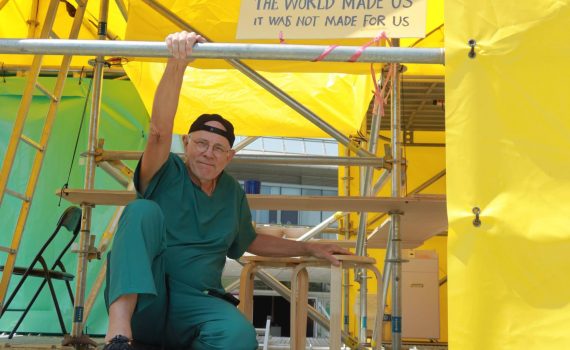
The new performance architecture exhibition Pollinator comes to Hong Kong for the first time at WestK harbourfront as part of the WestK FunFest 2025, creating a unique space for collaboration between local artists from different fields. The Pollinator is co-created by American artists Alex Schweder and Ward Shelley. They have invited 18 local performance and visual artists to take turns living in the five tents that are connected by a giant wheel. The idea is to attract artists from different cultural backgrounds and to explore how architecture affects social connections, according to the poster at the exhibition. During the artists’ residency, the only way to communicate or to move between the buildings is to use the giant wheel, which is entirely human-powered. “The wheel is like a mixer that mixes us up together as a community,” said Ward Shelley, 75, one of the co-creators of Pollinator. Each artist occupies one of the tents as a studio to display their creative process and final work. The first group of cohabitating artists comes from four fields: performance architecture, paper art, dance, and performance art. “One of the rules in the community is that artists cannot come down from the buildings for the whole period, and artists are not allowed to rest in the building where they have their studios,” said Shelley. “The rules make us interact.” “We do not know each other and we all come from different countries, so we think differently, ” said Florence Lam, 33, a performance artist. “But because we are going to be sharing the space and interacting with each other, my ‘neighbours’ will be involved in what I am creating,” Lam added. Ho Tung is a 27-year-old dancer. It is her first time participating in an outdoor performance art exhibition. “I often go to the ‘neighbours’ …
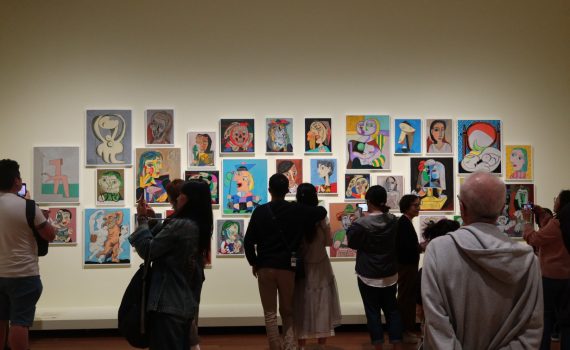
Picasso inspired Asian art on display at M+
- 2025-03-20
- Culture & Leisure
- The Young Reporter
- By: CHEN Yongru、ZHOU YunEdited by: WANG Jing
- 2025-03-20
Picasso's iconic works are displayed together with those of contemporary Asian artists, offering an opportunity for a unique cross-cultural experience for visitors. Co-organised by M+ and the Musée National Picasso in Paris, and in association with the French May Arts Festival, this exhibition named “Picasso for Asia-A Conversation” is held at the M+ Museum from Mar. 15. It provides the audience a fresh and unique look at Picasso's influence on Asian art, and explores the complex relationship between Western and non-Western, according to the M+ website. “Influenced by Picasso's Cubist painting style, Asian artists have injected traditional Oriental calligraphy and Zen into the Cubist framework, constituting a unique Oriental aesthetic,” said Wang Jingfang, 51, Director of China Artists Association. “For example, Hong Kong artist Chen Fushan's painting Untitled (Figures Transfixed by a Butterfly) combines geometric segmentation techniques to show surreal spatial layers in ink painting form,” Wang added. “I have a deeper understanding of Picasso's art when comparing the paintings of Picasso and those of Asian artists,” said Zhang Qing, 20, a university student in architecture. “Such cross-cultural exhibition is the presentation of artistic works and ideas at a higher level.” Lee Kityue , 45, a member of M+, has visited many different kinds of exhibitions before. Lee said that unlike previous solo artist exhibitions, this cross-cultural fusion exhibition made her feel fresh. “Breaking away from Western perspectives and interpreting Western art through Asian culture is very interesting,” Lee said. “I hope to see more exhibitions of this type in the future.” In addition to the basic artwork display, the exhibition also features a variety of immersive interactive installations, such as audio-visual projections and interactive painting systems. “Art is not a static image, not a one-way output,” said Yuki Zhang, 30, a digital artist. “With the use of interactive installations, …

Virtual party at Hong Kong Arts Festival
- 2025-03-01
- Culture & Leisure
- The Young Reporter
- By: CHAN Hiu Ying、CHEN YongruEdited by: WANG Jing
- 2025-03-01
Visitors to this year’s Hong Kong Arts Festival can immerse in a virtual reality party in Paris, titled Le Bal de Paris. The experience at the Hong Kong Cultural Centre has been on offer since Thursday as part of the Arts Festival. The dance is created by Spanish choreographer and film director Blanca Li and developed by a team of 100 people. All 1,100 tickets were sold out according to the Hong Kong Arts Festival website. Kot Ka-ching, 16, a secondary student, was asked by her school dance teacher to try the VR experience to try out different parts of the dance. “I am pretty surprised that during the dance, I can smell the scent of flowers and feel the breeze, making me fully immersed in it,” Kot said. “It would be great if there is someone to lead us throughout the experience, as there are too many places to explore, which made us a bit confused,” said Kot. Alex So, 30, a media worker, said he was impressed by the sense of space of the VR experience and felt he was in a boundless world, despite being in a limited space in real life. “I want to experience women's clothing because I never have the chance to wear it in real life,” said So. “This experience was so special. As soon as I put it on, the sense of immersion was instantly heightened.” “It is my first time at the Hong Kong Arts Festival,” said Catherine Zhang Ziyun, 30, the founder of Shanghai Serenade Culture. “I have always paid attention to the integration of culture, art, and technology. I believe art needs to be combined with science and technology to create new content and elements,” Zhang said. Zhang added she is looking forward to seeing more VR experiences, which …