
By: XIA Fan、WANG Ruoshui、ZHAO RuntongEdited by: XIA Fan、WANG Ruoshui、ZHAO Runtong
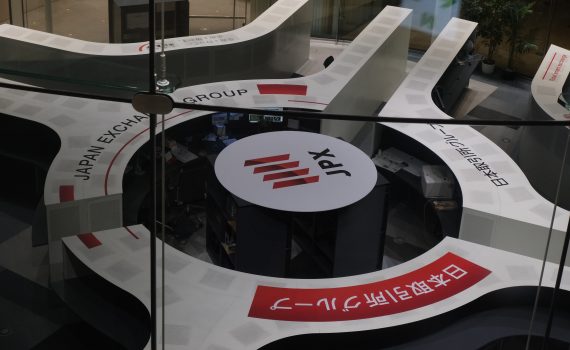
Japan Stocks edges lower after Moody’s cuts U.S. credit ratings, export sectors shine
- 2025-05-19
- Business
- By: XIA Fan、WANG Ruoshui、ZHAO RuntongEdited by: XIA Fan、WANG Ruoshui、ZHAO Runtong
- 2025-05-19
Nikkei 225, Japan’s premier stock market index tracking the performance of 225 large publicly traded companies listed on the Tokyo Stock Exchange, opened at 37572.36 today and dropped 0.68% to 37480.37 as of the market's end. TOPIX, an index overing all domestic common stocks mostly listed on the TSE Prime Market, traded higher at midday at 2744.16, but later reversed course and closed at 2740.45, down 0.075% compared with yesterday. Performances of Japan’s stock market aligned with global cautious sentiment after Moody’s downgraded the US government's top credit ratings. Export-oriented stocks went up amid the falling market. Pharmaceutical company Daiichi Sankyo surged 7.06% to 3,698 yen, which continued the growth trend since last week. Manufacturer Konica Minolta added 6.31% to 469 yen, while Mitsubishi Heavy Industries rose 3.04% to all time highs of 2,916 yen. Beverage company Sapporo Holdings jumped 2.92%to 7613, showing a trending up from the 3-month low on May 14. Analysts believe the weakening Japanese yen fostered a favorable environment for exporters, which would boost investor confidence in companies within this sector. A number of semiconductor-related stocks fell heavily today following the turmoil in U.S. markets. Lasertec Corporation (TSE: 6920), a designer and manufacturer of semiconductor testing equipment, saw its stock price plummet 5.16% today, making it one of the notable underperformers in the Japanese market. Market Commentators attribute this drop to the close correlation between Japanese semiconductor stocks and the U.S. semiconductor market performances. The PHLX Semiconductor Index fell 1.26% as of the report published time amid volatility driven by recent U.S. tariff fluctuations. Ongoing uncertainty in the U.S. market, fueled by frequent pauses and adjustments in tariff policies, has unsettled households and businesses. Sumitomo Mitsui DS Asset Management at the beginning of this year predicted a positive trajectory for the Japanese stock market, emphasizing …

New Gold Zone at 2025 International Jewellery Show boosts Hong Kong’s position as trading hub
- 2025-03-04
- Business
- By: Yichun FangEdited by: WANG Ruoshui、XIA Fan、BO Chuxuan
- 2025-03-04
The 41st Hong Kong International Jewellery Show kicking off on Tuesday, debuts the Gold Jewellery Zone at the Convention and Exhibition Centre, with international gold exhibitors drawn in. The Hong Kong Trade Development Council (HKTDC) describes this new addition as a showcase for novel gold jewellery design, part of efforts to strengthen the city’s position as a global hub for gold jewellery trade. Organised by the HKTDC, the Jewellery Show will run from 4 to 8 March, showcasing new product trends including affordable luxury jewellery, men's and unisex jewellery, sustainable development and jewellery technology. “Hong Kong is actively accessing both the technical support of mainland China and the international market, so I hold a strong belief that the gold market here will become increasingly prosperous,” said Winston Chow, director & deputy general manager of Chow Sang Sang Holdings International Ltd. HKTDC said that Hong Kong is leading in the gold product sector. Currently, manufacturers are conducting high value-added processes in Hong Kong, while shifting manufacturing activities to mainland China. Atticus Zhu, the founder of Shenzhen Shangpin Gold Jewellery company exhibiting in the gold jewellery area, said that the consumers of the Hong Kong gold market accept the premium of labor cost on design to a greater extent than mainland Chinese customers, who are relatively more sensitive to the gold price. “Hong Kong is the global hub for gold jewellery trade, providing a springboard to tap into various international markets,” he added. “For example, through Hong Kong, we reached out to the Malaysia market, a country with a 20% overseas Chinese population and has one of the most receptive markets for gold today. ” The gold price rose more than 25% in 2024, the most significant annual gain in 14 years, as regional wars and political changes continued the uncertainty among …
Hong Kong’s night economy push faces hurdles, bar operators mixed on future
- 2024-12-07
- People
- By: XIA Fan、WANG RuoshuiEdited by: WANG Ruoshui、XIA Fan
- 2024-12-07
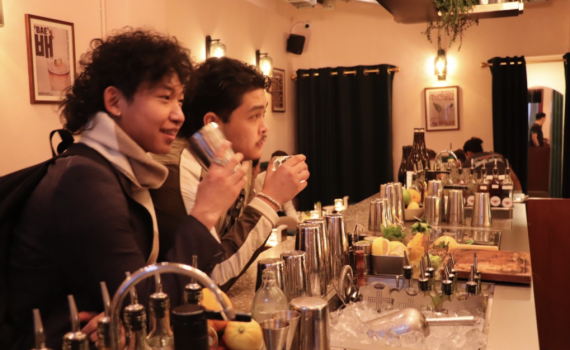
Bars in Central are eagerly waiting for customers as the city has been reviving its night economy ever since the pandemic. The government has launched a series of campaigns to boost spending and consumption at night, including a recent tax cut on imported liquor. John Kerwin Alanis, tender of Shop B- A Little Lab, is wiping the glasses to prepare for a new day. “Before the pandemic, at this time, people would fill my spot, ” said Alanis. No people visited the shop yet, he remained smiling while wiping the counter, “But things are getting better this year.” In mid-October, the Chief Executive of Hong Kong John-Lee Kachiu said in 2024’s policy address that the tax targeting importing liquor, referring to alcohol containing alcohol by volume (ABV) above 30%, was slashed to 10% from 100% for the portion above importing price $200, while the duty for portions below $200 remained the same. The movement aimed at “promoting the liquor trade and boosting the development of high value-added industries, including logistics and storage, tourism and high-end food and beverage consumption,” said Lee. Hong Kong experienced “cold winters” in retail and consumption in the post-pandemic era. The reduced tax was viewed as another effort to boost the local economy, though its effectiveness remains unclear. The bar and restaurant sector is one of the hardest hit by the pandemic in Hong Kong. According to the Hong Kong Census and Statistics Department, total bar revenue in the second quarter of this year was nearly HK$340 million, a drop of about 25% compared with the same period in 2019. “For us, we are getting the same prices from wholesalers for liquor so far, ” said Jimmy Singh, bar owner of ACED. “No difference at all. But if I can get lower prices, I will sell …