
By: YAM Long Hei JamieEdited by: LAU Ka Yan

HK Sign Language Day draws 2,400, as organisers push for public understanding
- 2026-09-20
- Society
- The Young Reporter
- By: YAM Long Hei JamieEdited by: LAU Ka Yan
- 2026-09-20
About 2,400 visitors joined the first day of Hong Kong Sign Language Day in Tsuen Wan on Saturday, as organisers hoped to encourage greater public understanding of Hong Kong Sign Language and deaf culture. The two-day event, organised by the Hong Kong Society for the Deaf, includes sign language workshops, stalls run by deaf people and interactive games. The event, featuring workshops that taught signs related to the upcoming Mid-Autumn festival, such as “moon cake”, “the moon” and “the moon rabbit,” comes ahead of the International Sign Language Day on Sept. 23. Cheung Hon-wah, director of the Hong Kong Society for the Deaf, said the event aimed to help the public discover how interesting sign language can be. “We want more members of the public to understand sign language and promote barrier-free communication,” he said. Cheung said he hoped the event would encourage more people to become professional sign language interpreters, urging the government to create more interpreter jobs in public services, such as hospitals, so the public would better recognise the need and in turn attract more people to the profession. “A deaf person needs sign language interpretation on many occasions, but we can find that the number of professional sign language interpreters is not enough,” Cheung said. The Hong Kong Council of Social Service lists 53 professional sign language interpreters in the city, a figure that falls short of the roughly 6,000 people who use Hong Kong Sign Language as their primary form of communication, according to the Census and Statistics Department. Deaf attendee Ah Tan said it is very difficult for deaf people to find jobs, and that support for deaf employment is insufficient. “Especially when the employer knows that you cannot hear, they will not know how to communicate with you,” Ah Tan said. She added …
Policy Address 2026: Northern Metropolis to build larger subsidised housing amid concerns
- 2026-09-16
- Society
- The Young Reporter
- By: YAM Long Hei JamieEdited by: LEUNG Chi Ngai
- 2026-09-16
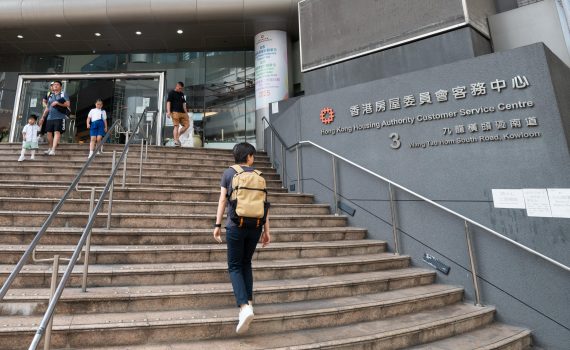
Subsidised housing in the Northern Metropolis will include a higher proportion of larger flats for purchase, Hong Kong Chief Executive John Lee Ka-chiu said at today's annual Policy Address. The share of units measuring around 45 square metres or more will rise from 20% to 25% from 2031, aiming to improve residents' overall quality of life, Lee said. The average public housing unit was 37.2 square metres in 2024, according to the Hong Kong Future Economy Institute. “If the transport can’t keep up, then no matter how good a place is to live, or how new and beautiful the developments are, it’s all meaningless,” Lai Chun-kit, 32, a chef, said. The Northern Metropolis, roughly one-third of Hong Kong’s total land area, is expected to provide over 70,000 public and private housing units within five years, according to the five-year plan announced today. The area’s transport is mainly linked by the Northern Link railway and the Northern Metropolis Highway. Both transport infrastructures are expected to be delivered by 2034 and 2036. Lai, together with his wife Chung and their daughter, will move into a public housing unit in Tuen Mun within a month, after five years of waiting. He said they have no intention of moving to the Northern Metropolis if they are allocated a flat there. The couple said that the quality of education provided by the school network would be the most important factor in their decision to relocate. “It’s not that people don’t want to choose that place, but the supporting infrastructure has to catch up as well,” Lai said. The government is set to advance transport infrastructure, building a new hospital in Ngau Tam Mei and develop cultural facilities. Job opportunities and adequate basic infrastructure are the key drivers in attracting people to settle in the Northern …
More than just a parade: Cheung Chau Bun Festival 2026
- 2026-05-29
- Society
- The Young Reporter
- By: Ng Wing Sum JodieEdited by: YAM Long Hei Jamie
- 2026-05-29
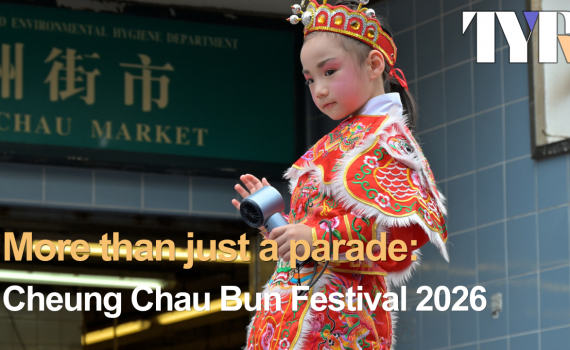
Reported by Jodie Ng Wing-sum, Ella Huang Wing-tung Edited by Jamie Yam Long-hei Video Description: The Piu Sik parade, a century-old tradition of the annual Cheung Chau Bun Festival, returned to the city on May 24. This year, 17 parade teams wove through Cheung Chau’s alleys to worship and pray for blessings.
Mona Lisa comes to life through immersive displays at the Heritage Museum’s exhibition
- 2026-05-02
- Culture & Leisure
- The Young Reporter
- By: Ng Wing Sum Jodie、Pann Hnin Nay ChiEdited by: YAM Long Hei Jamie
- 2026-05-02
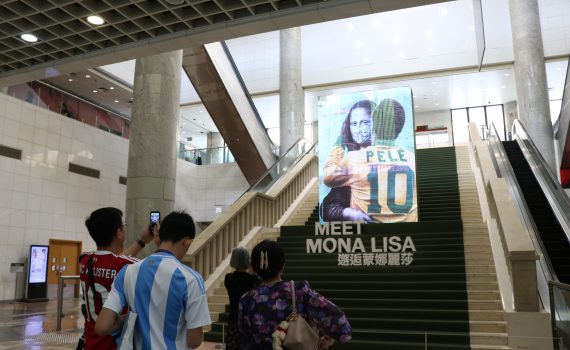
Large crowds filled the Hong Kong Heritage Museum on Friday as the “Meet Mona Lisa & Portraying the Renaissance” exhibition opened to the public on the Labour Day holiday. The exhibition, part of the annual French May Arts Festival, features multimedia immersive installations that introduce the history of the Mona Lisa, and diverse forms of Renaissance artworks, including four Leonardo da Vinci manuscripts. The multimedia section “Meet Mona Lisa” was produced by the Musée du Louvre and the Grand Palais Immersif in Paris. Most borrowed exhibits from France and Italy are making their Hong Kong debut, including The Crucifixion by Noël Bellemare, The Rebellious Slave by Michelangelo Buonarroti, and Luca Penni’s The Virgin and Child with the Infant Saint John the Baptist. Visitors crowded the galleries with long queues forming for interactive activities and the Mona Lisa’s “self-narrated” audiovisual walking tour by midday. Samuel Tang, 30, and Mavie Yu, 25, said they came to the exhibition today specifically for the Mona Lisa. Tang thinks the multimedia immersive experiences of the Mona Lisa's animations are more interesting than “regular stationary exhibitions”. He described the interactive elements as engaging, comparing the experience to watching a movie. “Usually we interpret the artworks on our own, but here the artworks break the fourth wall by talking to us and guiding us through the experience,” Tang said. The first-person narrative in the storytelling helped her understand the Mona Lisa’s backstory thoroughly, Yu said. Pursy Law and Waybe Tsang, both in their forties, brought their son for a family-bonding holiday after learning about the show on social media. “We want to bring our child to experience the cultural influence of the Mona Lisa,” Law said. “Everyone knows about the beauty of the Mona Lisa, but many are unaware of its story of being stolen,” she added. …
Survivors and advocates call for comprehensive sexual offence law reform
- 2026-04-26
- Society
- The Young Reporter
- By: YAM Long Hei JamieEdited by: SIU Tsz Hang
- 2026-04-26
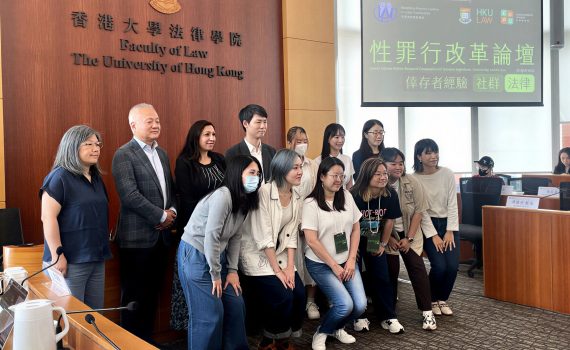
Advocates and sexual offence survivors on Saturday urged the government to pursue broader legal reforms beyond current proposals at the Sexual Offense Reform Forum. This call came ahead of a government plan to launch at public consultation on the reform of the city’s sexual offense laws later in 2026. The forum examined whether proposed reforms adequately address the realities faced by sexual violence survivors. Jointly organised by the Hong Kong Women’s Coalition on Equal Opportunities and the Equality Rights Project at the HKU Faculty of Law, the event attracted around 200 participants from online and in person. Jessie, a representative of a sexual offence survivors’ advocacy group, called for stronger reforms to Hong Kong’s consent laws, outlining three key changes not included in the Law Reform Commission’s recommendations. Three changes include: silence or lack of resistance must not be interpreted as consent; if consent was never sought, the accused cannot rely on a claim of “honest but mistaken belief” in consent; and the law should provide a clear statutory definition of both consent and the absence of consent. “I went through sexual assault, reported it to the police, and attended court. In the end, the defendant was acquitted because of how the law is written,” Jessie said. She said the defence repeatedly questioned why she did not physically resist, asking why she did not hit, bite or kick the offender, call for help, or leave the scene. “The defence turned the victim’s trauma responses into a weapon,” she said. “This tactic of using trauma against the victim, questioning clothing, lack of resistance, or why the victim did not leave the scene, is very common in court.” Jessie was also asked to recall precise details of the assault, including the number of times penetration occurred, how long it lasted, and how …
Visitors flock to Hong Kong Museum of Art for Claude Monet’s masterpieces
- 2026-04-26
- Culture & Leisure
- The Young Reporter
- By: Baguio Anne、Pann Hnin Nay ChiEdited by: YAM Long Hei Jamie
- 2026-04-26
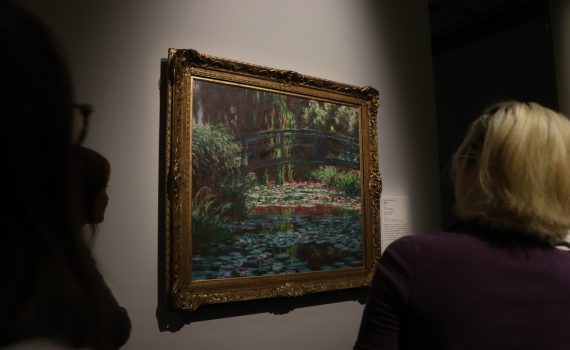
Visitors filled the Hong Kong Museum of Art on Friday for a garden art exhibition featuring two original masterpieces by French Impressionist Claude Monet. “Blooming: The Art of Gardens in East and West” features 106 artworks from the Art Institute of Chicago, Beijing’s Palace Museum and the Palace of Versailles in Paris, alongside pieces from the museum’s collection. Highlights include Monet's Water Lilies and Water Lily Pond from the Art Institute of Chicago. Other masterpieces include Zhang Daqian's Entrance of Bade Garden and Splashed-colour Landscape, as well as Wen Zhengming’s Spring Ablution at the Orchid Pavilion and sculptures such as The Enceladus Fountain and The Water Theatre from the Palace of Versailles. Despite rainy weather, crowds filled the galleries by midday, with long queues for popular works and interactive activities. Vasilisa Popov, 28, from Russia, said she came to the exhibition after reading it online, drawn by Monet. “I work in the culture sphere back home, so art is very special to me,” she said. “I’m actually flying back today, but I made sure to come here before leaving.” Glenda Wilson, 70, from New Zealand, called it a trip highlight and “beautifully courageous, really well put together, and fantastic.” She had visited the museum days earlier but returned for the show. “It’s the opening day and people love to see Monet,” she said of the crowds. Helen Kwok, 74, a regular visitor at the HKMoA, had seen Monet’s works at a 2016 Monet exhibition in the Hong Kong Heritage Museum. “I’d like to see Monet, but also the other various garden paintings from Versailles.” First-time visitors Few, 23, and Pakke, 26, from Thailand, celebrated Few’s university graduation here in Hong Kong. Though new to art, they said they enjoyed the exhibition, especially the French paintings of gardens. Pakke added that …
Animal rights activists protest HKTVmall’s parent firm over animal experimentation projects
- 2026-04-10
- Society
- The Young Reporter
- By: YAM Long Hei JamieEdited by: LAU Ka Yan
- 2026-04-10
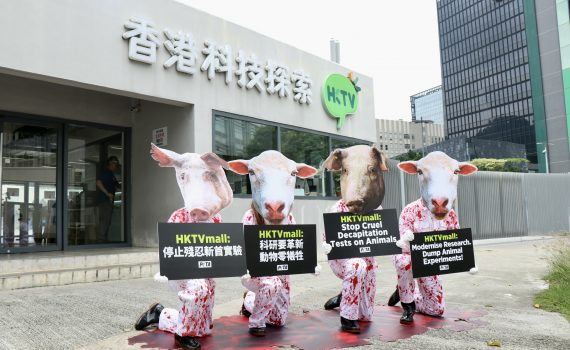
People for the Ethical Treatment of Animals Asia, an international animal rights group, staged a protest outside HKTVmall’s parent company in Tseung Kwan O on Friday, demanding the firm halt all animal experiments linked to its life sciences project. According to Hong Kong Technology Venture Company’s 2025 annual report, the firm has conducted 38 animal experiments since 2022 to keep organs – including heads and limbs – for extended periods after removal, aiming to develop new technology for long-term human organ preservation. The organisation called on HKTV to adopt non-animal testing alternatives and urged the public to boycott its product over what it described as animal cruelty. Four protestors who dressed in bloodstained clothes and wore pig and lamb masks stayed in a “pool of blood” outside the headquarters of HKTVmall for about an hour from noon. Jackie Tang, the campaigner and social media coordinator of PETA Asia said such visuals expose the “bloody reality” of animal testing. He said HKTV has been experimenting with “zero transparency,” as there is no way to oversee how the experiments were conducted, nor any indication that ethical alternatives were considered or how many animals were killed. “They claim that there is no cruelty involved, saying the animals are killed after being put into amnesia and decapitated, but they are still sentient beings, they feel terror and pain,” he said. Louis Ng Wai-mei, an advocate who represented Animal Rights Education by Non-profit Making Veterinary Services Society, said medical techniques and drugs used today were undeniably developed through animal testing. But she argued that scientific progress does not necessarily rely on animal testing. “Scientific and technological progress comes from challenging outdated practices and striving for better,” Ng said. She hopes that animal testing will eventually be abolished. HKTV has invested over HK$44.5 million in this …