
By: LI Yuzhou Asher、HU Mudi 胡沐迪、Xi Yuke JackieEdited by: CHEN Yongru、ZHONG Xinyun、Wang Yunqi

Amazon still hiring junior developers, CTO says during Hong Kong visit
- 2026-10-10
- Business
- The Young Reporter
- By: LI Yuzhou Asher、HU Mudi 胡沐迪、Xi Yuke JackieEdited by: CHEN Yongru、ZHONG Xinyun、Wang Yunqi
- 2026-10-10
AI summary: *Amazon CTO Werner Vogels confirmed during a Hong Kong event that the company continues to hire junior developers at its historical rates. *The Hong Kong government plans to launch an 18-month AI upskilling campaign in early 2027 aimed at training roughly 40,000 employees. *PwC data shows 2025 job postings for low-AI-exposure roles reached 1.3 times 2021 levels, while highly exposed roles fell to 80%. —------------------------ Amazon is still hiring as many junior developers as in the past, chief technology officer Werner Vogels said in Hong Kong on Friday, stressing that human skills remain important in the AI era. Speaking to university students, start-ups and technology leaders at Hong Kong Science Park, Vogels delivered a keynote speech titled “The Renaissance Developer” at “Future Builders: The AI Career Dialogue”, hosted by Amazon Web Services (AWS). “Everything that AI generates for you is yours, not that of the tool,” he said. Discussing responsibility for errors in regulated industries, he added, “You can’t say to the regulator, ‘Oh, that was AI.’ No. It’s yours.” “AI transformation is not really about technology, it's about people and the process,” said Chris So, managing director of AWS Hong Kong. He said the event aimed to build a steady flow for Hong Kong talent ready to lead in the AI era. In the 2026 Policy Address, the Hong Kong government announced plans to offer more than 200 training courses and activities by the first quarter of 2028 under its "AI for All" Inclusive Programme. An 18‑month AI upskilling campaign, which will be launched in the first half of 2027, is expected to benefit around 40,000 employees, the government said Sun Dong, Hong Kong’s secretary for innovation, technology and industry, said at the event, “As generative artificial intelligence (AI) flattens the technical learning curve, …
Hong Kong plans gold clearing system to strengthen role as trading hub
- 2026-09-19
- Business
- By: LIU Yingxi 劉穎熙、TANG Choi Luen 鄧載鑾、CHAN Cheuk Kiu 陳芍僑Edited by: TANG Siqi、Zhou Xinying、Wang Yunqi
- 2026-09-19
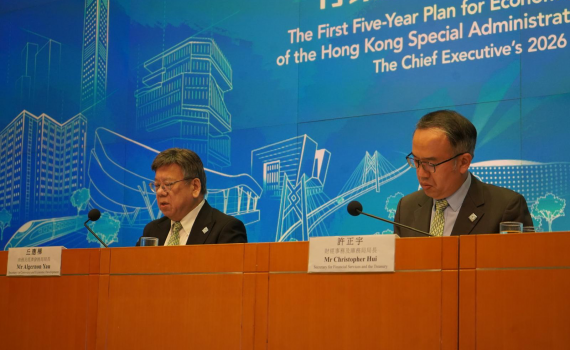
AI summary *Hong Kong plans to launch a central gold clearing and settlement system in the first quarter of 2027. *The Hong Kong Monetary Authority is also considering increasing the Exchange Fund’s gold holdings. *An independent commentator suggested limiting the combined allocation to gold, silver, hedge funds and bitcoin to 10% to 20% of a portfolio. Hong Kong plans to launch a central clearing and settlement system for gold in the first quarter of 2027 as part of efforts to build a modern, full-chain gold trading ecosystem, the government said at a press conference on Friday. The initiative was outlined in the city’s first five-year plan for economic and social development for 2026 to 2030 and the 2026 Policy Address. Christopher Hui Ching-yu, Secretary for Financial Services and the Treasury, said gold and commodities are among the new engines for Hong Kong's future market development. Hui said the precious metal clearing system had operated smoothly during its pilot phase. “In terms of the quantum of gold that's been deposited through the system, I would say it has also been material.” Hui added, “The material quantum of the gold being deposited through the system is also a good sign that our overall plan to build Hong Kong into the international gold market has been well‑recognized.” As of Sep. 17, the SPDR Gold Trust (02840) had a fund size of US$147.47 billion. In comparison, the Hang Seng Gold ETF (03170) had assets under management of US$220.77 million. Retail investors in Hong Kong are generally more concerned about investment choices, potential returns, and risks than the operation of clearing and settlement systems, said Kenny Wen, an independent stock commentator. Wen said gold could play a role in investment portfolios. He suggested limiting the combined allocation to investments such as gold, silver, hedge funds …
Policy Address 2026: Data visuals put Hong Kong’s new growth measures in context
- 2026-09-19
- Business
- By: Zhang Xuan、LIU Yingxi 劉穎熙、TANG Choi Luen 鄧載鑾Edited by: TANG Siqi、CHEN Yongru、Wang Yunqi
- 2026-09-19
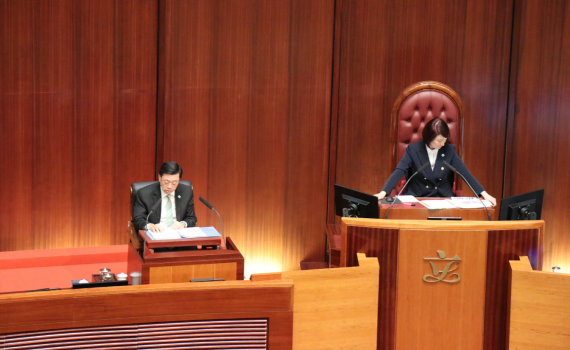
AI summary: New listing measures target overseas and technology companies. Tourism initiatives aim to extend visitor stays and increase spending. IPO and family-office policies aim to attract global capital. Hong Kong Chief Executive John Lee Ka-chiu delivered the 2026 Policy Address on Wednesday alongside the city’s first Five-Year Plan, outlining various measures to strengthen the city's status as an international financial centre, boost tourism, and attract international capital and family offices. The following charts provide context on Hong Kong’s fiscal position, tourism development, family-office policies and IPO market. Fiscal position provides the policy backdrop The Five-Year Plan says the Budget will provide resources for implementing the Policy Address and the plan while safeguarding the government’s financial sustainability. Flourish chart Sources:Financial Services and the Treasury Bureau Hong Kong’s fiscal deficit before bond issuance and repayments is projected to fall to HK$78.2 billion in 2026–27 from HK$188.3 billion in 2022–23. Tourism measures seek longer stays and higher spending Flourish chart Sources:partnerNet Flourish chart Sources:PartnerNet The 2026 Policy Address seeks to increase visitor spending and length of stay through “+ Tourism” initiatives. The Hong Kong Tourism Board will promote multi-destination itineraries with airlines and connect event organisers with retailers, restaurants and tourism-related organisations to provide ticket-stub offers. The government estimates that total tourism consumption related to inbound tourism will reach HK$238.1 billion in 2026, up about 9.5% year on year. According to The First Five-Year Plan for Economic and Social Development of the Hong Kong Special Administrative Region, by 2030, the proportion of non-Mainland visitors among overnight visitors is targeted to reach 40%. Family-office measures The 2026 Policy Address says the government will step up promotion following the passage of legislation enhancing preferential tax regimes for funds, single-family offices and carried interest. Flourish chart The target to assist no fewer …
Hong Kong to issue first stablecoin licenses next month, CE says
- 2026-02-13
- Business
- The Young Reporter
- By: TANG Siqi、Zhou XinyingEdited by: Wang Yunqi、ZHOU Yun
- 2026-02-13
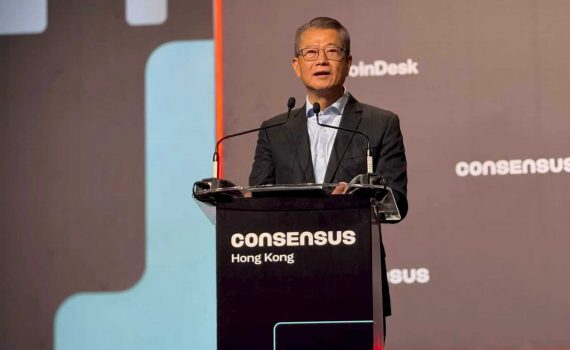
CoinDesk held Consensus 2026 on digital finance and emerging technologies from Tuesday to Thursday, with the acceleration of stablecoin license issuance becoming a highlight. “The Hong Kong Monetary Authority (HKMA) is actively processing licensing applications,” Chief Executive John Lee Ka-chiu said at the conference’s opening ceremony. “We believe the first batch of stablecoin issuer licenses will be issued within the next month.” Financial Secretary Paul Chan Mo-po said at the conference that stablecoins are helpful in easing funding pressure on the real economy, especially in payment and settlement. Hong Kong’s Stablecoins Ordinance, which took effect on August 1, 2025, establishes a licensing regime for issuers of fiat-referenced stablecoins in Hong Kong, placing the issuance and related activities of stablecoins under the formal regulatory oversight of the HKMA. In terms of the licensing criteria, Chan stressed that “we ensure that licensees have real-world use cases, a credible and sustainable business model, as well as strong regulatory compliance capabilities”. Chan also added that a small first batch of licenses will be issued in March, and more will follow subsequently. Sion Xiang, community manager at the decentralized finance protocol Phoenix, said that issuing stablecoin licences could boost the internationalisation of the domestic currency and strengthen its resilience against external shocks. However, Xiang pointed out potential risks that if banks or financial institutions use stablecoins as collateral, it could trigger a chain reaction of reserve imbalances across the financial system. In addition, he also mentioned that stablecoins may face the risk of de-pegging due to insufficient reserve assets. To address this threat, he emphasized the need for sufficient reserve assets, potentially through blockchain-based verification. Looking ahead, Hong Kong’s digital asset regulatory rollout will forge ahead, as Paul Chan stated that the government is also finalizing the details of new licensing regimes for digital asset …