
By: ZHOU Shiqing、Yu Yan PuiEdited by: Ye Enyi
Thousands of old buildings still waiting on fire safety systems
- 2026-11-11
- Society
- The Young Reporter
- By: ZHOU Shiqing、Yu Yan PuiEdited by: Ye Enyi
- 2026-11-11
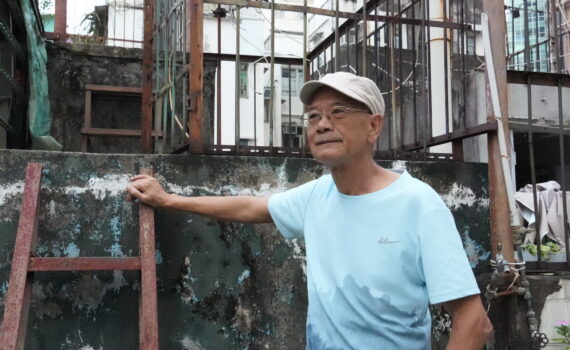
Tang Chun-kai, who owns a flat in a 1974 low-rise residential building in Yau Tsim Mong District, said he has been waiting for more than two months for the government to approve his building’s application to install a smart fire detection system. Meanwhile, the only fire-safety devices are fire-resistant flat doors and four portable fire extinguishers for the five-storey building. Under the Fire Safety Ordinance enacted in 2007, domestic buildings constructed before 1987 are required to install basic fire-safety provisions, including water tanks, hose reels, a manual fire alarm system and emergency lighting, as regulated by the Fire Services Department. Tang and the five other incorporated owners are also required to upgrade to fire-rated walls and windows, and reconfigure rear staircases to provide a clear escape route, overseen by the Buildings Department. Tang said he’s been dealing with government red tape, delayed building plans and resistance from the other owners to pay for the expensive updates for the last nine years. He said they finally reached the pricing stage, but then the government halted the fire-safety renovations in the aftermath of the Wang Fuk Court fire last year that killed 168 people. Tang’s building is currently one of close to 11,000 buildings in Hong Kong that have not fully complied with fire safety requirements as of December, according to the Research Office of the Legislative Council Secretariat. And as one of the 1,800 buildings without an appointed contractor, Tang’s project was put on hold while inspection work was transferred to a newly established body called the Building Maintenance Support and Services Council, according to the press release from the Development Bureau and the Housing Bureau. Now with his renovations on hold, Tang and the other owners are hoping to change to the cheaper, newly approved smart fire system. But this …
Budget 2026: Hong Kong boosts Chinese medicine industry to drive local growth
- 2026-02-25
- Health & Environment
- The Young Reporter
- By: Yu Yan Pui、Ye EnyiEdited by: ZHOU Shiqing
- 2026-02-25
The Hong Kong government will inject another $500 million into the Chinese Medicine Development Fund to promote research, training and international publicity, Financial Secretary Paul Chan Mo-po announced in the budget speech today, as the government continues to promote Chinese medicine in the city. Cheung King-ho, an associate professor in Chinese Medicine from Hong Kong Baptist University, said the Chinese Medicine Development Fund financially supported research and promotion, rather than focusing on developing basic scientific knowledge as in the past. As the only Chinese Medicine school in Hong Kong, HKBU regularly gets awarded money from the fund. “Our school has been collaborating with large scientific organizations, such as Microsoft and NVIDIA, assisting in the process of drug selection with artificial intelligence for industry development,” Cheung said. Chinese medicine students can train in western medical centres as part of the government’s plan to integrate Chinese and western medical practices, announced by the government in February. Chung Yan-ching, 21, a local Chinese medicine student said, “We hope to be included and be trusted in the medical system with government’s policy support.” Most bachelor degree students in Chinese medicine at HKBU, the city’s only school for Traditional Chinese Medicine,are local students, with less than one-tenth overseas or mainland students, said Cheung. “Training Chinese medicine professionals in Hong Kong has served as a transitional process of acquiring knowledge from the longer historical development on the mainland from different lineages, appearing as a supplement and extension of industry,” Cheung said. As the mainland system is more mature, local students are required to do an internship in Guangzhou, Cheung added. A mainland PhD student in Chinese medicine from HKBU, Yang Hanhang, 26, said that fewer mainland students come to Hong Kong to study traditional Chinese medicine because there are already many famous traditional Chinese medicine universities …