
News

More birth incentives, but ‘motherhood penalty’ remains a barrier
- 2026-11-09
- Society
- The Young Reporter
- By: ZHENG WU Anny、ZHENG Yuan ElaineEdited by: CHAU Wing Yau
- 2026-11-09
Chole Liang and her boyfriend have spent about a year discussing their future. They plan to marry, but not to have children. For the 29-year-old teacher, the cost of raising a child and housing had made her reluctant to become a parent, despite the government’s latest birth incentives in the recent Policy Address. “I can’t imagine renting a decent flat costs HK$20,000 monthly, and daily spending adds on HK$10,000. With a newborn baby, there will be an extra HK$10,000 for baby milk, clothes and toys,” said Liang. She said the new birth bonus is just “a water drop in the sea”. The latest Policy Address sets out 11 measures to encourage births, including financial incentives and support for housing and childcare. But academics say these measures may not be enough to persuade people to have children, as unequal caregiving responsibilities and the risk of career setbacks for women also influence their decisions. The Federation of Hong Kong and Kowloon Labour Unions conducted a study in February about women’s fertility willingness and found that around 60% of 550 women aged 18 to 45 had no intention of having children, citing financial and housing concerns. The Policy Address announced a three-year extension of the existing HK$20,000 newborn baby bonus, with payments for a second or subsequent child increased to HK$30,000. The package also includes higher tax allowance, lower down payments and stamp duty relief for eligible families with newborns buying a home, as well as more childcare places and expanded access to fertility treatment. “Fertility decisions are a calculation of costs and returns. The measures aim to reduce the cost of bearing children by offering cash incentives,” said Guo Hua, a research associate at the Chinese University of Hong Kong’s Hong Kong Institute of Asia‑Pacific Studies. “However, people may find the cash …

Elderly care challenges facing Hong Kong’s ethnic minority seniors
- 2026-11-09
- Society
- The Young Reporter
- By: LAU Ka Yan、YANG ShuyiEdited by: Lou Zhengzheng
- 2026-11-09
For eight years, 69-year-old Rai Rekha lived with an aching back, relying on herbal remedies from her home country of Nepal because language barriers left her unsure how to seek medical help in Hong Kong. Rekha moved to the city to reunite with her daughter, who has a permanent job here. She speaks neither Cantonese nor English and is unfamiliar with the government elderly care services available to her. She is one of about 26,000 ethnic minority residents aged 65 and older in Hong Kong, according to the 2021 population census, who are eligible for the same healthcare and welfare support as other Hong Kong residents. Her experience shows how language barriers can leave EM seniors from accessing care. Frontline social worker Kenneth Law said that many remain invisible because welfare systems largely operate in Chinese and English, while there is a shortage of staff who speak South or Southeast Asian languages to cater for ethnic minorities. The government’s 2026 Policy Address said the Elder Harmony Network would be established from 2027 to increase support for EM residents. Collaborations between the existing EM care teams and district care teams would be strengthened to reach more EM seniors and refer them for assistance as needed. For families helping older relatives obtain care, the difficulties can extend beyond finding out which services are available. Surtani Rain, an Indian woman whose mother has cancer and needs regular follow-up visits, said she had struggled to balance work with accompanying her mother to the hospital. “My mum doesn’t understand Chinese and English, so sometimes I, as her only child, have to take leave from work to take her to her doctor’s appointments,” said Surtani. Surtani said her mother was angry that she had to take time off work for her, and refused to go to …

Can Hong Kong protect local jobs without affecting its international restaurants?
- 2026-11-09
- Society
- The Young Reporter
- By: Baguio AnneEdited by: Lan Xinbei
- 2026-11-09
Hong Kong’s new three-to-one hiring ratio seeks to prioritise local workers, but it raises a key question: can tighter quotas protect local jobs without affecting the city’s international dining scene? Reported by: Linnea Hedman, Anne Baguio Edited by Betty Lan Xinbei This is video link:https://youtu.be/yWzizGuTU2c?si=CnWt3SeGFB1ApHy5

Hong Kong’s only dedicated comedy club hosts more international debuts in its final months
- 2026-11-08
- Culture & Leisure
- The Young Reporter
- By: Pann Hnin Nay ChiEdited by: CHAN Hiu Ying
- 2026-11-08
Sri Lankan Australian comedian Dilruk Jayasinha made his Hong Kong debut at TakeOut Comedy Club on Friday and Saturday, in one of the final international acts before the venue’s planned closure in February. Opened in 2007, TakeOut describes itself as Asia’s first full-time comedy club. Its closure will end a two-decade run as a venue dedicated to stand-up comedy in the city. Maitreyi Karanth, 54, the producer of Jayasinha’s shows and a Hong Kong-based comedian, said TakeOut’s closure would leave a gap in the city’s comedy scene because few other venues offered the same setting for stand-up performances. She said the club had been purpose-built for comedy, with its stage, lighting and seating layout designed around live comedy shows. “The founder has put thought into it to make what he calls a ‘kill room’, meaning that you have to kill in that room because it is just so right for a comedian to do his comedy,” said Karanth. “We don’t have this kind of venue anywhere in Hong Kong.” Jayasinha’s performances were among the final international bookings before TakeOut closes. His two shows drew about 170 people in total, according to Karanth. Having grown up in Sri Lanka before moving to Australia, Jayasinha drew on his multicultural background and experiences living abroad for much of his material. He also included observations about Hong Kong in his set, joking about the steep streets and staircases around the club’s SoHo location in Central. “Just add maybe a few more staircases and hills, please. I don’t think you have enough,” he said. The dimly lit room filled with laughter as Jayasinha moved between jokes and interactions with the audience. Although TakeOut announced its planned closure on social media in July, the news still surprised some first-time audiences. Geoff Trotter, 64, attended Jayasinha’s show …

Can Hong Kong make room for everyday cyclists?
- 2026-11-07
- People
- The Young Reporter
- By: Yutong Su、Pann Hnin Nay ChiEdited by: QIN Ziyang
- 2026-11-07
For Martin Turner, the chairman of the Hong Kong Cycling Alliance, a trip to the bakery, a visit to a friend, and a stop to pay a bill can all fit into one bicycle journey. “When you’re on a bike, you’re part of the world,” said Turner, who cycles around Hong Kong nearly every day. “You’re out there, you’re in it, you can do all those things, and it’s enjoyable, healthy, and fun,” he added. Turner sees cycling as a practical way to navigate the city, not simply a recreational activity. But Turner’s experience is not the norm. In Hong Kong’s dense urban districts, fragmented cycle paths, steep slopes and roads shared with motor vehicles make everyday cycling difficult for many residents. That leaves dense areas, especially Hong Kong Island and Kowloon – areas with high population density and many short journeys – dependent on disconnected paths and roads shared with cars. For residents making short trips within these districts, cycling often remains an impractical option. “The city’s cycling infrastructure has largely been designed for recreation rather than commuting,” said Wang Donggen, Chair Professor and Head of the Department of Geography at Hong Kong Baptist University. Wang added that climatic conditions, which are usually hot and rainy, land limitations, and residents’ habits also hinder daily cycling commutes in Hong Kong. “For many people in Hong Kong, bicycles have mainly been leisure or sports equipment, not a means of daily transport,” Wang said. Government data support that point. According to the Transport Department’s Travel Characteristics Survey 2022 Final Report, 70% of cycling-only trips and 73% of cycling legs connected to other transport modes took place within the same district. The survey also found that 86% of cycling-only trips lasted 30 minutes or less. Yet most new cycle tracks are planned outside …

Despite fines, visitors keep bringing e-cigarettes into Hong Kong
- 2026-11-04
- Society
- The Young Reporter
- By: PENG Yixin Naomi、WU Sitan ElaineEdited by: ZHENG Xinyi
- 2026-11-04
With a border checkpoint only a few hundred metres away, Jennifer Jiang, 20, a mainland university undergraduate visiting Hong Kong, hurriedly hid two e-cigarettes in her boots after a friend told her that possessing alternative smoking products was legally prohibited in Hong Kong and may result in a heavy fine. “I felt really nervous. After confirming the law online, my first idea was to throw away my two e-cigarettes, but they were brand new and kind of expensive…. So I thought I’d take a gamble," Jiang said. Finally, Jiang slipped through customs luckily with her e-cigarettes intact. In 2022, the Department of Health banned alternative smoking products, prohibiting the import, manufacture, sale, and commercial possession of e-cigarettes and heated tobacco products. This April, it extended the ban to public possession. Anyone found carrying more than five e-cigarette capsules or 100 heating sticks in public places faces a maximum fine of HK$50,000 and up to 6 months’ imprisonment. Those carrying smaller amounts face a fixed penalty of HK$3,000. Under the Import and Export Ordinance, importing e-cigarettes and other prohibited smoking products remains a criminal offence carrying a maximum fine of HK$2 million and seven years’ imprisonment. Despite the penalties, some travellers still bring e-cigarettes into Hong Kong. The Customs and Excise Department detected 2,600 cases of illegal importation involving alternative smoking products and seized about 9.35 million items last year. “Although public education has been conducted, the relatively new legislation still leaves room for improvement in timing and reach, particularly for cross-boundary visitors,” said Kelvin Wang Man-ping, professor at the University of Hong Kong’s School of Nursing, who has more than 15 years of experience in tobacco-control research. Hong Kong’s control points handled a record 334.6 million passenger trips in 2025, according to the Immigration Department. Amid such heavy flows, Customs …

Hong Kong’s legal gaps in deepfake porn leave victims unprotected
- 2026-11-04
- Society
- The Young Reporter
- By: SHI Puxuan Amy、MA Yifan ChloeEdited by: CHEN Xiyun
- 2026-11-04
In February, Chiao, 22, saw an AI-generated photo with her face superimposed on a naked body appear in the comments of one of her Threads posts. She was shocked and hoped her family and friends could tell the nude photo was fake, she said. “I refused to share any portraits of myself on public platforms for months, as I was terrified my image would be turned into pornographic content somewhere out of my sight,” said Chiao, a student based in Taiwan, who doesn’t want to reveal her full name for fear of it happening again. Chiao now works part-time at an influencer marketing agency, where she must publish promotional content on her personal social media account showing her face. The required exposure of the job is stressful, she said, explaining that it recalls her trauma and raises the fear of falling victim again. Luna, 32, a part-time influencer from Taiwan who also doesn’t want to reveal her full name, said she once received a direct message that included a screenshot of an image showing her face swapped onto an intimate image. Luna discovered this photo had been shared in an online chatroom whose members used anonymous accounts. She saved the chat logs as evidence. The group also contained deepfake content of other influencers in pornographic images, Luna recalled, with group members actively posting new face-swapped images at the time. Both Chiao and Luna said they decided not to report the abuse to police. They said they thought authorities would struggle to identify the perpetrators and that filing a report would do little to address the harm they had already suffered. AI-generated deepfake sexual abuse is an increasing threat for online users, particularly young women who say police can do little to help them. Pornographic images account for 98% of deepfakes, …
Chinese wine attracts growing interest at HK Wine & Dine Festival
- 2026-11-03
- People
- The Young Reporter
- By: ZHENG Xinyi、Gengjing HuangEdited by: CHEN Ziyu
- 2026-11-03
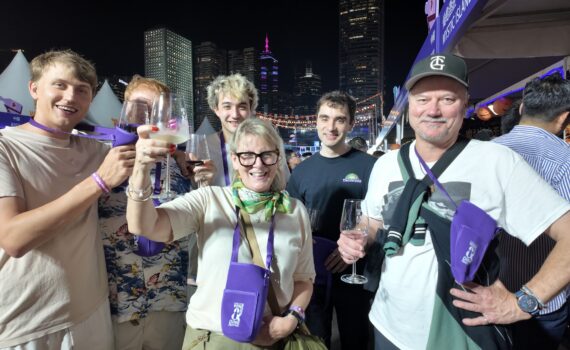
Chinese flavored wines drew strong interest from visitors at the Hong Kong Wine and Dine Festival in Central over the weekend from Oct. 29 to Nov.1, with tea and coffee-infused cocktails releases among the most popular offerings. “The innovation has turned once-conventional wines into newly popular, award-winning hits at this year's festival,” said Ken Cheng, 45, manager at a Hong Kong-based Chinese wines distributor. Chinese wine booths drew many tasters at the festival as Chinese producers recorded a strong performance at the 2026 Decanter World Wine Awards in June, where they won 214 medals, including two platinum, 11 golds, and 100 silvers. Cheng said younger consumers are increasingly pivoting toward fresh and distinctively flavoured vintages, adding that the growing demand for such approachable wines is reshaping the global wine market. Ken Yuen, a local wine distributor representing mainland labels, said local consumers are exceptionally open to novel profiles. “Our best sellers here are actually unique infused releases, such as caffeine-free coffee flavoured and tea flavoured wines that align perfectly with Hong Kong’s daily coffee culture,” Yuen said. “Ningxia’s wine exports surged 180% year-on-year, with Hong Kong absorbing nearly half of that total. Winemakers attribute this rapid growth to local consumers’ exceptional openness to novel profiles,” Yuen added. While distributors focus on expanding trade volume, boutique winery owners are also working to build international recognition for Chinese wines. “Our original motivation for founding the winery was simple, giving back to the community and bringing Chinese-flavoured wines to the world stage,” said Rita Kung, a Hongkonger who co-founded boutique winery Mystic Island in Shandong and was one of the exhibitors. Kung said balancing the company's revenues and costs remains challenging; however, the desire to bring Shandong's locally crafted wines to the world has not wavered. Kevin Lo, an air and sea logistics …

21-Year-Old swimmer sets record-breaking time in 45 km around Hong Kong Island
- 2026-11-03
- People
- By: SIU Tsz HangEdited by: SIU Tsz Hang
- 2026-11-03
Reported by Kajsa Svedlund Kylsjö Edited by Linnea Hedman In a stunning display of stamina and community spirit, 21-year-old Emeric Payer set a new course record for the 45-kilometres HK360 circumnavigation swim around Hong Kong Island on Nov. 2, 2026. Payer completed the gruelling open-water challenge in a historic time of 10 hours, 22 minutes, and 59 seconds, shaving more than 13 minutes off the previous course record of 10:35:58, set by Waris Mills on Nov. 26, 2025. A dream come true For Payer, standing at the finish line as the new record holder was a milestone he once thought unattainable. "When I signed up six months ago, I saw the 45 km distance and the fast pace they put me up on and I was telling myself, 'I will never do that,'" Payer said after reaching the shore. Having never attempted long-distance swims of this scale, Payer trained under Edie Hu, an experienced open-water swimmer who completed the HK360 in 2018. Under her coaching, Payer ramped up his training over six months, joining local races and steadily increasing his mileage. "A couple of weeks ago, he did a 10-hour swim in Repulse Bay, swimming back and forth from the beach to South Bay. It was really nice that day to see his confidence that he could actually do it," Hu said. Braving the dark and unpredictable waters Open-water swim experts and organisers regard the 45-kilometre HK360 as one of the region’s most demanding endurance challenges. Swimmers must contend with unpredictable currents, choppy waters, and heavy commercial shipping traffic. Payer launched his attempt under the cover of darkness at 4 am. When the sun finally rose just before 6 am, it provided a vital mental boost for the long journey ahead. "This morning’s sunrise was magical, one of the most …

Pedestrian diversions turn journey to Lan Kwai Fong into 150-minute ordeal on Halloween night
- 2026-11-02
- Photo Essay
- By: Pann Hnin Nay ChiEdited by: CHAN Hiu Ying
- 2026-11-02
Central’s streets became a maze of one-way pedestrian routes on Saturday night as revellers packed the district for the finale of Hong Kong’s first citywide Halloween Month. TYR took about 150 minutes to reach Lan Kwai Fong from Exit C of Hong Kong MTR station at around 9pm, while Exit D1 of Central station – one of the closest access points to the nightlife district – was temporarily closed until the end of MTR services. With Halloween falling on a weekend for the first time in five years, police implemented special crowd-control and traffic arrangements across Central and Lan Kwai Fong, directing revellers along one-way pedestrian routes. Officers monitored crowd movement along the diverted routes, using megaphones to urge people to keep moving and preventing them from walking against the designated flow. The celebrations marked the culmination of the Hong Kong Tourism Board’s inaugural Halloween Month, a citywide programme launched on Oct. 17 and staged across districts, including Central, Kai Tak, Mong Kok and Tsim Sha Tsui.