

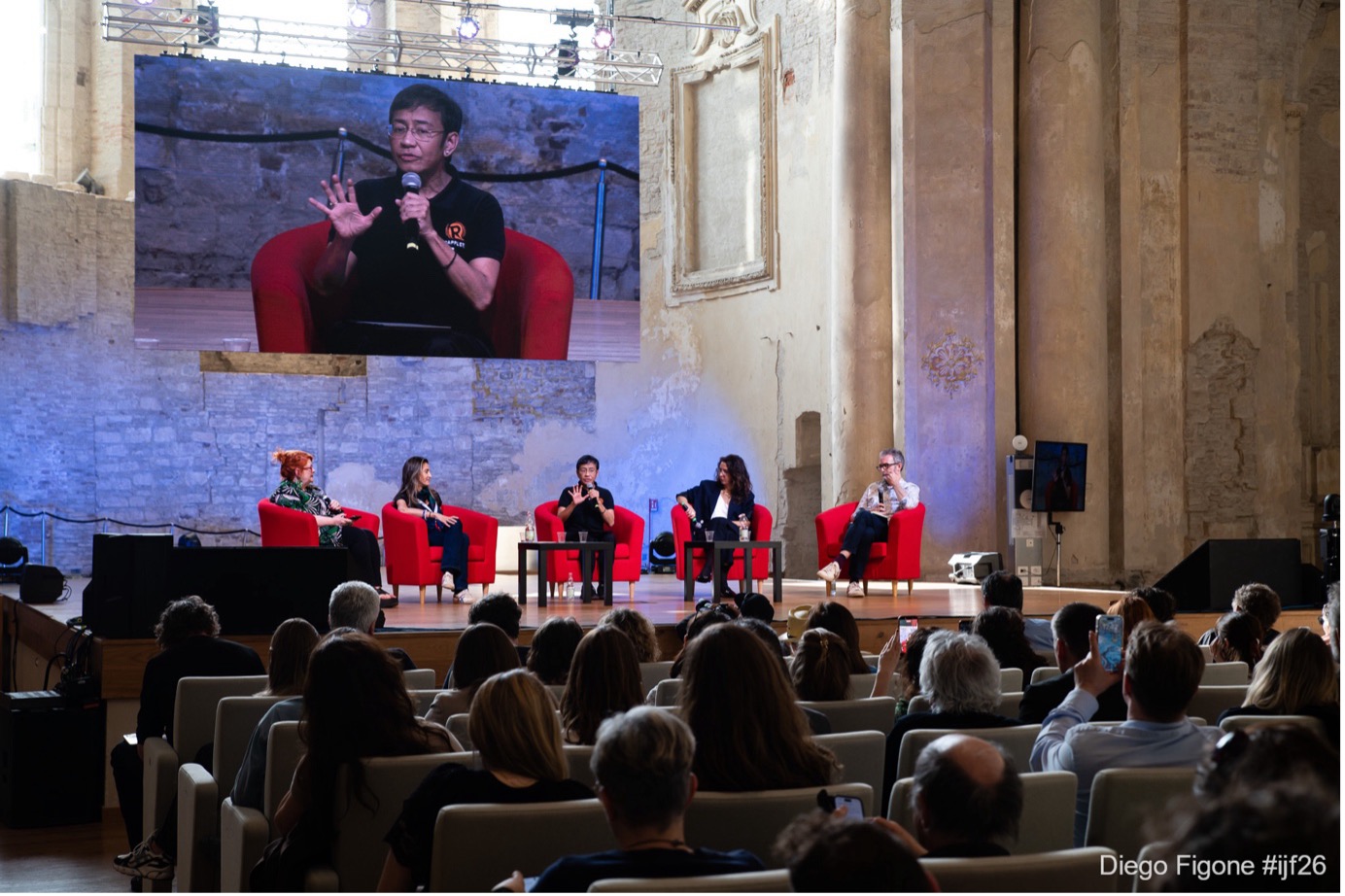
Democratic decline is unfolding through a “funnel” driven by online narratives, weakened institutions and rising corruption, Nobel Peace Prize laureate Maria Ressa warned at the Perugia International Journalism Festival on Thursday.
Ressa said the pressures facing journalists are intensifying as democratic systems weaken, describing her own experience as one of “PTSD and déjà vu” as she watches developments in the United States.
Several attendees said the discussion helped them make sense of an increasingly chaotic media environment.
“The ability for these reporters to contextualize the time period that we’re in right now is really inspiring,” said attendee Caroline Chaffiotte, a master’s student from the Erasmus Mundus journalism programme and who said also worked for local media in the US.
Ressa herself pointed to those pressures. Co-founder of Philippines independent news outlet Rappler, she rose to prominence for her coverage of former Philippines president Rodrigo Duterte’s anti-drug campaign. She has faced “21 different cases or investigations” that she has described as politically motivated, all but one of which have been dismissed.
“Nothing can bring her (Ressa) down. She makes us feel more supported,” said Gabriele Blaschko, a German reporter who is also a master’s student in the Erasmus Mundus journalism programme.
“To see them kind of clarify and provide at least the beginnings of a path towards protecting democracy and maintaining the structures that we have in the institution was really inspiring,” said Chaffiotte.
Ressa described a “funnel” model of democratic decline.
“The top of the funnel is narrative warfare,” she said, referring to how political actions are transformed into “content triggers” and amplified across platforms such as X, Facebook, TikTok and YouTube.
She said these systems are shaped by incentives that prioritise emotional engagement. “The distribution system literally prioritize the spread of lives laced with fear, anger and hate,” she said.
As these narratives spread, Ressa warned that institutional safeguards begin to weaken.
Journalists at the festival said they were already experiencing these pressures in practice.
“I think maintaining a level of objectivity is very difficult, though I don’t like the word ‘objectivity’,” said Chaffiotte. She described the strain of covering fast-moving political discourse while maintaining professional standards.
“I think it's tough in the US just because mainstream media is so focused on narrative function as a medium,” she said. “In 2016, that was kind of the major issue with a lot of political coverage of Trump, where you focus on the narrative of -- he's a billionaire playboy, he's a real estate magnet -- this isn't a legitimate campaign.”
Chaffiotte argued that journalism must move beyond narrative-driven reporting.
“We need a more existential perspective, ” she said, “I would like to see more independent outlets to be able to promote sort of a cohesive institutional critique.”
At the bottom of the funnel, Ressa said, lies what she described as “strategic corruption and kleptocracy”, which means the consolidation of power enabled by weakened institutions.
“We can see the influence even in Germany,” said Blaschko, as she shared her concerns over cross-border political influence in her country.
“We had the general election last year, but we have some smaller state elections happening this year. The right-wing party, as in every other country right now, has a very strong bond with the US and also Russia, ” she said. “Last year, during the electoral campaign, Elon Musk gave a voting recommendation for a party in Germany.”
According to a the Democracy Report from Sweden’s V-Dem Institute, for the first time in five decades, the United States lost its "liberal democracy" status and is now classified as an "electoral democracy.”
Reflecting on past coverage, Chaffiotte said US news organisations underestimated the structural risks posed by political actors.
“You have to constantly respond to whatever Trump had said during the day, or whatever the latest press release was having to address it, as this is a legitimate position from the president of the United States,” she said.
In such an environment, Chaffiotte felt reporters often face criticism from all sides.
“You were damned if you did, damned if you didn't. You're perpetuating liberal propaganda or you’re perpetuating conservative propaganda. Everyone was unhappy with the product. Everyone was infighting on sort of the information sphere,” said Chaffiotte.
“So it's a very disheartening culture and environment to work in, especially when you have the president embarrassing you on a national stage every day,” she added.
Despite the challenges, some said persistence remains key.
“Keep fighting, keep pitching, because at some point someone’s gonna say yes, ” Chaffiote said.
《The Young Reporter》
The Young Reporter (TYR) started as a newspaper in 1969. Today, it is published across multiple media platforms and updated constantly to bring the latest news and analyses to its readers.
Anti‑abortion march, pro‑choice protests clash in central Munich
Humour helps serious journalism win back young audiences, journalist tells Perugia festival


Comments