
Deafening barks and whimpers echo daily behind rows of metal fences, where more than 300 dogs - kept in groups of three to four each - are housed in kennels of about two square meters at Hong Kong Dog Rescue’s Tai Po shelter. Together with another 200-plus medium to large-sized dogs at its Ap Lei Chau home, these shelters are bursting at the seams.
This is only too common a picture for many of the city’s 37 registered animal welfare organisations, which are struggling to keep up with Hong Kong’s rising abandonment rate and a declining adoption rate.
April Yip, the founder of Home for Homeless Dogs, said their non-profit dog shelter is now full after taking in an extra 100 dogs beyond its original capacity of 230 last year.
“Animal shelters across Hong Kong are all struggling with full capacity,” she said.
To make what seems a losing battle even worse, many adopted dogs are often returned by their adopters for trivial reasons. Not only do these returned adoptions stretch the resource-thin shelters even further, but they also put dogs at risk of being euthanised unnecessarily.
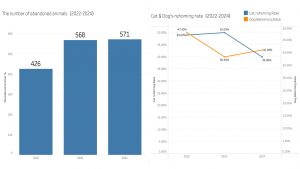
From 2022 to 2024, the number of abandoned animals in Hong Kong rose from 426 to 571, according to a Legco research report. The Agriculture, Fisheries and Conservation Department, the government body managing wildlife, transferred 480 cats and 995 dogs to local animal welfare organisations during the same time period, according to a response report from the controlling office of AFCD.
However, the adoption rate dropped from 47.9% to 41% for dogs and 49% to 39.9% for cats.
Yannie Wong of Hong Kong Dog Rescue said one of the major reasons for the rising abandonment rate was the end of work-from-home arrangements after the COVID-19 pandemic.
Between 2017 and 2023, the number of pet dogs and cats in Hong Kong peaked in 2020 during the COVID-19 pandemic, according to the same Legco research report.
“People were more flexible to take care of a pet because they had more time at home and they needed companionship at that time,” Wong said.
“But after the pandemic, they have to work in the office again and no longer have time to care for their pets,” she added.
The rising abandonment rate and decreasing adoption rate also lead to an increased risk of dogs being euthanised.
Ruffle, a mixed-breed Chinese rural dog, was once at risk of euthanasia after being abandoned.
Wong said Ruffle was once adopted by a young couple during an HKDR adoption event in 2019. The couple broke up in 2023, and Ruffle remained in the care of the male owner since the female owner was in an economic situation that was not suitable for continuing to keep pets.
However, the male owner frequently sent Ruffle to different friends' homes for foster care. Ruffle then developed aggressive behaviour, and the male owner decided to have her euthanised.
“Ruffle had aggressive behaviour due to the fear of separation; she is actually a little bit nervous but not that dangerous if people build up the bonding with her,” Wong said.
In 2023, a vet clinic that saw Ruffle’s information on the HKDR website told Wong that they saved Ruffle from euthanasia planned by the male owner.
Wong then took Ruffle back and posted the adoption information to try to find her a home. Fortunately, Ruffle’s former female owner, who was then capable of raising a pet, decided to take her back and promised Wong that she would never abandon her again.
“It was one adoption that made us really happy and impressed,” Wong said.

In Hong Kong, stray dog rescue operations are carried out through a partnership between the AFCD and 12 local animal welfare organisations, including HKDR.
Stray dogs that are the subject of public complaints will be caught by AFCD and kept in their management centres first. Dogs without microchips, when caught, are held for a minimum observation period of four days before assessment, and others will be kept longer until their owners are traced successfully.
Only those who have been assessed as healthy and docile will be transferred to AFCD’s partner animal welfare organisations for rehoming. Otherwise, euthanasia will be performed on dogs once they remain unclaimed and stay beyond two weeks, according to the Legco.
The centres also receive dogs voluntarily surrendered by their owners, of which 360 were surrendered last year, according to the spokesperson of AFCD.
The AFCD spokesperson said 375 dogs were euthanised in 2025.
Yip said she firmly opposed the euthanasia of stray dogs. She said cats and dogs are not wild animals, as they were abandoned and became strays because of human beings.
“It is completely unreasonable that humans try to solve the problem by killing them,” she said.

Even though 266 dogs passed all of the AFCD’s assessments and were transferred to animal welfare organisations in 2025, only 37% of them were successfully adopted.
Amid increasing abandonment and decreasing adoption rates, animal welfare organisations have undertaken a large amount of resettlement and accommodation work.

Yip also flagged the issue of returned adoption as it was not just a waste of the organisation’s time and effort but would also cause severe psychological trauma to dogs.
“After being returned, these dogs would usually present signs of depression, like hiding in a corner of the shelter for a long time and refusing to eat,” she said.
Wong said the strict pre-adoption screening for adopters from HKDR - including a questionnaire and interview - was not enough to prevent adopted dogs from being returned. Out of 382 adoptions processed by HKDR last year, 17 dogs were returned, accounting for nearly 4.5%.
Facing growing shelter pressure and low adoption willingness, NGOs are calling on the government to strengthen animal welfare education.
The AFCD is promoting animal welfare through various channels and regularly holds talks in schools and housing estates. Last year, it organised roving exhibitions, dog obedience classes, and pet adoption days across all 18 districts to help boost adoption rates. They hope to actively cooperate with NGOs to promote adoption and strive for the best outcomes for animal welfare.
However, Yip said the AFCD would not take up the initiative to collaborate with local NGOs as a government body.
“More measures can be taken to solve the abandonment crisis and reduce the number of dogs being returned,” Yip added.
Wong also said that although HKDR remained one of the few shelters that worked with the AFCD, they still lacked substantial support.
“The government provides very minimal financial support and there are only 10 designated clinics that offer some free vet treatment. It’s extremely hard to get an appointment as they are always full,” Wong said.
“In the end, we always just make appointments with other clinics that we’re close with but it’s not free,” Wong added.
Wong hopes the government will also provide more animal welfare teaching materials for all schools in Hong Kong to build a culture of animal protection among young people.
“We give school talks, but our reach is limited,” she said.
The AFCD’s spokesperson said the government understands that society holds different views on animal management and will continue to adopt a balanced and neutral approach.
《The Young Reporter》
The Young Reporter (TYR) started as a newspaper in 1969. Today, it is published across multiple media platforms and updated constantly to bring the latest news and analyses to its readers.
Casino non AAMS che accettano PayPal: guida pratica a bonus, pagamenti veloci e sicurezza

15 schools, one record blow: the struggles of zero primary one classes in Hong Kong


Comments