
LegCo election 2025
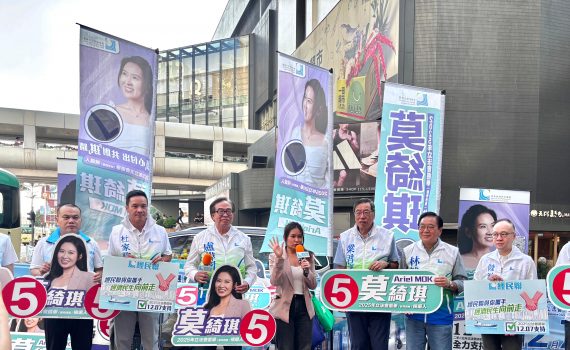
Legislative Council Election 2025: generational handover as members stepping aside for younger generation
- 2025-12-08
- Politics
- By: Dake LiuEdited by: LAI Uen Ling
- 2025-12-08
On a November morning in Hong Kong, the sun scorching the tiled roof of the Wong Tai Sin Temple, hundreds of people pressed together to head to the main altar in a rite for the upcoming Legislative Council election. Devotees walked slowly past the great bronze incense burner, heads bowed, respectfully planting three sticks of incense each. Alan Chan, 68, edged forward in the slow-moving river of bodies, his three incense sticks already lit and trembling between his fingers. For decades this had been his quiet anchor: a bow, a murmured name — Tommy Cheung Yu-Yan. But the 76-year-old lawmaker had just announced his retirement from Legco after 25 years. His prayer caught in his throat. He stared at the altar’s flickering candles, the sea of unfamiliar faces on campaign flyers taped to nearby pillars. "These young candidates I don’t recognise a single one…How am I supposed to vote? How am I supposed to pray?" he said. Cheung is one of 12 current Lego members aged 70 or above who declared they will not run in this year's election, including former Legco president Andrew Leung Kwan-yin, 74, and convener of the Executive Council Regina Ip Lau Suk-yee, 75, accounting for a little over a third of all 35 lawmakers who announced their election withdrawal. Most veteran lawmakers said that they hope to make way for the younger generation. This unprecedented wave of withdrawals is despite no existing legislation specifying a retirement age limit for members of Legco. Although the reasons for the generational shift remain unclear, some commentators have speculated that Beijing seeks a younger cohort of legislators who will appeal to Hong Kong’s youth and align more closely with national development priorities. Martin Cheung Tat-ming, Chief Researcher at a leading local think tank, said the most direct reason why …

Legislative Council Election 2025: Ethnic minorities voters satisfied with first ever designated polling station arrangement
- 2025-12-07
- Politics
- The Young Reporter
- By: AU YEUNG JimEdited by: KURNIAWAN Trista Vania
- 2025-12-07
Two designated polling stations have been set up for Hong Kong’s ethnic minority population to cast their ballots for the Legislative Council election on Sunday. The designated polling stations are located at Tang Shiu Kin Victoria Government Secondary School and Kowloon Park Sports Centre, to allow ethnic minority voters who participate in religious events at the Wan Chai Khalsa Diwan Sikh Temple and Kowloon Masjid respectively to cast their ballots, according to the authorities. These designated polling stations are part of the government’s pilot arrangements to cater to voters with special needs. “Sometimes it was difficult for us to wait in a queue, but now it is perfect,” said Aida Zubaida, 33, a housewife from India who has lived in Hong Kong for more than 10 years. “There are separate counters, so we can go easily and orderly.” According to the 2021 Population Census, about 8.4% of Hong Kong’s population belong to an ethnic minority group. Indonesians top the list, followed by Filipinos, White people and Indians. Zubaida said she hopes the next Legislative Council can address the social inequality encountered by the ethnic minority population today, especially in terms of financial support. “There shouldn’t be partiality between Chinese and ethnic minorities, in jobs, employment and other areas," Zubaida said. “We are suffering a lot here, so that’s why we are expecting more separate places for us.” “If we have more job opportunities, we can easily have financial support. But in Hong Kong, the Chinese language is very important here. Even though we are trying to learn the language, it has been very difficult for us.” According to a report published by the Equal Opportunities Commission, Hong Kong’s equality watchdog, it is common for ethnic minorities to face discrimination in accessing goods and services. In terms of employment, ethnic minority …

Legislative Council Election 2025: Hongkongers cast ballots for second “patriot-only” legislature
- 2025-12-07
- Politics
- The Young Reporter
- By: AU YEUNG JimEdited by: KURNIAWAN Trista Vania、ZHANG Yiping
- 2025-12-07
Polling is underway on Sunday to elect the next term of the Legislative Council, the second “patriot-only” election since Beijing’s electoral overhaul in 2021. As of 5:30 pm, turnout for geographical constituencies stands at 23.76%, with over 981,000 voters casting their ballots. In the previous LegCo election in 2021, turnout at the same time was 18.5%. The polling period this year was extended for one hour, running from 7:30 am to 11:30 pm. Chief Executive John Lee Ka-chiu cast his vote at Raimondi College polling station at 8:30 am. “The Legislative Council has a lot of powers, for example, in approving spending or making new laws,” Lee said during a media session at the polling station. “We will work together to fill loopholes in our existing system, reinforce our city’s safety, and give residents a greater sense of security,” Lee said. “All voters must therefore come out to vote today, because your ballot represents reform, safeguarding victims of the [Tai Po] fire, and our unity in marching forward,” he added. Tai Po’s Wang Fuk Court suffered a level-five fire on Nov. 26, which claimed more than 150 lives. Despite the casualties, authorities kept the election as scheduled, citing the need to avoid a vacuum period in the legislature. Residents who showed up to cast a ballot said they wanted to support Hong Kong’s development, and hoped the next LegCo could focus more on social affairs. “As a Hongkonger, it is our responsibility to support Hong Kong’s development,” said Jack Zhong, 36, an IT engineer who cast a ballot in the Kowloon West geographical constituency. Zhong said he hopes the next Legislative Council would focus on economic development to improve residents’ quality of life. “As an IT engineer, I would like to see more supportive measures in the information technology …