
transportation

Can Hong Kong make room for everyday cyclists?
- 2026-11-07
- Society
- The Young Reporter
- By: Yutong Su、Pann Hnin Nay ChiEdited by: QIN Ziyang
- 2026-11-07
For Martin Turner, the chairman of the Hong Kong Cycling Alliance, a trip to the bakery, a visit to a friend, and a stop to pay a bill can all fit into one bicycle journey. “When you’re on a bike, you’re part of the world,” said Turner, who cycles around Hong Kong nearly every day. “You’re out there, you’re in it, you can do all those things, and it’s enjoyable, healthy, and fun,” he added. Turner sees cycling as a practical way to navigate the city, not simply a recreational activity. But Turner’s experience is not the norm. In Hong Kong’s dense urban districts, fragmented cycle paths, steep slopes and roads shared with motor vehicles make everyday cycling difficult for many residents. That leaves dense areas, especially Hong Kong Island and Kowloon – areas with high population density and many short journeys – dependent on disconnected paths and roads shared with cars. For residents making short trips within these districts, cycling often remains an impractical option. “The city’s cycling infrastructure has largely been designed for recreation rather than commuting,” said Wang Donggen, Chair Professor and Head of the Department of Geography at Hong Kong Baptist University. Wang added that climatic conditions, which are usually hot and rainy, land limitations, and residents’ habits also hinder daily cycling commutes in Hong Kong. “For many people in Hong Kong, bicycles have mainly been leisure or sports equipment, not a means of daily transport,” Wang said. Government data support that point. According to the Transport Department’s Travel Characteristics Survey 2022 Final Report, 70% of cycling-only trips and 73% of cycling legs connected to other transport modes took place within the same district. The survey also found that 86% of cycling-only trips lasted 30 minutes or less. Yet most new cycle tracks are planned outside …

Hong Kong eyes tech-driven online platform for port community to catch port trade opportunities| LSCM Logistics Summit 2025
- 2025-10-11
- Business
- By: TANG Siqi、CHEN YongruEdited by: WANG Ruoshui、BO Chuxuan
- 2025-10-11
The city’s officials and industry leaders emphasised the Port Community System, an electronic platform to optimise port operations and seize opportunities in the evolving port trade market, at this year’s Logistics Summit on Friday. The PCS, which caught the attention in numerous discussions among industry experts, refers to a digital platform that leverages cutting-edge technology to “provide a comprehensive, real-time cargo tracking function, creating a seamless digital thread that connects sea, land, and air networks,” according to an opening remark speech delivered by Mable Chan, Secretary for Transport and Logistics, on Friday morning. According to government data citing Alphaliner's ranking of the world's top 30 container ports, Hong Kong fell to 11th place in 2023 from 8th place in 2019. Alphaliner’s latest ranking shows Hong Kong dropped further to 13th place in 2024. Kazunori GOTO, the deputy head of the Yusen Logistics Global Management (Hong Kong) Limited, mentioned that many logistics companies today only provide basic transportation services, which fail to meet customers' demands for visibility. GOTO stated that the logistics process involves seven participants, including factories, customs, and end-users, and the complexity of communication between these links often leads to disconnections, resulting in inefficiencies, delays, and information gaps. Kenneth Law, the manager of LSCM, stated that compared to traditional ports, the PCS platform integrates all information on a single platform, which significantly improves information accessibility. Law believes that this system will reduce corporate costs in areas such as IT and cargo tracking, effectively lowering transaction costs and thereby driving the overall development of the port economy. Chan believes that the PCS can directly enhance Hong Kong's competitiveness as an international trade, finance and logistics hub. "By its nature, it is government-run, it is official, so in a way it instils and upholds a high level of confidence in …

Hong Kong Kai Tak Terminal crawls to make progress amid Singapore’s busy cruise schedules
- 2025-04-25
- Business
- The Young Reporter
- By: BO Chuxuan、Haoming ZhouEdited by: BO Chuxuan、XIA Fan
- 2025-04-25
Standing on a chilly winter morning, Wang Wei-de, a Taiwanese cruise passenger, is looking for brunch with local flavour with his family at Kai Tak Cruise Terminal. “It feels deserted here. I didn’t expect the restaurants won’t open until 11:30 am,” said Wang, whose Cruise ship arrived at 7:30 am on Jan. 22. Upon arriving in Hong Kong for the first time, Wang was disappointed by the transporting and ancillary facilities at KTCT. “It would take too much time on the way to MTR if we’re going downtown,” said Wang, who decided not to head downtown because of time limitations, “shuttle bus is only free for one way, and other alternatives are expensive.” With HK $950 spent on one meal and local cookies in the terminal, Wang and his family ended up hanging in stores inside the terminal with no consumption. KTCT was often complained about by tourists for the lack of supporting transportation facilities, and many businesses have also closed down due to a lack of business. The government has responded positively to the problem by increasing the number of free shuttle bus routes and distributing $50 liquefied petroleum gas coupons to taxis, which saw an improvement. However, taxi drivers soon complained about the insufficient passengers and attributed the problem to poor government coordination and communication. The Kai Tak Cruise Terminal, completed in 2013 at the cost of about $8.1 billion, carries the Hong Kong government's aspiration to become an Asian cruise hub. On Dec. 30, 2024, an action plan for the development of cruise tourism was released by the Culture, Sports and Tourism Bureau, reflecting the government's commitment to using the terminal as a venue for conventions and exhibitions, as well as cultural, creative, and community leisure activities, to make full use of the facilities after almost three …
Budget 2025: HK$2 transport subsidy scheme capped at 240 trips a month
- 2025-02-26
- Society
- The Young Reporter
- By: LEUNG Chi Ngai、YAM Long Hei JamieEdited by: Chun Lim LEUNG
- 2025-02-26
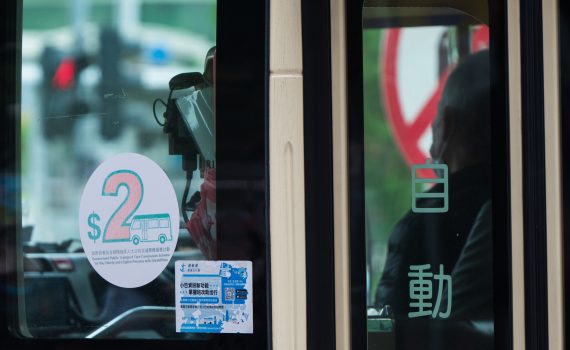
Passengers of public transport over 60 years old will have their HK$2 rides limited to 240 trips per month, Financial Secretary Paul Chan Mo-po proposed in this year’s budget speech. For trips below HK$10, eligible passengers will continue to pay HK$2, but for trips costing more than HK$10, they will have to pay 20% of the total fare. The updated scheme preserves the policy intent while striking a balance on “enhancing the sustainability of the scheme and minimising the impact on the beneficiaries,” said Chan. Government reimbursements to public transport operators is estimated to hit a record high of HK$5.4 billion in 2025-2026, more than tripled compared to HK$1.4 billion in 2021-2022, according to government figures. Currently, the HK$2 subsidy scheme which allows all permanent residents over 60 years old to take public transport for two dollars per trip comprises 0.7% of the total government recurrent expenditure. Dai Fung-wa, 80, who lives in Mei Tin Estate in Tai Wei, said the new policy is unfair to people over 70 years old. Dai said people between 65 and 70 years seldom take public transport after retirement. “You can still work in your 60s, but if you are over 70, you can only take care of your grandchildren at home,” Dai said. Government figures show that 49.4% of residents aged between 60 and 64 years were in the labour force in the past three months, compared to 13.7% of those over 64 years old. Government expenditure on the HK$2 scheme is more than doubled in 2022-2023 from HK$1.4 billion to HK$3 billion, when the eligibility age was lowered from 65 to 60, with extended coverage to include red minibuses, kaito ferries and trams. Lam Chun-sing, Legco member for the Federation of Hong Kong and Kowloon Labour Unions said subsidising transport for …

Taxi industry demands for consummate policy under threats in hailing car ecology
- 2025-02-18
- Society
- By: Chun Lim LEUNG、Chun Hei LUKEdited by: CHEN Yik Nam
- 2025-02-18
A 17% rise from the second to third quarter last year on passenger complaints of taxi driver’s behavior among taxi industry, highlighting a growing crisis in trust among commuters. Tseng Wing-tong, 28, a local teacher, expressed her dismay over the degrading image of traditional taxis in the city. She had a harrowing experience with a taxi, where the driver was "recklessly" running through traffic and flouting basic safety rules. "I was literally scared for my safety," she said. "The image of taxis here has taken a hit," Tseng said, reflecting on a widespread perception of poor service and unclean vehicles. “If traditional taxis want to compete, better driver training and better maintenance of vehicles are needed so that people can get back into a place of trust,” she added. Based on the Transport Complaints Unit, the number of overcharging cases increased from 11 in 2021 to 42 in 2023. Cases of refusals to take passengers or to drive to specified destinations leapt from 27 in 2021 to 85 by 2023, a 214% increase. The number of complaints has remained fairly stable, in the region of 11 to 13 annually. After online-based ride-hailing platforms like Uber became popular, local taxis have been getting fewer and fewer attention. The official Uber Newsroom’s research shows that 60% of passengers said that Uber Taxi is the safest choice for sorting good taxi drivers. Kwong Ka-chun, 42, a red taxi driver, said that much stricter regulations or better training programmes are needed to restore public trust in the taxi industry. "The main reason for the negative perception is definitely the bad behaviour of some drivers,” he said. “I've witnessed colleagues refuse to take passengers because the fare isn't high enough.” Kwong remembered the day when one passenger refused to get in his taxi because she …