
TOP STORIES
The cost of bidding farewell to pets
- 2025-02-23
- Society
- The Young Reporter
- By: CHEN Yongru、TANG SiqiEdited by: WANG Jing
- 2025-02-23
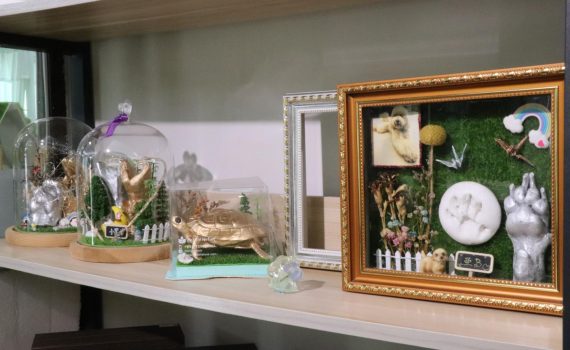
Wong Lam lost her 12-year-old pet dog named Peach in January. “Peach is irreplaceable to me and I wanted to have a proper remembrance,” Wong said. She considered spending on a “Life Crystal” souvenir, a keepsake made from dead pet's ashes and fur. But the hydration process alone would cost HK$800 to 900. After hesitating for a long time, she decided to buy a simple urn with two animal paw prints for HK$800. “My budget was only about HK$2,000,” she said. In 2018, about 242,000 households had cats and dogs, according to government figures. It is an increase of almost 40% since 2005. Burying dead animals in public places is against the law. In this case, pet owners can choose to leave it to the government or go to a specialised agency that charges more expensive fees. The Food and Environmental Hygiene Department transport animal carcasses collected in plastic bags and bury them in landfills. Pet owners who can afford the higher cost may choose to have their pets institutionalised as they feel this will allow their pets to depart this world in a more dignified manner. Mathew Wu is the owner of Pet to Nature, Hong Kong's first hydration hospice for pets. He said although more young people are coming to the shop, they are becoming more “rational” in consumption compared with five years ago. “Business used to be good and people were willing to spend money,” said Wu. “Maybe it's the economic environment now, fewer people are willing to buy souvenirs.” Iris Chan, the owner of Pet Memorial, a high-end pet hospice, said that the importance Hong Kong people place on their pets has increased in recent years. “Most people regard their pets as family members,” she said. “ Some families even come together to see it off." …

Hongkongers' northbound dental journey to better smiles
- 2025-02-23
- Society
- The Young Reporter
- By: ZHONG Xinyun、CHEN XiyunEdited by: YANG Haicen
- 2025-02-23
A typical weekend for Wan Jiachen begins with a 40-minute subway ride through the bustling Futian Port, heading to the Shenzhen Second People's Hospital to get a check-up on his latest dental fillings. “Dental service in Shenzhen is my first choice,” said Wan. He is a bank worker with a Shanghai household registration (hukou) and a Hong Kong identity card. He now lives in Hong Kong because of his new job. The long journey crossing the border can be exhausting, but Wan said it is worth it. “In Hong Kong, it has become more difficult to secure an appointment with a public dental clinic, and the price is unaffordable for ordinary wage earners,” he said. In Shenzhen, he pays HK$100 to HK$200 for teeth cleaning, but in Hong Kong it’s around HK$800. Wan is not the only Hong Kong resident traveling north to seek dental treatments. According to Shenzhen government figures, in 2023, Shenzhen provided 700,000 cases of medical treatment for Hong Kong residents. Currently, Hong Kong has only 0.37 dentists per 1,000 people, which falls behind many countries worldwide, according to Lo Chung-Mau, the Secretary for Health of Hong Kong. Limited local public and private healthcare resources is a major issue. “The service quality and professionalism vary significantly between clinics,” said Daniel Wong, a 57-year-old local Hong Kong resident. “Hong Kong lacks private clinics. Their small scale is also a problem.” Private clinics also tend to be more expensive. According to the clinic’s price list, Nixon Dental at Mongkok charges HK$6,000 for one-time full mouth root planing. For the clinic’s branch in Central, the same service costs even higher at HK$8,000. According to Hong Kong government statistics, as of December 31, 2023, Hong Kong has 2,876 registered dentists, with around 700 working in the public sector. “The scarcity of …

Luxury bags and wedding gowns lead the rental fashion craze
- 2025-02-23
- Society
- The Young Reporter
- By: XU Jingyi、ZHENG XinyiEdited by: WANG Ludan
- 2025-02-23
Cici Fan, 21, a university student, darts between various luxury handbag stores in Tsim Sha Tsui after receiving a last-minute notification to attend an important business dinner. She paced and occasionally looked inside from the shop window. Finally, she entered a store and secured a Dior handbag for HK$800. “I finally feel at ease because it solved my problem of not having enough money to buy a fancy tote bag for a dinner party,” Fan said. But from the moment she walked out of the store, she had to carefully look after the bag until it was safely returned to the store because it was rented. Fan is the small epitome of the Hong Kong clothing rental craze. More Hongkongers have started trying rental services in different boutiques in recent years. Renting clothing and accessories from luxury brands allows consumers to display high-end lifestyles in social settings without spending much money. It provides a cost-effective way for people to keep up with fashion trends. Some overseas luxury rental brands, such as Rent the Runway and Style Theory, are starting to emphasise the local market by offering online services for Hong Kong consumers. Kimi Lee, the owner of the 37-year-old luxury bag rental store Huiyuan, has been running it for six years. He said it was tough for the store to operate in its early days. “Very few people came to try this business at first because most people were not familiar with the concept of renting a bag,” he said. Lee said things have started to look different in recent years. “Now the number of monthly rental orders is more stable at more than 100, and the customer base has expanded from local Hong Kong office workers and fashion enthusiasts to mainland tourists,” Lee said. To satisfy the needs of …

Shenzhen restaurants win Hong Kong diners’ hearts
- 2025-02-23
- Society
- The Young Reporter
- By: FENG Zhenpeng、Li YinhengEdited by: MAO Anqi
- 2025-02-23
On a typical Sunday evening, Jack Kwan from Hong Kong, 32, is waiting to be seated at a well-known hot pot restaurant in Shenzhen. During peak dining hours, crowds gather at the restaurant’s entrance to look at the menu. They wait patiently until their queue number is called. Kwan sips on the chrysanthemum tea, provided by the restaurant for those who are waiting to be seated. “I feel time passes faster when queuing here with tea provided. It is much more relaxing. We do not experience this level of convenience while queuing in Hong Kong,” he said. Kwan goes to Shenzhen to try out different cuisines once or twice a month. After COVID-19, heading north to eat has become a popular trend for Hongkongers on weekends. Shenzhen restaurants often offer lower prices, which attracts more Hong Kong diners and makes them more competitive than restaurants in Hong Kong, especially during weekends and holidays. In 2024, over 52 million Hong Kong residents travelled through Lo Wu Port, one of the 16 border checkpoints connecting the two cities, an increase of 68% compared to the previous year, according to the Hong Kong Immigration Department. Jason Wu, 26, who went to Shenzhen for the first time during the recent Lunar New Year holidays, said the disparities in income and consumption levels in the two cities make cross-border dining a better choice for him. “Hong Kong has a higher wage level and a stronger consumption capacity than Shenzhen, but Shenzhen’s price level is lower than Hong Kong,” he said. Government data shows that the median monthly wage for a Hongkonger was HK$20,500 in 2024. On the ranking of cost of living of cities worldwide, Hong Kong tops the list while Shenzhen ranks 34th, according to Mercer’s report. “I am pretty attracted by the affordable …

Animal rights group protests against animal cruelty outside Hong Kong International Fur & Fashion Fair
- 2025-02-22
- Society
- The Young Reporter
- By: YAM Long Hei JamieEdited by: Lok Tung LAU
- 2025-02-22
Animals rights group, People for the Ethical Treatment of Animals (PETA) Asia staged a protest outside the Hong Kong International Fur & Fashion Fair at its opening at Wan Chai on Feb 19, calling for an end to suffering. “Love death, embrace pain,” shouted a protester dressed as the Grim Reaper. “These fur products are full of death and tears,” he said. “Embrace death with me at the fur fair.” He reminded people that fur products are made through the suffering and deaths of many animals. Five protesters stood outside the venue for about an hour from noon. “It is ironic that Hong Kong ranked sixth in fur exports, despite the high public awareness of the animal cruelty involved in fur goods,” Tang said. The fur trade fair runs from Feb 19 to 22 at the Hong Kong Convention and Exhibition Centre, featuring the trading of fur and leather garments, fur skins, furrier's tools, accessories, pelts, and machinery. Among the 56 exhibitors, 12 are from mainland China, several are from Europe, the USA and North America, and the rest are from Hong Kong. “Fur is a product behind the times. Many countries banned fur, but Hong Kong, as an international hub, continues participating in this enormous trade,” said Jackie Tang, campaigner and social media coordinator of PETA Asia. In 2021, Hong Kong was the world's sixth-largest fur export hub. “ The fur trade fair is one of the most important exhibitions in the fur industry, with up to 70% of consumption coming from this event each year,” said Wallace Wong, director of the Hong Kong Fur Federation. The Federation said that the fur trade is a responsible industry, highly regulated and committed to environmental conservation. But a PETA investigation revealed that labels claiming products to …

Ukrainian journalists defend local voices as war with Russia enters third year
- 2025-02-21
- Society
- The Young Reporter
- By: LAI Uen LingEdited by: AU YEUNG Jim
- 2025-02-21
Ukrainian journalists at the frontline regions of the Russia-Ukraine war shared their challenges in wartime reporting at a seminar at the Danish School of Media and Journalism. Organised by Nordic Journalism Center, a group of Ukrainian journalists were invited to share their experience in operating newsrooms in wartime Ukraine as the war with Russia enters into a third year. Oleksiy Soldatenko, programme director of the Institute for Regional Media and Information of Ukraine, said journalism in Ukraine has been struggling with the lack of funding and human resources. “We have no equipment, we have energy cuts and blackouts, but we understand that we are part of this profession and we need to work within professional standards," Soldatenko said. He added although working with communities in destroyed cities is difficult, some regional newspapers continue to reach readers. “We work for our communities, but sometimes communities are not there,” Soldatenko said. “We have cities and towns that are completely destroyed, like Pahmo, but the newspaper from Pahmo is still working and going, trying to reach their people wherever they are, across Ukraine and in other countries of the world.” Iryna Synik, editor of Stepova Zorya, a local newspaper based in Russian-occupied Petropavlivka in southern Ukraine, relies on online subscriptions to support operations. Synik said there is no room for depression because she and her only colleague have to edit and produce all the news pieces. But she remains motivated to run the 95-year-old local newspaper. "Because we are a local newspaper, we can tell stories that would not appear in the national news," Synik said. Marharyta Halich, editor of regional TV broadcaster Suspilne Zaporizhzhya, said finding interesting stories during wartime is challenging because people are tired of hearing negative news about destruction and casualties. Halich said she constantly feels empty and depressed …

Shift in news consumption habits gives rise to donation-based revenue model
- 2025-02-19
- Society
- The Young Reporter
- By: AU YEUNG Jim、YAM Long Hei JamieEdited by: NG Natasha Goa Sheng
- 2025-02-19
Tang Ho-wing, 36, is an independent journalist running the news outlet, “boomheadhk”, on social media platforms such as Facebook and Instagram. The page mostly covers local and international political issues, and has attracted over 22,700 followers. “Hongkongers' news consumption habits have shifted. Increasingly, they want to consume content not covered by the mainstream media or specialised content that features unique views,” Tang said. The main purpose of his outlet is to supplement the mainstream media and offer readers new insights on social issues. Tang’s outlet relies on readers’ donations to cover the cost of his reporting work. “When people want to read more specialised and unique reporting, or lesser-known content, they are willing to pay,” Tang said. According to Reuters Institute Digital News Report, in an online survey of 2,000 respondents in Hong Kong, only 18% said they pay to access news online in 2024, down from the peak of 29% in 2020. The report added that because the public’s news consumption habits have changed and advertising revenue has declined, media organisations that struggle in adapting to the rapid change have reported financial losses. Hong Kong Free Press, an independent non-profit news media that relies on readers’ donations, reported a HK$1.4 million loss in 2023, according to its annual report. HKFP has 895 regular monthly donors as of 2023. Damon Wong Chun-pong, Chief Editor of InMedia, a local online independent news outlet, said his outlet did not experience significant financial losses. “The drop in paid readership following 2020 is a full picture that includes the closure of mainstream media outlets, such as Apple Daily and Stand News,” said Wong. “By comparison, our readership didn’t drop a lot.” He said some readers follow other small and new news outlets after some closure of some of the mainstream outlets. The newcomers include …

Taxi industry demands for consummate policy under threats in hailing car ecology
- 2025-02-18
- Society
- By: Chun Lim LEUNG、Chun Hei LUKEdited by: CHEN Yik Nam
- 2025-02-18
A 17% rise from the second to third quarter last year on passenger complaints of taxi driver’s behavior among taxi industry, highlighting a growing crisis in trust among commuters. Tseng Wing-tong, 28, a local teacher, expressed her dismay over the degrading image of traditional taxis in the city. She had a harrowing experience with a taxi, where the driver was "recklessly" running through traffic and flouting basic safety rules. "I was literally scared for my safety," she said. "The image of taxis here has taken a hit," Tseng said, reflecting on a widespread perception of poor service and unclean vehicles. “If traditional taxis want to compete, better driver training and better maintenance of vehicles are needed so that people can get back into a place of trust,” she added. Based on the Transport Complaints Unit, the number of overcharging cases increased from 11 in 2021 to 42 in 2023. Cases of refusals to take passengers or to drive to specified destinations leapt from 27 in 2021 to 85 by 2023, a 214% increase. The number of complaints has remained fairly stable, in the region of 11 to 13 annually. After online-based ride-hailing platforms like Uber became popular, local taxis have been getting fewer and fewer attention. The official Uber Newsroom’s research shows that 60% of passengers said that Uber Taxi is the safest choice for sorting good taxi drivers. Kwong Ka-chun, 42, a red taxi driver, said that much stricter regulations or better training programmes are needed to restore public trust in the taxi industry. "The main reason for the negative perception is definitely the bad behaviour of some drivers,” he said. “I've witnessed colleagues refuse to take passengers because the fare isn't high enough.” Kwong remembered the day when one passenger refused to get in his taxi because she …

Golden Horse Film Awards Best Actress Chung Suet-ying shares career experiences at her alma mater
- 2025-02-17
- Society
- The Young Reporter
- By: QIN Ziyang、XU JingyiEdited by: AO Wei Ying Vinci
- 2025-02-17
Golden Horse Film Awards Best Actress, Chung Suet-ying of the film The Way We Talk returned to her alma mater, Hong Kong Baptist University, to share her career experiences with journalism students on Friday. Chung played Sophie Fong in The Way We Talk, an optimistic deaf girl who faces difficulties in life but tries to be seen as “normal”. She won best actress at the 61st Golden Horse Awards and was nominated best actress for the 43rd Hong Kong Film Awards. Chung was a graduate of the financial journalism stream at the School of Communication. She said that the Journalism Department enhanced her nosy and curious nature.“Being nosy is not shameful, but a way to absorb knowledge and enjoy learning, just like reading and asking questions,” she said. She added that what’s common between journalism and movies is that they're both about stories. “I can extract the ideas from stories told by others, and convert them to become my motivation,” Chung said. “I think it's amazing that she went from financial journalism to acting. Everyone has their own path to success, and I believe her experience will also inspire my future career planning,” said Zhang Jiahe, a freshman at Hong Kong Baptist University, who aims to study financial journalism in the future. Chung first became a disc jockey after graduation. After that, she was in several on-screen performances, including films, TV series and music videos.In Time, she played Wat Tsz-ying, and she was nominated 40th Hong Kong Film Awards best supporting actress for her debut performance in a feature-length film. In The Lyricist Wannabe, she was the female-lead, and was nominated for the 60th Golden Horse Film Awards for best actress. She also wrote song lyrics for singers such as Eason Chan, Jace Chan and Kaho Hung. Many students were …

ADHD Challenges and Support in Hong Kong
- 2025-02-17
- Society
- The Young Reporter
- By: Wing Chi HO、Chun Lim LEUNGEdited by: Wai Yan MIU
- 2025-02-17
There were 5%-9% of children in Hong Kong suffering from Attention Deficit Hyperactivity Disorder, according to Castle Peak Hospital. Parents face difficulties in caretaking roles, while organizations like the Hong Kong Association for AD/ HD have offered consultations and workshops to release the pressure on caretakers as well as patients. Reported byWing Chi HO and Chun Lim Leung Edited by Vivian Miu and Jeffrey Chan