
The Young Reporter

Hongkongers flock to Sai Kung during Chinese New Year
- 2022-02-07
- Society
- The Young Reporter
- By: Malick GaiEdited by: Kylie Wong
- 2022-02-07
Every weekend, Sang Poon plays saxophone at the Sai Kung waterfront. Poon used to work in a bar playing jazz and pop music, but lost his job during the pandemic and turned to busking. He says Sai Kung is a hotspot for visitors. “I love the view here. I have fun playing music and I get to make some money," said Sang Poon. Despite Hong Kong encountering the largest Covid-19 wave of the pandemic, residents are flocking to Sai Kung as travel restrictions kept most home for the Lunar New Year. "It's been busy for the past week. Business is okay because of the Chinese New Year holidays. It is especially busy on Sundays," said Tim Fung, a staff member at the Chuen Kee seafood restaurant in Sai Kung. Sai Kung has become a preferred destination for Hongkoners looking to sightsee, hike and eat as well as escaping the busy city. "There's beautiful scenery here with a relaxed atmosphere. It's really a nice holiday vibe and we enjoy it," said Kathryn Troy and Stephen Troy, a couple walking with their 15-month old daughter. The Troys live in nearby Sha Kok Mei village and visit the waterfront regularly. While seafood restaurants at the waterfront hustle, nearby grocery shops closer to Sai Kung square are not as busy. Timothy Ng owns Butcher King, a fresh vegetable and meat store on Yi Chun street, which has been operating for 31 years. “The last two to three years have been the hardest because of the pandemic," said Ng.

Shortened quarantine for inbound travellers from high-risk countries
- 2022-02-05
- Society
- The Young Reporter
- By: Kate ZhangEdited by: Nick Yang
- 2022-02-05
From today, inbound travellers from high-risk countries will need to be quarantined in a hotel for 14 days instead of 21 days. They then have to self-monitor at home an additional seven days. The rules applies to all places outside mainland China, Taiwan and Macau. But the flight ban for eight countries will be extended until February 18 to avoid imported cases and pressure on the local medical system. Under the new quarantine policy, inbound travellers can go out during the home quarantine period, but they have to undergo two mandatory tests on the 16th and 19th days after their arrival in Hong Kong. “The revision from 21-day hotel quarantine to 14-day hotel quarantine plus seven-day self-monitoring is not because of pressure from anybody,” chief executive Carrie Lam Cheng Yuet-ngor said last week. “The science tells us that Omicron variant has a relatively short incubation period. So a 14-day quarantine will be good enough according to my experts.” An infectious disease expert agrees with the science behind this change. "If we compare imported cases detected in the last month versus imported cases detected earlier in the epidemic, there are now very few if any cases detected after the third day of hotel quarantine," said Professor Benjamin Cowling, the head of the Division of Epidemiology and Biostatistics at the University of Hong Kong. Kong Shasha, 24, an exchange student studying in Italy, will return to Hong Kong tomorrow. If the mandatory quarantine period is still 21 days, she would prefer to stay in Italy. "I cannot accept being isolated for 21 days, and this revision in policy has helped me a lot," said Kong. However, some in the business community want more to be done. "It will help the local business community if they want to do outbound business travel because …

Cancellation of Lam Tsuen Well-wishing Festival under Covid-19
- 2022-02-03
- Culture & Leisure
- The Young Reporter
- By: Karmen LiEdited by: Jayde Cheung、Jenny Lam
- 2022-02-03
Covid forces cancellation of the Lam Tsuen Well-wishing Festival for a second year. Well-wishing Square is closed for the first 15 days of Lunar New Year.

Two sentenced under sedition law for handing out leaflets advocating independence
- 2022-02-01
- Politics
- The Young Reporter
- By: Karmen LiEdited by: Malick Gai、Jayde Cheung、Jenny Lam
- 2022-02-01
Former school clerk Cho Suet-sum, 45 was jailed for 13.5 months at the District Court yesterday. Her co-defendant, 17-year-old Wong Chun-wai, will undergo nine months of rehabilitation. The pair pleaded guilty to one count of conspiracy to print, publish and distribute seditious materials. The court heard how they handed out leaflets that included the slogan “Hong Kong people, build an army. Establish a state.” The withered bauhinia covered in red paint on the leaflet, mimicking the regional emblem, was intended to provoke violence, according to the judgement. National security law judge, Kwok Wai-kin ruled that the defendants incited others to commit violence to attain Hong Kong independence, which is very close to incitement to secession under national security law. Judge Kwok said Cho manipulated the naivety of Wong and incited others to use violence to achieve her political purpose, making her offense more serious. Cho is the second defendant convicted and sentenced under the sedition law since 1997. Property manager Chiang Chung-sang, 41, was sentenced to eight months in prison at West Kowloon Court on the same day. During the 1967 leftist riots, the sedition law was used to ban propaganda materials from communist forces against the colonial British government. The clause was used again recently against Apple Daily and Stand News after national security law came into effect. Cho was denied bail seven times and has been remanded in custody since June last year, while the teenager was granted conditional bail in August last year. Kwan Man-wai, counsel for Cho, said that the prosecution has overstated the wordings of the slogans. He added that calling others to change the existing political structure is not necessarily inciting violence. Ronny Leung, counsel for Wong, said that Wong wishes for early discharge in order to resume his studies and take the Diploma …

Ontario restaurants to resume dine-in
- 2022-01-31
- Health & Environment
- The Young Reporter
- By: Kiki LoEdited by: Jenny Lam
- 2022-01-31
Dining in at restaurants in Ontario will be allowed from today at 50% capacity following a 25-day suspension because of Covid restrictions. Customers are required to scan a QR code that shows whether they have been vaccinated in order to enter restaurants and other businesses, including theatres and gyms. Unvaccinated people will only be allowed if they can provide proof of medical exemption. Ontario premier Doug Ford announced on Jan 20 that restaurants, gyms, movie theatres, museums and gaming halls would reopen this Monday as the Covid-19 situation shows signs of improvement. The limit for social gatherings would also increase from 5 to 10 people indoors and from 10 to 25 people outdoors. “Percent positivity has now dropped to 15.9%, new admissions to hospitals are starting to slow, and patients are spending a lot less time in the hospital when admitted. And our workforce is stabilizing, with more people coming back to work than calling in sick,” Ford said. He also said there’s evidence to show that the measures to blunt transmission of Omicron are working, adding that the government would gradually ease public health measures in February. In early January, with the increase in the number of Covid-19 hospitalizations, dine-in at restaurants and cinemas, gyms and museums were suspended in Ontario. Stephy Yip, an exchange student from Hong Kong in Kingston, welcomed the lifting of restrictions. “I'm really looking forward to eating at the restaurants. It is more convenient because I don't have to walk home for lunch during class anymore," the 22-year-old said. Another student in Kingston, Dasha Sylenko also said she supports the reopening of restaurants and gyms. “I am very excited about the reopening. I can’t wait for the gyms to open,” she said. Ontario reported 2,012 cases of Covid-19 and 16 hospitalizations on Thursday, compared …

Chinese New Year in Singapore’s Chinatown under COVID
- 2022-01-30
- Photo Essay
- The Young Reporter
- By: Nick YangEdited by: Jayde Cheung、Jenny Lam
- 2022-01-30
Chinese New Year is approaching. In Singapore, Chinatown is bedecked with festive light displays and colorful lanterns. It also serves as a shopping centre where Singaporians prepare for the new year. However, the celebration is subjected to COVID-19 restrictions, including group gatherings of a maximum of five people and five guests at home. Religious ceremonies are also forbidden. “We will be celebrating this Chinese New Year during the pandemic again, but what matters is the spirit of this joyous occasion,” Lee Hsien-loong, Prime Minister of Singapore, said in his Facebook account on Jan. 24.
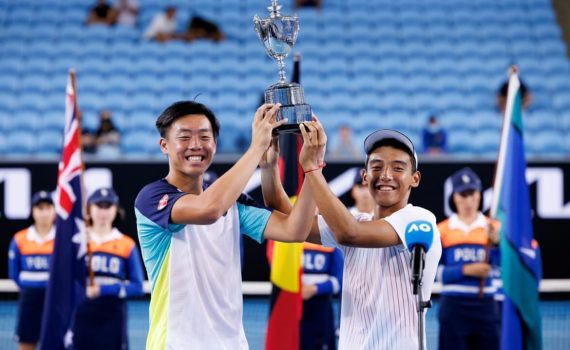
Australian Open: Hong Kong’s Coleman Wong wins junior boys’ double, first ever in Hong Kong history
- 2022-01-28
- People
- The Young Reporter
- By: Clarice Wu、KOO Chi Tung 顧知桐Edited by: Jayde Cheung
- 2022-01-28
17-year-old Coleman Wong Chak-lam becomes the first Hong Kong tennis player to win the junior boys’ double in Australian Open with his American partner, Bruno Kuzuhara. Wong and Kuzuhara played against Alex Michelsen from the United States of America and Adolfo Daniel Vallejo from Paraguay. Wong and his partner brought home the champion title with two sets, scoring 6-3 and 7-6 (7-3) respectively. The match continued for 1 hour and 12 minutes. Wong and Kuzuhara got a head start by winning the first point shortly after the match started, followed by Wong’s aces which opened a 4-1 lead. The pair won the first game by 6-3. They held all the cards until Michelson and Vallejo counterattacked with three big points to take a 6-5 lead in the second game. The Hong Konger-American pair was forced to go to a tiebreak but still managed to win the match. The pair was overjoyed as Wong rushed to their coach, James Alleby, after their victory. “We can’t believe it and we just think it’s dreaming,” he said. The young tennis player expressed his gratitude for the support shown by Hong Kong citizens. “I love you guys. Hong Kong is the best. Hopefully I can keep doing well to make you guys proud!”, Wong said. Siobhán Bernadette Haughey, the first Hong Kong swimmer to win an Olympic medal has also congratulated Wong on her Instagram when he won his second round against Turkey’s Togan Tokac in Australian Open Junior Championships. Wong appreciated the support coming from the swimmer. “I feel so happy and motivated because she really helped me a lot by sending many positive things to me,” he said. Wong also encouraged young aspiring tennis players in Hong Kong to “work hard and be passionate in tennis”. The triumph marked the second milestone …

Police officer sentenced to four weeks in jail for upskirting
- 2022-01-26
- Politics
- The Young Reporter
- By: Jayde CheungEdited by: Clarice Wu
- 2022-01-26
An off-duty traffic police officer was sentenced to four weeks in jail for taking photos up women’s skirts. The crime took place in the chain store Don Don Donki in Tsim Sha Tsui on Jan 21 last year. So Yin-ho, 38, was charged with committing an act outraging public decency. He remained calm as Magistrate Jacky Yip Kai-leung meted out the sentence. The Magistrate ruled that upskirting is a serious and formidable crime that upsets women. So denied the charge despite security cameras recordings from the store and eye witness statements presented in court. “It was premeditated and abhorrent,” said the Magistrate. “You do not feel guilty and denied all the accusations, including refusing to admit owning the phone to sneak the photos, even claiming that the safety guards at the store were biased against you.” A psychological report stated that So was likely to repeat the offence. He also showed no remorse while remanded in custody. So plans to appeal and has been released on a bail of HK$25,000 with conditions. "Upskirting" is against the anti-voyeurism law which came into effect on October 8 last year. It prohibits "unlawful recording and observation of intimate part". Francis Kong, a social work supervisor of Caritas Specialised Treatment and Prevention Project of Sexual Violence, said that most people do not grasp the magnitude of the problem due to the absence of explicit legal accusation and punishment. “Clear legislation is important,” said Kong, “the punishment is just a way to compensate the victim. The law should also advocate respect for one another’s will on sexual contact.” Kong believed that upskirting is a form of intrusive sexual violence that neglects other parties’ will. He has called for more education on the issue because heavy penalties, he said, will not prevent similar behaviour in the …
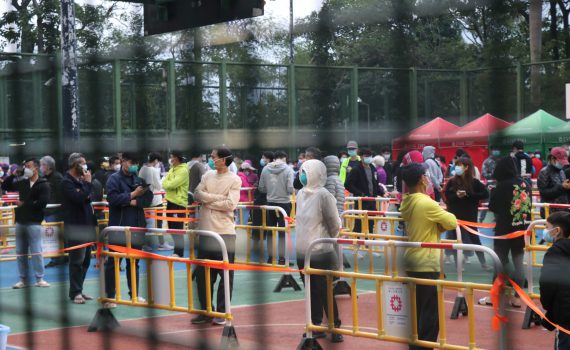
Covid lockdown in Kwai Chung leaves residents in the lurch
- 2022-01-25
- Society
- The Young Reporter
- By: Karmen LiEdited by: Jayde Cheung、Jenny Lam
- 2022-01-25

Students learn together on Instagram as Covid-19 gets worse
- 2022-01-24
- Society
- The Young Reporter
- By: Gigi ChongEdited by: Tiffany Ma
- 2022-01-24
The candidates of 2022 Hong Kong Diploma of Secondary Education maintain their burning ambition to study by posting under #2022dsestudygram, a trending hashtag that has gained over 6,000 posts on Instagram. “Studygram makes me more concentrated on my studies during the class suspension period when I see how hard others study though their Studygram,” said Cindy Lam Pui-yin, a DSE candidate taking Physics and Economics as elective subjects, on top of the four compulsory subjects including Chinese, English, Mathematics and Liberal Studies. “The future depends on what you do today,” is one of the inspiring quotes captured by the student-managed Studygrams, where pupils keep a record of their study progress in Instagram accounts, to encourage peers amid class suspension due to rapid spread of Covid-19. The Education Bureau announced that all schools must hold classes online only on Jan.20, but schools can arrange in-person half-day lessons for form six students to prepare for the final examinations. Examinations and student activities in other levels should halt and postpone, according to the announcement. Although online lessons save travelling time and give students more autonomy in learning, Lam worries that the sudden amendment will affect her performance in the public exam. “We haven’t been taught the full curriculum for some elective subjects yet, and the class suspension is having an impact on my preparation for the public exam,” said Lam. Michelle Lam, also a candidate for the examination, owns a studygram with over 700 followers, said that online teaching always distracts her from focusing on the lessons. “I don’t dare to relax when I see so many people study hard even though the in-person classes are suspended,” Lam said. The 2022 DSE will start on Apr. 22 while the class suspension lasts until Chinese New Year holidays.