
The Young Reporter
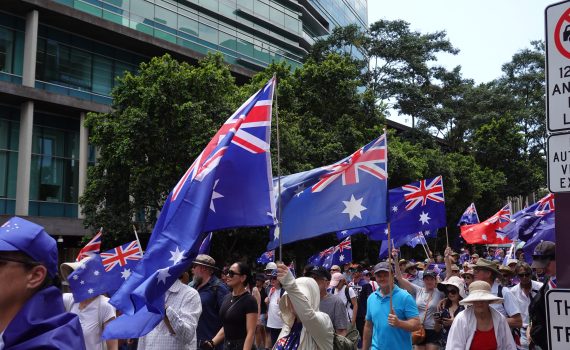
Thousands march in Brisbane against mass immigration
- 2025-10-27
- Society
- The Young Reporter
- By: CHAU Wing YauEdited by: KURNIAWAN Trista Vania
- 2025-10-27
Around 2,000 protesters gathered in Brisbane’s central business district on Oct.19 to call for an end to mass immigration, which they believe is worsening Australia’s housing and cost-of-living crisis. Nearly 300 counterprotesters joined nearby, with banners calling the protest a racist and fascist movement. This is the second round of anti-immigration protests, also known as “March for Australia”, across the country. The first was held on Aug. 31 with thousands protesting in major cities, such as Sydney, Melbourne and Perth. In Brisbane, 6,000 protesters, out of a city of 2.5 million, joined the demonstrations. “Racism may intensify, and I feel concerned about my safety,” said Alice Wong, 28, a Hong Kong student in Melbourne planning to obtain permanent residency, who didn’t go to the protest for physical safety concerns. Wong said the protest promotes the idea of white superiority. “When they protest against immigration, it feels like they think immigrants are taking away their resources, like housing or job opportunities,” she said. Australia’s housing market is surging at its fastest pace in almost four years, with Brisbane becoming Australia’s second-most expensive housing market, according to the House Price Report in 2025. Kev, 72, an Australian who participated in the protest and preferred to keep his last name anonymous, said he has never seen a country in such a bad economic position. “We’ve never had so many people coming to the country so quickly, and the government has been no help,” he said. In September 2023, Australia’s net overseas migration peaked at 558,000 after lifting COVID-19 restrictions, according to the Australian Bureau of Statistics. Australia recorded a net overseas migration of 446,000 people in 2024, down from the previous year but still far from pre-pandemic numbers of 239,000 in 2020. Kev said he isn’t against immigrants, but he wants to see …

Starting salaries of Hong Kong bachelor’s graduates end five-year upward trend
- 2025-10-26
- Society
- The Young Reporter
- By: YANG ShuyiEdited by: WANG Jing
- 2025-10-26
The average starting salary for university graduates of bachelor’s degrees in Hong Kong remained at HK$19,500 this year, marking the end of a five-year upward trend amid the US-China trade war, a survey has found. The “2025 Guangdong–Hong Kong–Macau Greater Bay Area Pay and Benefits Survey” published on Oct. 23, also reported that the production, sales, and customer service sectors face the highest declines in the starting salary. "Due to Hong Kong's poor economic conditions and uncertain future outlook, some employers tend to lower the starting salary for fresh graduates," said Huang Xu, director of the Centre for Human Resources Strategy and Development at Hong Kong Baptist University, who led this survey. Huang said Hong Kong’s current economic situation is significantly impacted by the new round of the US-China trade war that began in April this year, and that is one of the reasons why the average starting salary for university graduates has not increased as expected. "In our long-term tracking of employee salaries offered by 2,000 Hong Kong companies, we observed a significant decline following the outbreak of the trade war in April," said Huang. The average salary increase rate in Hong Kong is 2.5%, and it is below last year's figures of 3.5%. This year’s survey was conducted from July to September, with a total of 258 participating companies that represent over 240,000 employees. Gou Jyun-lung, 20, who studies interactive design at the Chinese University of Hong Kong, said the average starting salary meets his expectations for his first job in the future. "With many universities in Hong Kong expanding enrollment, competition for jobs is becoming more intense,” Gou said. “So, if my future salary can reach HK$19,500, I would be satisfied." Zhang Que, 21, is a final-year social science student who is currently looking for a job, …
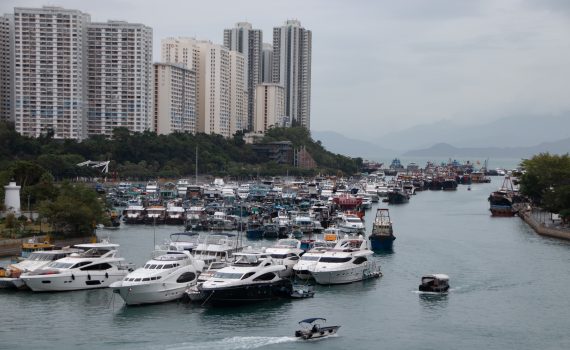
Aberdeen faces challenges amid its deep-rooted fishing culture
- 2025-10-22
- Culture & Leisure
- The Young Reporter
- By: CHEN Ziyu、MA Tsz Chiu OscarEdited by: MA Tsz Chiu Oscar
- 2025-10-22
Every typhoon, the two Aberdeen Typhoon Shelters are filled with fishing vessels seeking refuge from strong winds. On the southwest coast of Hong Kong Island, across from the small island of Ap Lei Chau, Aberdeen Harbour is a natural shelter for boats. When Super Typhoon Ragasa struck Hong Kong and prompted the Observatory to hoist the highest level T10 signal in September, the two shelters were full. “Ragasa left a trail of destruction in Hong Kong, but it didn’t affect Aberdeen much,” said Lee Choi-wah, 68, the former president of the Hong Kong Chamber of Seafood Merchants, who owns a seafood store in Aberdeen Wholesale Fish Market. Because of its geographic location, this naturally protected harbour made Aberdeen the most important fishing village in Hong Kong before the 1970s, with more than 50,000 residents active here, according to the Fishermen Museum. They were known as “boat dwellers” and many of them worked as fishermen. “Aberdeen is an important spot for seafood trading,” said Lee. “At its peak, 80% of seafood products in Hong Kong were traded here.” Boat dwellers in Aberdeen operated grocery stores and restaurants on boats, forming a community on the water. This includes Jumbo Floating Restaurant, the most well-known seafood restaurant on boats in Aberdeen, which operated for 44 years before it was closed during the pandemic and subsequently sank in the South China Sea in 2022. Lee, from a family of boat dwellers, spent his childhood living on a boat. “It was exciting when I could just jump off and swim with other kids after finishing my homework,” said Lee. He added that sometimes he and his friends casually fished together between the moored boats. The 1961 Hong Kong Census recorded the highest number of boat dwellers since the end of World War II. Over 138,000 …

Mental health stigmas stop treatment, scholars say
- 2025-10-17
- Health & Environment
- The Young Reporter
- By: Fu RongEdited by: Robin Ewing
- 2025-10-17
Stigmas over mental health stop people from seeking out help, said scholars at a global conference on mental health in Hong Kong yesterday. Breaking stigmas is important for getting better social support and professional engagement, said Paul Wong Wai-Ching, a professor of social work and social administration at the University of Hong Kong and one of thirteen scholars speaking at the National Counselling and Psychotherapy Conference Hong Kong 2025. “The main issue is that people don’t come to counselling or therapy,” said Kenneth Law, a social worker from the Zubin Foundation, a local charity that works with ethnic minorities. “Either they are afraid or don’t know how to.” Hong Kong fell at 88 out of 147 in Oxford University’s World Happiness Report this year, its lowest-ever position. Around a quarter of Hong Kong children suffer from mental disorders and a quarter of people aged 15 to 24 show suicidal behavior, according to surveys by the Chinese University of Hong Kong and the University of Hong Kong in 2023. “I got inspired on what to do in my field,” said Cathy Wu Jiaxu, a student at Hong Kong Baptist University who attended the conference. “This conference provided me an opportunity to be updated and prepared,” said Caroline Shaw, a wedding planner for more than two decades who changed careers and is studying to be couples counselor. Other talks included female menstrual mentality from Vanessa Wong; athletic performance from Karen Lo Eugene-chuang; narcissistic relationships from Armani Durvasula and teenage digital usage from Nicolson Siu Yat-fan, Evgeny Evseev and Kimberly Carder; suicide bereavement by Paul Wong Wai-Ching. The conference will move to Malaysia and then the Philippines in October and November.

Blazing fire dragon dance ignites Tai Hang to celebrate Mid-Autumn Festival
- 2025-10-08
- Society
- The Young Reporter
- By: SIU Tsz Hang、YAM Long Hei JamieEdited by: AO Wei Ying Vinci
- 2025-10-08
Reported by Jamie Yam Long-hei, Henry Siu Tsz-hang Edited by Vinci Ao Wei-ying Video description: The Tai Hang Fire Dragon Dance, a century-old Mid-Autumn Festival tradition, was held from October 5 to 7. A 67-metre dragon, illuminated by 12,000 burning incense sticks, winded through the community to pray for peace and prosperity.

Hong Kong celebrates 76th Chinese National Day
- 2025-10-01
- Society
- The Young Reporter
- By: AO Wei Ying Vinci、MA Tsz Chiu OscarEdited by: NG Natasha Goa Sheng
- 2025-10-01
Flags and banners are displayed around Hong Kong while celebrating China's 76th National Day on October 1, 2025. Hong Kong’s regional flag and Chinese national flag were raised at the ceremony held in Wan Chai’s Golden Bauhinia Square at 8am today to celebrate the 76th anniversary of the founding of the People's Republic of China. Ceremony attendees including Chief Executive John Lee Ka-chiu and other government officials. The public watched the ceremony at a distance from Wan Chai Ferry Pier, as the government announced no public viewing area for the ceremony. Lee Ka-chun, 16, who is a local student, said he secured a spot with his friends at the Wan Chai Ferry Pier observation deck at around 7am. He said it is a pity that he can only view the ceremony through his telephoto lens on a camera today, citing his past flag-raising viewing at the Tiananmen Square allowed him to be nearer to the ceremony, after passing through security checks. During the national anthem, two helicopters hanging a Chinese national flag flew over Victoria Harbour, while ships under the Police and the Fire Services Department sailed along the harbour. It is the first time Kai Tak Sports Park hosted a flag-raising ceremony, outside the city’s largest stadium at 11am. Free ice cream and beverages were distributed near the venue by the park’s authorities. Leah Zhang, 27, travelled from Jiangmen to Hong Kong for two days during the National Day Golden Week. She said she came across a social media post on RedNote about the flag-raising ceremony at Kai Tak. “I thought more people would be here to see the flag-raising ceremony. There are only limited promotions from the Kai Tak Sports Park, which could be the reason,” said Zhang. A firework display is held at 8pm on the same …

Zijin Gold price jumps nearly 70% on Hong Kong debut amid heated gold market
- 2025-09-30
- Business
- The Young Reporter
- By: ZHONG Xinyun、LIN XiaoyouEdited by: ZHAO Runtong、BO Chuxuan
- 2025-09-30
The international unit of a Chinese mining giant has raised almost HK$25 billion (US$3.22 billion), taking the crown as the second-largest Initial Public Offering in Hong Kong, and achieved a robust first-day performance on Tuesday amid a rising gold market. Priced at its IPO price of HK$71.59, Zijin Gold International(Zijin Gold), a subsidiary of Zijin Mining Group Co., Limited(Zijin Mining), saw a 68.5% jump to close at HK$120.6, after opening at HK$111.50 and reaching an intraday high of HK$123. Trading under code 02259, Zijin Gold sold 349 million shares globally during its IPO, with 90% of the shares allocated to international investors. The city’s investors received a 10% allocation of the total, resulting in a 240.7 times oversubscription, according to the firm’s allocation result announced on Monday. The Hang Seng Index added 0.87% to 26,855.56 as of market close. < img src="https://public.flourish.studio/visualisation/25390467/thumbnail" width="100%" alt="chart visualization" /> “In the Hong Kong capital market, pure-play-play gold mining mining listed companies are relatively scarce,” wrote Tang Yan, a risk director of Sunflower Investment, a Shanghai-based asset manager, in a written reply to the reporter. She added that what makes the company an attractive choice this scarcity for investors makes the company an attractive choice seeking gold exposure for investors seeking gold exposure. With a total of 29 cornerstone investors committing HK$12.47 billion (approximately US$1.6 billion), the company received solid support from prominent asset managers and investment giants, including GIC Private Limited, BlackRock, Schroders, UBS AM Singapore, Fidelity Hong Kong, and Millennium Management. The funds raised by the gold miner are primarily planned for the acquisition of the Raygorodok Gold Mine in Kazakhstan and the upgrade and construction of existing mines, accounting for aboutabout 33.4% and 50.1% respectively. Kenny Wen, Executive Committee Member of the Hong Kong Society of Financial Analysts, said that the …

Typhoon Ragasa: Windthrown trees blocked several roads in Wong Tai Sin
- 2025-09-27
- Society
- The Young Reporter
- By: AO Wei Ying Vinci、LAU Ka YanEdited by: AU YEUNG Jim
- 2025-09-27
Super typhoon Ragasa hit Hong Kong on Wednesday, bringing gale and heavy rainfall to the city. The Observatory issued the highest-level T10 signal to alert the public about the extreme weather conditions. Staff members from the Fire Services Department and the Leisure and Cultural Services Department examined the road blockage by fallen trees in Wong Tai Sin during Wednesday evening after the T8 signal was cancelled. Workers continued clearing remaining debris in Diamond Hill on Thursday morning. The government's 1823 call centre, the Fire Services Department and the Leisure and Cultural Services Department had received 1,224 reports of fallen trees as of 8pm on Wednesday. The Hospital Authority said 101 people were injured during the typhoon period. Individuals concerned received the necessary medical treatment at the Accident and Emergency departments of designated public hospitals.
Super Typhoon Ragasa set the second-longest T10 signal in Hong Kong since 1999
- 2025-09-26
- Society
- The Young Reporter
- By: ALISHIBA MATLOOB、LAU Ka Yan、Ye Enyi、Wing Chi HO、MA Tsz Chiu OscarEdited by: WONG Hong Ni、ZHANG Yiping
- 2025-09-26
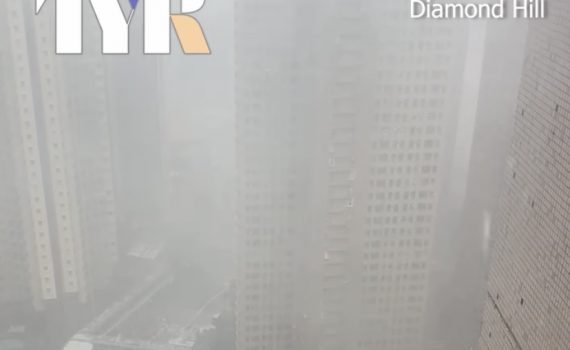
Super typhoon Regasa swept past Hong Kong on Sept. 24, resulting in a T10 storm warning that lasted for 10 hours and 40 minutes, the second-longest in history. 90 injuries were reported by the Hospital Authority, and over 600 flights were cancelled in Hong Kong. As typhoon Ragasa moved west, our reporters filmed the typhoon from different locations around the city. Follow this link to watch the full reel: https://www.instagram.com/reel/DPBA7dpk5kD/?utm_source=ig_web_copy_link&igsh=MzRlODBiNWFlZA==
Typhoon Ragasa: Tuen Mun light rail service disrupted, fallen trees block roads
- 2025-09-26
- Society
- The Young Reporter
- By: SIU Tsz Hang、CHENG Tsz Sen SeanEdited by: AO Wei Ying Vinci
- 2025-09-26
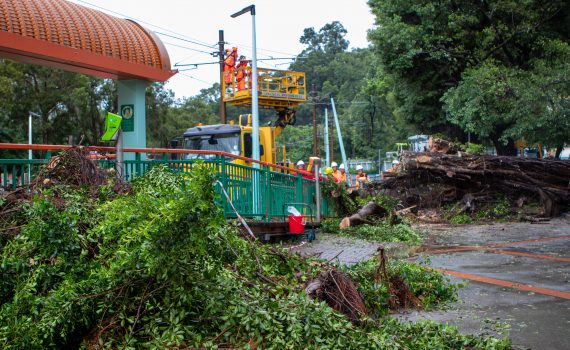
Super typhoon Ragasa slammed Hong Kong with strong winds and torrential rain with the Observatory issuing the highest-level 10 signal at 2:40 am on Wednesday. The typhoon has left 101 people injured during the typhoon period, according to the Hospital Authority as of 8pm. They received medical treatments at the Accident and Emergency departments of public hospitals. According to the government, the 1823 Call Centre, the Fire Services Department and the Leisure and Cultural Services Department received 1,224 reports of fallen trees as of 8pm. The Drainage Services Department received 22 reports of flooding, while the Civil Engineering and Development Department received four reports of landslides as of 8pm. Light Rail stops, including Prime View, Tai Hing (South), and Shek Pai are disrupted due to extensive damage.