
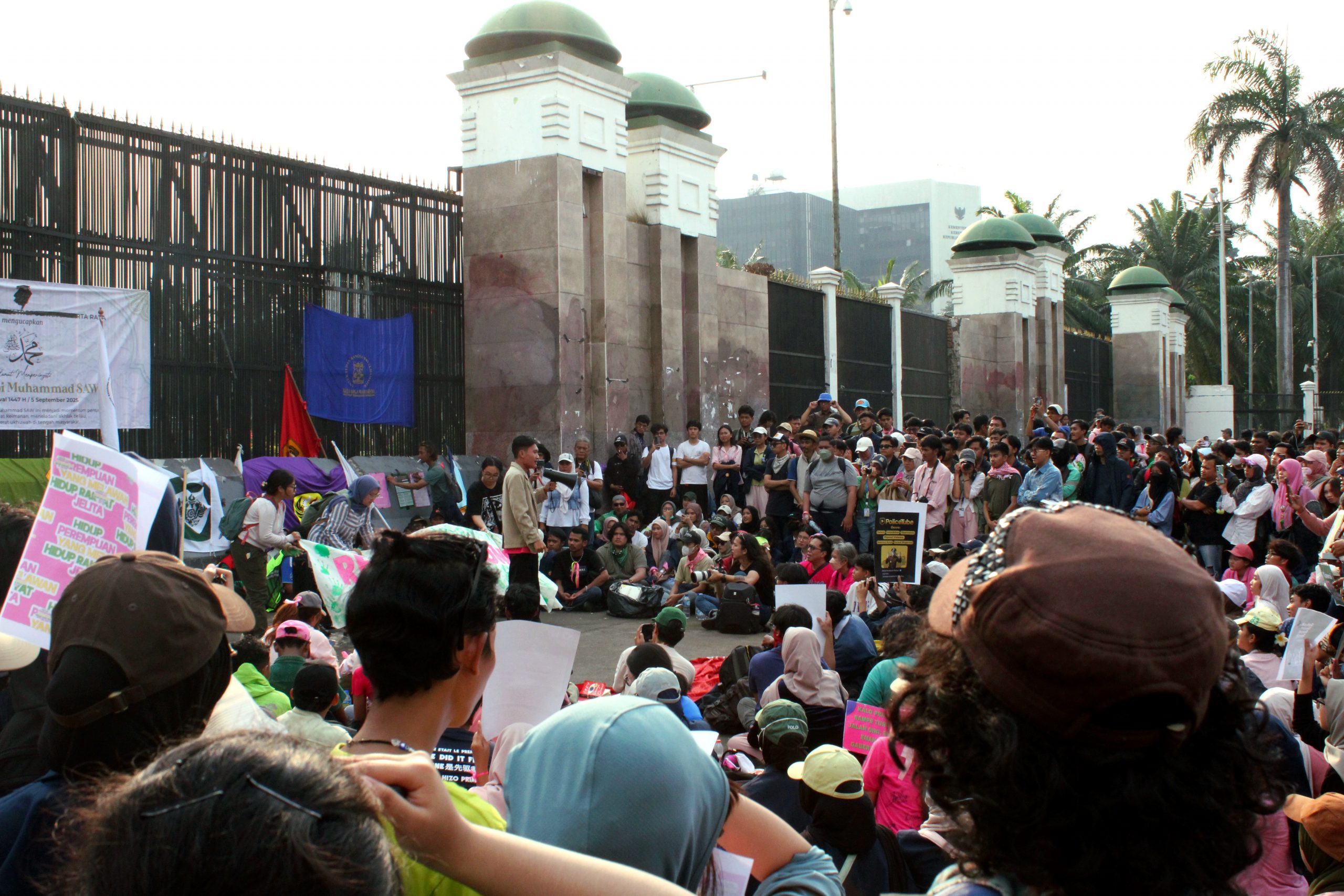
Thousands of protesters swarmed the streets of Jakarta on Aug. 25, outraged by Parliament’s approval of a new monthly housing allowance that is ten times the minimum monthly wage in Indonesia.
Within a week, what began as questions over economic imbalances turned into violent protests in 20 major cities against police brutality, demands for the protection of vulnerable communities, and worries about the future of Indonesia’s democracy.
From Aug. 25 to 31, the Indonesian Legal Aid Foundation reported more than 3,000 people were arrested and 10 were killed.
Despite a government response, people are still unsatisfied and fighting for democracy.
The Underlying Cause
Tito Ambyo, an Indonesian journalist and journalism lecturer at the Royal Melbourne Institute of Technology, said the political and economic frustrations have been growing since people expected reformation after the violent protests in 1998.
In May 1998, a riot broke out due to economic inequality, corruption, and the authoritarian rule of President Suharto. It escalated to the targeting and attacks of Chinese Indonesians and the destruction of public property.
“After the 1998 riots and our president stepped down, we won. But the next leaders were disappointment after disappointment,” he said.
In 2012, former President Susilo Bambang Yudhoyono’s cabinet faced corruption allegations, with his ministers, including the Chairman of the House of Representatives, indicted by the Corruption Eradication Commission.
Ex-President Joko Widodo’s government passed a job creation law aimed at easing work regulations and encouraging investment in 2020. However, it sparked public protests because the bill was seen as weakening workers’ rights and opportunities.
He described the Indonesian elites in the government as “careless” and “callous” with their actions.
Protesters took to the streets on Aug. 25 after the House of Representatives announced the members of parliament would receive a monthly housing allowance of 50 million rupiah (HK$23,676).
Dzaky Putra, editor-in-chief of local news organisation What Is Up Indonesia, who also took part in the protest, said the decision showed how the elites are “out of touch” with civil society.
“They decided that themselves, voted upon it, and at the same time it was also approved by the Ministry of Finance,” he said.
He added that the first wave of protests focused on economic instability and wage stagnation.
As of Feb. 2025, Indonesia’s Central Bureau of Statistics reported the average monthly salary of employees is 3.09 million rupiah (HK$1,551).
“The Indonesian political economy system just doesn’t work for the poor. With high taxes, the poor stay poor, while the rich get richer,” he said.
Current President Prabowo Subianto has announced measures including increased military spending, cuts to regional funding, and higher taxes.
As of Apr. 2025, statistics show around 24 million people in Indonesia live below the poverty line, which means they earn up to 595,242 rupiah per month (HK$278).
The Conversation Changed
Three days after the start of the protests, an armoured police vehicle ran over and killed a rideshare motorbike driver, Affan Kurniawan, 21, during a clash between police and protesters.
“A young man has been killed, and everyone can’t help but be affected by his death,” Dr Jemma Purdey, a researcher on Indonesian politics at the Australian-Indonesian Centre in Melbourne, said.
The demonstrations turned violent and spread to major cities across the country.
“The protest changed from being about the economy into a conversation about the security of the vulnerable people. It became a conversation about the plight of an informal worker,” Purdey added.
Between Aug. 28 and 31, government buildings and police headquarters were set on fire, and thousands of protesters looted legislators’ homes.
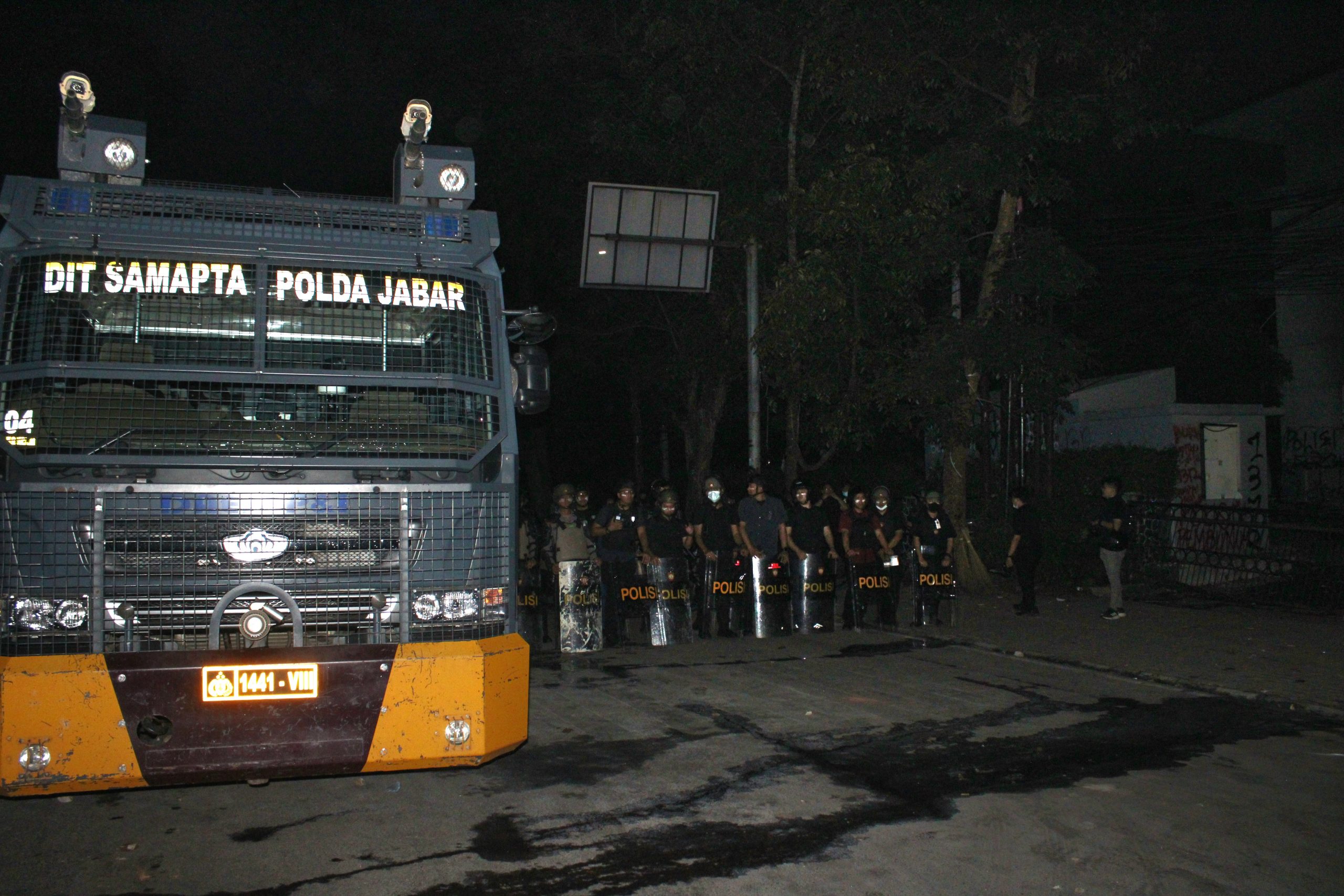
The Indonesian Legal Aid Foundation reported 3,337 people were arrested and 10 were killed during the protests in 20 major cities from Aug. 25 to 31.
Olivia, 20, an Indonesian student studying overseas who prefers not to disclose her last name for privacy reasons, joined a group of 200 Indonesians protesting in Melbourne to support the cause.
“I joined the protest not only because I care for my country, but because Affan was a young man who could have pursued a career and was the backbone of his family,” she said.
On Sept. 1, protesters presented a list of demands to the House of Representatives, including a freeze on salary and allowance increases of members of Parliament, an end to military involvement in civilian security, better wages across all sectors, and greater budget transparency.
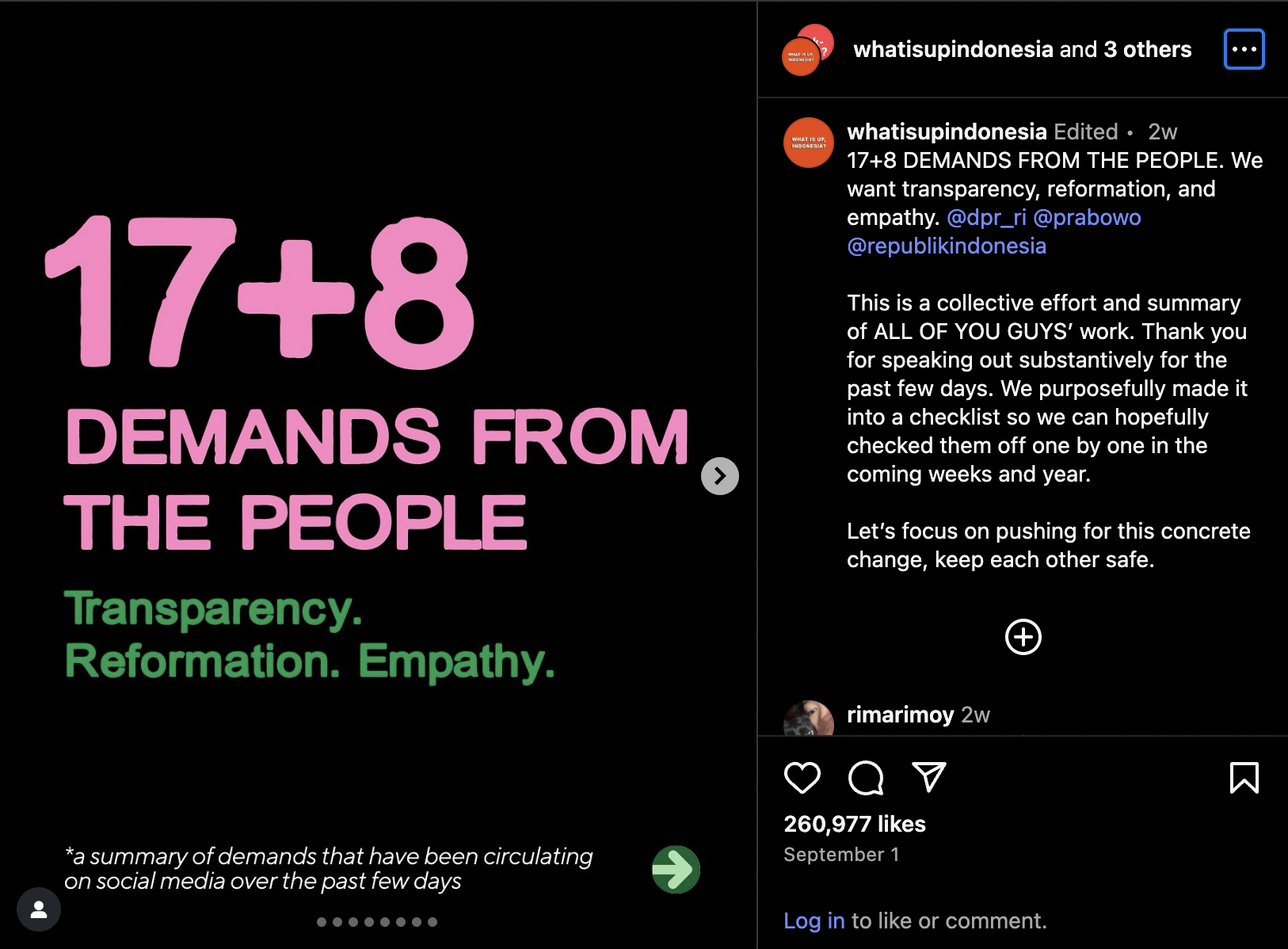
Some demands pushed a deadline of Sept. 5, while other demands, such as proposals to overhaul the parliament and implement fairer tax reforms, were set for Aug. 31 next year.
“I think our biggest demand is reformation. We should continue monitoring the government and ensure the policies are accountable and benefit the people instead of creating greater power imbalances,” she said.
Dissatisfaction with Government Response
On the deadline day, the government announced their response, including terminating housing allowance, facility cuts and increasing transparency in legislative processes.
However, protesters like Putra are still unhappy.
“They still didn’t respond to the economic inequality many people in the workforce are facing. It feels like the protest went nowhere,” he said.
Putra said that the demands of the people are not a priority for the government.
“The government could choose to respond to our demands. Their focus is to maintain their power in the parliament,” he added.
The president had also reshuffled his cabinet and replaced five ministers, including the Finance Minister and the Coordinating Minister for Political and Security affairs.
Vivi Sentosa, 51, a citizen, said the move does not address the people’s needs.
“I hope with the new ministers, the government will listen to the people, and there will be less political unrest and more economic stability,” she said.
Sentosa is a caterer for school canteens; her business closed during the peak of the protests as schools were forced to go online.
“We can’t always have protests as bad as this, and it will keep happening if the government doesn’t respond well. Businesses are paying a cost that would in turn hurt the economy,” she said.
What This Means for Indonesia’s Democracy
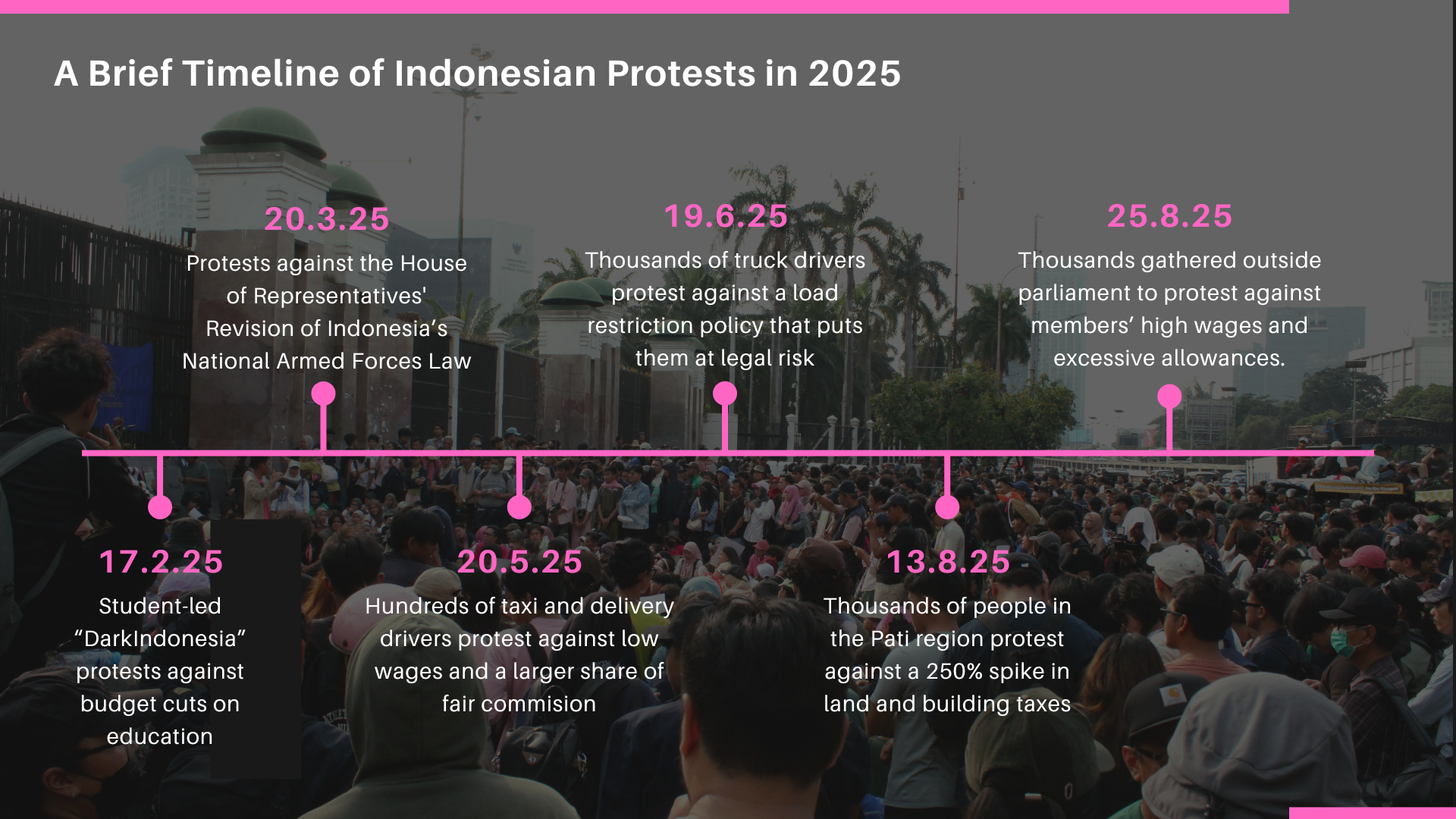
In recent months, Indonesia has seen a wave of protests, including the “Dark Indonesia” demonstration against education budget cuts in February, and a violent protest in the Pati region over a 250% hike in land and building taxes in August.
Professor Jemma Purdey said that Indonesia’s democracy has been backsliding in recent years.
“There are concerns over the militarisation of Indonesian politics,” Purdey said.
Indonesia previously passed bills allowing the military to take on more civilian posts in cities, help in agricultural projects, and begin manufacturing medicine.
She added that the military should not hold excessive power or control over citizens’ lives.
“The government needs to be more consultative. Rules and legislation are being pushed too fast. Indonesia needs security,” she said.
Purdey said she hopes that the younger generation will continue to work together in raising important issues to the House of Representatives and hold them accountable.
Ambyo said this protest gave him hope for Indonesia’s democracy because it had a deeper impact than other protests.
“We’re seeing regional and international solidarity of Indonesians telling the government that we are watching you,” he said.
He added that democracy is fighting back and continuing on social media.
“Our activists are smart, and they are careful not to let the protests become violent like the 1998 protests. Civil society doesn’t want the president to step down, but to fight together with us,” he said.
《The Young Reporter》
The Young Reporter (TYR) started as a newspaper in 1969. Today, it is published across multiple media platforms and updated constantly to bring the latest news and analyses to its readers.
Policy Address 2025: Government provides sufficient focus on the needs of subdivided communities amid continued poverty concerns

Kruger's backstory: the conservationists protecting South Africa’s wildlife



Comments