
Politics

18/19 Policy Address: Career prospects of contract teachers remain uncertain despite additional $4.7 billion in education
- 2018-10-10
- Politics
- The Young Reporter
- By: Jo Ng、Karen Kwok、William TsuiEdited by: Erica Chin、
- 2018-10-10
The government will spend an additional $4.7 billion every year on education, including a new Life-wide Learning Grant, more administrative support for schools and more funding for students with special educational needs, Chief Executive Carrie Lam Cheng Yuet-ngor announced in the annual policy address today. Of this, $1.5 billion a year will go to equalizing permanent teacher salaries in public primary and secondary schools in the new all-graduate teaching force policy. This policy eliminates the older, and lower-paid, certificated master/mistress teaching positions. “The Government’s expenditure on education is the most meaningful investment in our future and we should treat our teachers nicely,” the chief executive said in her policy address. Around 2,200 more permanent teaching posts were created last year, slightly increasing the teacher-to-class ratio in public schools. However, contract teachers say they are being treated unequally. A report by the Hong Kong Professional Teachers’ Union in 2018 shows that teachers hired on contract are paid 30% less than those in permanent teaching positions. “The all-graduate teaching force policy still fails to ensure that contract teachers can get equal pay because schools can bargain with their salary based on that of permanent teachers’, ”said C.K. Cheng, a contract teacher from a local secondary school. Contract teachers also have poor career prospects. Although more than a third of them have seven years experience and 10% have been teaching for ten years, according to the report, few are offered permanent teaching positions. They also face the pressure of having to renew their contracts every year. “The turnover of teachers on the contract term is high. They don’t know when they will be fired,” said Mr. Cheng. Ip Kin-yuen, Legislative Council member and vice president of Hong Kong Professional Teachers’ Union, said increasing the teacher-to-class ratio is one of the solutions to address …

18/19 Policy Address: Government takes lead to extend maternity leave to 14 weeks
- 2018-10-10
- Politics
- The Young Reporter
- By: Vimvam Tong、Maisy Mok、Fifi TsuiEdited by: Dorothy Ma、Sammi Chan
- 2018-10-10
Reported by Vimvam Tong, Maisy Mok, Fifi Tsui Edited by Dorothy Ma and Sammi Chan Working mothers in Hong Kong will be able to enjoy 14 weeks of 80% paid maternity leave, that is an extra four weeks under existing labour laws. The first female chief executive of the city, Carrie Lam Cheng Yuet-ngor announced today in her second policy address that the newly extended leave will take immediate effect for civil servants. The extension is rolled out in view of the “much lower labour participation of women compared to men” and “a lower ratio of managerial roles taken by women” in Hong Kong, said Mrs. Lam. Employers can get up to $36,822 reimbursement per employee from the government to pay the leave. For employees with a monthly income of $50,000 or below, the additional four weeks of maternity leave pay will be borne by the government in full. The proposed extended maternity leave brings Hong Kong on par with the International Labour Organisation’s suggestion after the related employment ordinance had remained unchanged for 48 years in Hong Kong. Compared with other locations in the region, the duration of maternity leave in Hong Kong is in line with Japan, but is still shorter than Singapore by two weeks. In mainland China, new mothers can enjoy 19 to 22 weeks off, depending on the province while fathers can get up to 30 days of paternity leave. Mothers in Hong Kong have mixed reaction to the 14-week leave. “ I believe 10 weeks are enough,” Katy Lam, an educator and a mother of two believes that the duration of leave should depend on the woman’s occupation. “14 weeks would be better than 10 for sure,” said Venda Lee, a 34-year-old expectant mother, who works as a movie trailer producer. She sees …

PolyU students go on hunger strike against paper-covered "democracy wall"
- 2018-10-05
- Society
- The Young Reporter
- By: Ezra Cheung、Katherine LiEdited by: 、Raphael Blet、Michelle Ng
- 2018-10-05
"The university's management has pushed us to the point of desperation," said students starting a hunger strike. Two student leaders from Hong Kong Polytechnic University announced this evening they were to go on a hunger strike, to protest against the school management's decision to take control of the "democracy wall" initially managed by the university's student union. The conflict began on September 24, four days before the fourth anniversary of the mass pro-democracy Umbrella Movement, as some students stuck messages supporting the city's independence onto the notice board, commonly referred as "democracy wall". PolyU management covered half of the board with large sheets of red paper on Tuesday. Students were enraged claiming their freedom of speech was being stifled. Several dozens of students gathered when the student union held a press conference at the university's main podium at 8:30 pm on Friday following their protest on Thursday demanding the vice president an explanation as to why the management decided to cover the wall. The student union's president Wing Lam Wing-hang and the student union council chairman Victor Yuen Pak-leung announced that they were to "start their hunger strike immediately" at the podium. "The university management has pushed us to the point of desperation... They are numb to conscience," the student union said in their open letter. "The school has been dismissive to the student union council representatives." Mr. Lam said the student union had collected more than 4,000 signatures against the school's decision. "We do not compromise on freedom of speech," Mr. Lam added. Kate Liu, 24, an urban planning PolyU student from the mainland, thought the action the university took was "mild". "Students having their own views is good," she said. "But the university should be with the government in fighting against Hong Kong independence." During the press conference, a …

Hundreds mark fourth year since Hong Kong's Umbrella Movement
- 2018-09-28
- Politics
- The Young Reporter
- By: Katherine Li、Edited by: Ezra Cheung
- 2018-09-28
Several hundred people gathered outside the Hong Kong government headquarters this evening marking the four-year anniversary of the start of the mass pro-democracy Umbrella Movement, as worries prevail that freedom of political expression is being increasingly muzzled by Beijing. In 2014, tens of thousands occupied major roadways in Admiralty, Causeway Bay and Mong Kok for 79 days starting from September 28 rallying for "genuine universal suffrage" and democratic reform in the highly autonomous city’s leadership elections. The crowds raised yellow umbrellas, the movement's symbol, and held a three-minute silence at 5:58 pm today as audio recordings during the movement was played back on loudspeakers to commemorate the moment when the Hong Kong police began to blast 87 tear gas canisters at the unarmed protesters four years ago. "Hongkongers keep fighting," the crowds chanted. Former teacher Jenny Woo told Hong Kong people to look ahead, saying the present political climate was different from four years ago. "I joined [the remembrance event] because the youth are our future," said Ms Zeng, 55, a mainland immigrant who moved to the city just before the movement. Having participated in the Mong Kok occupation, Ms Zeng said she had been moved by a documentary she watched a week before about the movement. Supporters also applauded the nine defendants, including Occupy advocates Benny Tai Yiu-ting and Chan Kin-man, for the upcoming trial for the movement in November. "I have no regrets at all," Professor Chan told the crowds. He regarded the movement as "the most glorious moment" of his life. "We could not shake the regime," activist Joshua Wong Chi-fung said on stage. "But at least we could inspire people's hearts." In the past few days, local pro-Beijing media have continuously slammed the Umbrella Movement for crippling the city's rule of law and polarising the society. …
July 1 protest with new starting point draws less crowd
- 2018-07-01
- Society
- The Young Reporter
- By: Katherine Li、Vanessa Yung、Nadia LamEdited by: Michael Shum、、Michelle Ng
- 2018-07-01
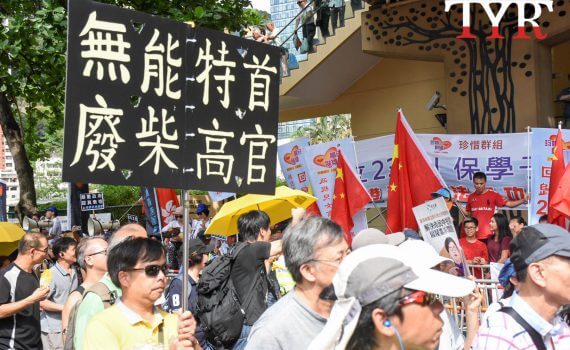
This is the second year the starting point of the July 1 march has been changed to the Central Lawn of the Victoria Park while the number of participants continues to drop. About 50,000 people joined the rally this year as the organiser reported, while the police claimed there are 9,800 people at peak, which was the lowest since 2003. For the second consecutive year, the organiser failed to reserve the soccer pitches as the starting point due to the handover celebration organised by The Hong Kong Celebrations Association. The application to assemble at East Point Road also failed later. Au Nok-hin, the vice-convener of the Civil Human Rights Front, called for citizens not to join the rally at East Point Road. He claimed that the participants could join at the Hysan place or Wan Chai Computer Centre instead. "I am worried that the police will find opportunities to arrests citizens in East Point Road. I know that there are already dozens of police there. The grip placed on protests have definitely tightened," Mr. Au said before the protest started. As TYR reporters observed, the participants could join or leave the rally freely during the march. However, in some places with crowd control barriers in place, people are not allowed to enter. According to the Leisure and Cultural Services Department, The Celebrations Association was given priority since it is a registered charity group under the Inland Revenue Ordinance. Different parties have different complaints towards the government. In regards to democracy, Martin Lee, founder of the Democratic Party in Hong Kong, believes that Carrie Lam is not doing enough. "My greatest complaint about the current government is that this chief executive has done nothing, nothing in this past one year, about democracy," said Mr. Lee. "The Basic Law has been interpreted by the …

Catalonia's brewing independence
- 2018-06-08
- Society
- The Young Reporter
- By: Japson Melanie JaneEdited by:
- 2018-06-08
Spain has a new prime minister this week. Pedro Sanchez defeated his predecessor, Mariano Rajoy in a vote of no confidence. Rajoy is embroiled in a corruption scandal. Although Basque and Catalan nationalist parties voted in favour of Sanchez, it is unclear whether they will support his government. Sanchez, like Rajoy, will likely have to contend with Catalonia’s continuing fight to split from Spain. Walk past any major street in Barcelona and you will notice row upon row of flags fluttering from balconies. In Catalonia, the Senyera estelada, is a symbol of independence. Some of these yellow and red striped ensigns with a lone white star have been there for so long that the stripes have been bleached almost pink and white by the sun. But the newer polemic symbol of Catalonia’s quest to split from Spain are the yellow ribbons. These too are all over Barcelona: spray painted on pavements, tied to railings and lampposts, some of them, giant displays outside residential building stretching several storeys high. Yellow ribbons have become more common since last October when pro-independence parties claimed that most people in Catalonia chose independence from Spain in a referendum. Liz Castro is an American writer and publisher living in Barcelona. In May 2015, she was elected national secretary of the Catalan National Assembly, a grassroot movement for Catalan independence and Ms. Castro is currently chairwoman of the Assembly’s international committee. She has been writing about Catalonia’s fight for independence for years and is also an activist in the Catalan independence movement. Following last year’s referendum, Ms. Castro wrote The Street Will Always Be Ours. Ms. Castro said that Spain is actively suppressing the Catalan economy by not funding the infrastructure that the region needs. "Catalonia represents 16% of the population but Spain only allocates ten or …

29 years since Tiananmen massacre: dozens went for an "alternative" vigil while 115,000 gathered at Victoria Park
- 2018-06-05
- Politics
- The Young Reporter
- By: Katherine Li、Ezra CheungEdited by: 、
- 2018-06-05
While 115,000 people gathered at Victoria Park for the 29th time to memorialise the 1989 Tiananmen Square crackdown in Beijing, some 150 people participated in an "alternative" vigil outside the Cultural Centre in Tsim Sha Tsui yesterday. This June 4th Tiananmen Square candlelight vigil took place at the Hong Kong Cultural Centre in Tsim Sha Tsui in front of the Freedom Fighter statue on Monday evening. It aimed to serve English-language speakers in Hong Kong, said organisers Michael Mo Kwan-tai and Danny Chan Tsz-chun. It was the first June 4th vigil in Hong Kong that was conducted entirely in English. "We want to hold this event at an international standard, to show the people of Hong Kong that we have not forgotten," said Mr. Mo, who was also an Amnesty International Hong Kong campaigner previously. This alternative vigil focused on raising international awareness and supporting "the souls who fought for freedom beyond our borders". The organisers urged the international society to investigate into the June 4th Incident. Mr. Mo read aloud poems written by Liu Xia, widow of dissident Nobel Peace Prize laureate Liu Xiaobo. He also paid tribute to Su Changlan, Chinese women's rights activist who supported the 2014 Umbrella Movement and "the hundreds of human rights lawyers and activists still facing jail terms, surveillance and harassment on a daily basis". Regarding the fact that many still question whether it is helpful or necessary for this alternative vigil to be held, Mr. Mo felt that the operational goals of the Hong Kong Alliance in Support of Patriotic Democratic Movements of China increasingly dissuaded younger people from attending the candlelight vigil at Victoria Park, a conundrum which could be solved with an alternative vigil. "I can actually feel that there are more young faces here," Mr. Mo said. "The turnout number is also …

Will School Social Workers be a Panacea for Child Abuse Problem?
- 2018-03-14
- Politics
- The Young Reporter
- By: Amy Ho、Edited by: Erica Chin、Jade Li、Japson Melanie Jane、Wing Li
- 2018-03-14
With scabs covered all over her limbs and face, bedsores on the soles of her feet and bruises all over her body, a 5-year-old girl died in January from being repeatedly abused by her father and stepmother. Lam Lam’s life was full of sorrow, pain, and tears. But she was just one of many child abuse cases that happened in Hong Kong. According to government statistics, there have been more than 800 cases of child abuse every year in Hong Kong since 2006. The data also shows that more than half of the victims were abused by their parents. According to Dr. Louis Kok, Child and Forensic Psychologist of Hong Kong Institute for Children’s Mental Health, children tend not to report abuses by their parents because they want to protect and stay with them. Since 2000, every secondary school has to have at least one social worker. Law Chi-kwong, Secretary for Labour and Welfare has suggested extending the policy to primary schools and kindergartens. Social workers who work for primary schools nowadays are not only in charge of students’ guidance services, but also their activities, according to Emy Law Yee-ming, member of the Reclaiming Social Work Movement and the social worker of a local primary school. She said that social workers have to spend time on other duties so they do not have enough time for counselling. "They have to deal with after-class care, arrange extra-curricular activities for students, prepare, contact and make other arrangements as well as to recruit students to join activities," said the social worker Law. Ip Kin-yuen, a member of the Legislative Council and the vice-president of Hong Kong Professional Teachers’ Union, hoped that the new policy would help social workers in primary schools to be employed under a new long-term contract system. Mr. Ip said …

Legco By-election: democrats reclaim 2 of 4 places, still losing ground to secure veto power
- 2018-03-12
- Politics
- The Young Reporter
- By: Edited by: Ezra Cheung、Raphael Blet、Michelle Ng
- 2018-03-12
Candidates from the pro-democracy camp eventually managed to retain half of the four disqualified seats in the Legislative Council by-election yesterday, showed in the final voter turnout rate this morning. However, these equal shares do not enable the whole camp to reseize the power to block most bills as it still falls short of the influence significant enough to strike a balance in this semi-democratic legislature's split voting system. Au Nok-hin in Hong Kong Island and Gary Fan Kwok-wai in New Territories East were the two victorious democrats. But the pro-Beijing competitors, Vincent Cheng Wing-shun and Tony Tse Wai-chuen, outran the pro-democracy camp in Kowloon West and the Architectural, Surveying, Planning and Landscape functional constituency respectively. Au, a Southern District Council member who left the Democratic Party last year, obtained 137,181-strong support whilst his pro-Beijing arch-rival, Judy Chan Ka-pui of New People's Party, got 127,634 votes. Gary Fan, current convenor of Neo Democrats, won 183,762 votes to defeat Bill Tang Ka-piu, representing both Democratic Alliance for the Betterment and Progress of Hong Kong and the Federation of Trade Unions, who got 152,904 votes. This time, Fan acquired 7% more votes than his ally, Alvin Yeung Ngok-kiu of Civic Party, in the 2016 by-election. Yeung received 160,880 votes back then. Yet, previously ousted Legislative Councillor, Edward Yiu Chung-yim, failed to recapture the seat in Kowloon West. He requested a re-count at about 5 am because he was just trailing Vincent Cheng by about 2,000 votes. But in the end, he did not manage to combat Cheng's 107,479 votes with his 105,060 votes. Winning the 2016 general election, Yiu was the representative of the Architectural, Surveying, Planning and Landscape functional constituency. But he was disqualified and expelled from the Legco by the High Court for his "improper" oath-taking following Beijing's interpretation of Article …

China aims to lift 10 million people out of poverty
- 2018-03-07
- Politics
- The Young Reporter
- By: Katherine Li、Edited by: Alexandra Lin、Zinnia Lee
- 2018-03-07
Reported by Katherine Li and Wallis Wang Edited by Alexandra Lin and Zinnia Lee China will step up efforts to alleviate poverty using targeted measures and promote the development of local industries, education and healthcare, Premier Li Keqiang revealed in his government report speech. "This year, we will further reduce the poor rural population by over 10 million, including 2.8 million people who are to be relocated from inhospitable areas," Premier Li said. Cheung Siu-wai, a China analyst, explained that there will be more cooperation between local and central government and a case-by-case focus on poverty alleviation. "The government will allocate resources in coordination with local authorities, which means they will find out specific issues and difficulties in different locations in order to find a solution," Mr. Cheung said. Zuo Hongding, deputy director of Jinsha County Agriculture and Animal Husbandry Bureau that works on poverty alleviation in Guizhou province, said different areas need different approaches to alleviate poverty. "For mountainous areas that cannot be easily reached, we have no choice but to relocate the people. A family of five who we helped in 2015 was relocated to a 100 square meter house and was provided with livestock and fertilisers. And now they are well above the poverty line," Mr. Zuo said. The bureau where he works has helped more than 1,000 families in the town of Qinchi in Guizhou province. They plan to lift another 10,000 people out of poverty in the county over the next three years. Premier Li also announced that the government will "take targeted measures against corruption and misconduct in poverty alleviation and improve the methods used in evaluation and oversight" to manage the poverty alleviation funds more effectively. Mr. Cheung supported the new approaches on fund and resource allocation in targeted poverty relief. "In …