
News

Creativity inside the red lines: Hong Kong artists adapt to National Security Law
- 2022-11-21
- Politics
- The Young Reporter
- By: Tsz Yin HO、Le Ha NGUYENEdited by: Malick Gai
- 2022-11-21
Ng Kap-chuen, a cartoonist who goes by his artist name Ah To, left his native Hong Kong for the United Kingdom in April this year for fear of being jailed for his art. Ng, 39, is known for being critical of Beijing and the Hong Kong government. He has produced a number of artworks since 2014 expressing discontent over controversial issues, such as the National Security Law, social unrest, and COVID-19 measures. Some artists, including illustrators and cartoonists such as Ng, whose works tend to challenge and criticise the government in a satirical and controversial manner said they fear being accused of violating the NSL, implemented in 2020 after anti-government protests broke out across the city in 2019. The NSL aims to prevent, stop and punish subversion, secession, collusion with foreign forces and terrorist acts, with critics warning it could silence dissent and erode freedom in the city. “The immense pressure, terror, and uncertainty of not knowing when I would be arrested really tortured me mentally and made it hard for me to be in a good mood for creation,” said Ng, a pro-democracy artist who still draws cartoons about Hong Kong’s social issues and politics from the UK. “I don’t feel comfortable if I can only make artwork that doesn’t express all my feelings. Self-censorship is not my way,” said Ng. “I am working on some sensitive topics that other artists in Hong Kong avoid talking about. They draw about local policies while I focus on sensitive political issues.” While no artists in Hong Kong have been arrested under the NSL, in September, five speech therapists were sentenced to 19 months in prison for conspiring to write and distribute books with seditious intent. The case involves a series of illustrated cartoon books about wolves and sheep, symbolising Chinese authority …

Foodpanda riders strike over wage cuts
- 2022-11-21
- Society
- The Young Reporter
- By: Zimo ZHONG、Chengqi MOEdited by: Karmen Li
- 2022-11-21
Saam Bilal, a Pakistani Foodpanda rider, woke up at 6:30 am. He finished a quick breakfast before starting his 12 to 14-hour shift delivering food orders. It took Bilal two hours to get to work from his home in Tuen Mun to Central. “I used to earn around HK$50 per order, which is double compared to the wage now,” he said, showing his order record. “Now I only get HK$20 to HK$30 for each order.” Bilal joined a strike by a group of Foodpanda delivery workers on Nov. 3 and Nov. 4. Most of the strikers are Pakistani. On 29 September, the food delivery platform introduced a new system to calculate the riders’ earnings. Instead of using the linear delivery distance, Foodpanda switched to using Google Maps. Although Foodpanda claimed that the minimum order service fees had remained unchanged, couriers complained that the new system led to the salaries cuts again. Another local Foodpanda rider, Tim Law, 39, has worked for Foodpanda for about three years. He said that he earned at least HK$200 less every day since the implementation of the new mapping system. “(In order to get the same salary,) I have to work longer hours and sometimes I can’t even finish my work until 2 am,” Law said. The wage cut has sparked several strikes in October and November. Another rider who gave his name as M Lee joined Foodpanda in 2020. He was resentful about the company's batch system, an order distribution system which ranks delivery workers into batches based on certain criteria. The batch number determines the shift booking and service fees category they’ve been placed into. “Foodpanda uses this way to control us. If you follow the rules, you’ll become Batch 1, and the system will send you better orders, which means higher service …

Hong Kong eases curbs on vaccine pass checks except cinemas and ice rinks
- 2022-11-17
- Society
- The Young Reporter
- By: Kin Hou POON、Ka Ki FUNGEdited by: Kelly Pang
- 2022-11-17
A number of premises like public wet markets, religious venues and game centres will no longer have active vaccine checks for visitors starting from today, but scanning the LeaveHomeSafe QR code is still required. Active inspections of vaccine passes will be scrapped for premises, as the government announced last Thursday. No actively check is patron’s vaccination records or exemption certificates upon their entry. That means amber code holders are permitted to visit those venues. People under the category of amber code means they are inbound visitors from overseas places or Taiwan, who are not allowed to enter premises subject to "active checking" of the vaccine pass. Wong Muk-ching, dean of Lai Yiu Alliance Church welcomes the policy, he said using vaccine pass to decide whether the congregation can go back to the church was unacceptable. “Amber code holders can go back to the church after the policy implemented, which they are not allowed to do so before,” Wong said. “There are people who have obtained amber codes due to not having the valid vaccine pass which has restricted them from going back to church during the COVID-19 outbreak. Those having an amber code can return the church in a legal way,” he added. Wong said the government has enacted effective policy in coping with COVID-19, ensuring those who are infected will not be able to enter the church. “This policy now even makes those with amber codes entering the church more conveniently,” he said. “Ice rinks which require facemasks and cinemas that prohibit food or drink could drop “active checking”,” Libby Lee Ha-yun, Under Secretary for Health announced today in the press conference. But one day before the launch of the updated policies, the government announced that social distancing measures for these two venues remain the same as before, meaning …

Hong Kong Pride Parade Rainbow Market
- 2022-11-14
- Society
- The Young Reporter
- By: Yu Yin WONG、Tsz Ying CHEUNGEdited by: Phoebe Law、Jenny Lam
- 2022-11-14
Hong Kong Pride Parade Rainbow Market brings together the city’s LGBT+ community this weekend. The theme of this year is asexuality.
M+ museum marks 1st anniversary with debut of Yayoi Kusama exhibition, starts charging for admission
- 2022-11-13
- Culture & Leisure
- The Young Reporter
- By: Le Ha NGUYENEdited by: Malick Gai
- 2022-11-13
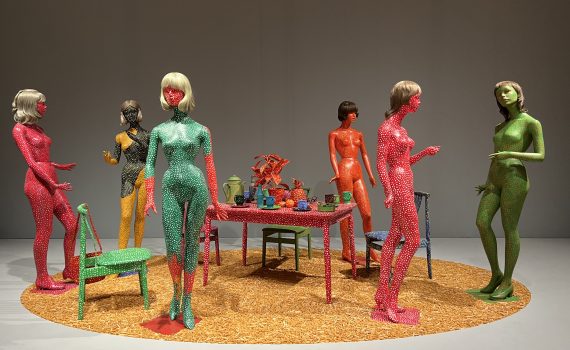
One year after opening, Hong Kong’s visual culture museum, M+, started charging admission this Saturday as it launched its first Special Exhibition, “Yayoi Kusama: 1945 to Now.” The museum charges HK$120 a ticket for general admission. However, visitors wishing to see the well-known contemporary Japanese artist’s exhibition and the largest retrospective in Asia outside Japan, have to pay an extra HK$120. “This is the first time in Greater China the full trajectory of Kusama’s art is presented in a comprehensive retrospective exhibition. It provides a holistic and unique perspective on the accomplishments of this visionary artist,” said Doryun Chong, deputy director and chief curator of M+ museum in a statement. The retrospective features more than 200 artworks, including paintings, sculptures, and installations, from the earliest drawings to the most recent ones of Kusama’s career spanning over seven decades. The 93-year-old “Queen of polka dots” specifically made three brand new works for her first showcase in Hong Kong: large-scale installation Death of Nerve (2022), immersive art environment Dots Obsession—Aspiring to Heaven's Love (2022), and two sculptures titled Pumpkin (2022). “I think it's very impressive to see an extensive collection which is nicely curated to show Kusama’s different stages of work,” said exhibition attendee Emily Liu, 35. However, Liu is among the visitors who disagree with the museum’s new ticketing policy. “Hong Kong is trying to promote its art and culture to the world and become a cultural center of Asia, but charging people relatively pricey tickets to enter a city’s landmark is contradictory to the concept,” said Liu. Concession tickets, for HK$150, are available for full-time students, children between the ages of seven and 11, senior citizens aged 60 or above, persons with disabilities and a companion, and Comprehensive Social Security Assistance recipients. Free admission is granted for children below the …

Remembrance Day ceremony in Central honors fallen war heroes
- 2022-11-13
- Politics
- The Young Reporter
- By: Tsz Yin HOEdited by: Malick Gai
- 2022-11-13
Hundreds of people gathered at the Remembrance Day ceremony at the Cenotaph in Central on Sunday, with government officials, representatives of the Commonwealth countries and embassies, veterans, and their families in attendance. It was November 11 of 1918 when the German Empire surrendered to the Allies, therefore ending World War Ⅰ. Remembrance Day is observed on this day each year to commemorate those who died in both World Wars. The estimated casualties of military and civilians in World War Ⅰ and Ⅱ are at least 16.5 million and 60 million, respectively. This year, a complete format of the ceremony was restored, after having been changed to a simplified rundown because of the pandemic, with the presence of the Police Marching Band. The band played the traditional British piece “Colonel Bogey March,” at the start of the ceremony. A two-minute silence was observed at 11 am. Government officials and representatives then laid their poppy wreaths beneath the Cenotaph. Ex-serviceman put down donated wreaths on behalf of members of the public. The wreaths will remain in place for three days. Representatives of different religions, including the Catholic church, Taoist and Muslim community led the prayers along with veteran representatives. "This is an annual occasion for me and it is remembering those that went to war and did not come back to their homes," said John T. Siewert, a 98 year-old veteran, who served on the USS Satterlee Destroyer in 1944. Siewart is believed to be the only one at the ceremony who participated in the war. He steered the Destroyer during the landing of Normandy to break the German defenses. Siewert said that he is fortunate to be able to attend the ceremony, as some of his comrades were sacrificed, and he was able to retire safely from the battlefield. “I have …

Hong Kong International medical fair uncovers new tech and connections
- 2022-11-11
- Health & Environment
- The Young Reporter
- By: Rex Cheuk、Mei Ching LEEEdited by: Kylie Wong
- 2022-11-11
The final day of the 13th Hong Kong International Medical and Healthcare Fair’s physical exhibition was held today, with many new products and technological developments unveiled. The fair, organised by the Hong Kong Trade Development Council (HKTDC), opened on Nov 9. It was held in conjunction with the second Asia Summit on Global Health (ASGH). More than 300 exhibitors present their latest products and developments at the exhibition. Over 110 startup companies participated in introducing their up-to-date investments to transfer their business to a global scale with potential investors. “3D Organon,” a medical anatomy VR platform invented by Umedco (Far East) Ltd, was exhibited in the hospital equipment zone. The VR headset is designed for educational purposes, improving medical students’ understanding of anatomy interactively. It is used by the Chinese University of Hong Kong, while other tertiary institutions have approached the company for further application in education, said Henry Yik, business manager of Umedco Ltd. “The atmosphere and visitor flow of the exhibition is better this year as there is a particular exhibition for medical technology, unlike last year, the healthcare tech fair was combined with other exhibitions,” said Yik. More than 300 exhibitors from Canada, Korea, mainland China, Taiwan, and so forth attended the fair. AIRS Medical, a Korean-based medical AI startup, is one of the overseas exhibitors at the fair. Its products include an AI diagnosis technology reducing MRI scan time by about 50%. Aditi Joshi, business development manager of AIRS Medical, said they have successfully connected with their target buyers at the exhibition, such as local MRI scanners distributors and medical imaging clinics. “We also identified potential business opportunities from foreign buyers from the US, China, and the Philippines throughout the exhibition,” said Joshi. Another spotlight among startup exhibitors is a transdermal drug and cell delivery technology …

Hong Kong immigration wave: the elderly left behind need more assistance
- 2022-11-11
- Society
- The Young Reporter
- By: Tsz In Warren LEUNG、Rajnandini PANDEYEdited by: Leona Liu
- 2022-11-11
Chow Suk-chen, 90, whose daughter has moved to Canada for more than a decade, used to be caught between the frustration of her daughter’s departure and the desire to be a sympathetic mother. “You can’t make them stay with you just because you’re scared to be lonely. The kids will eventually leave you behind when it’s time to go,” she said. An old Chinese saying is that while his parents are alive, the son may not go abroad for a distance. For thousands of years, this phrase, which emphasizes the responsibility of children to accompany their parents, has been enshrined as a guideline for the Chinese regarding old-age issues. However, as the number of residents leaving Hong Kong continues to rise for three years, more and more elderly people are being left behind in this city and need help from charities to face their old age. The Census and Statistics Department (CSD) found in mid-August that 113,200 Hong Kong residents had left the city during the past 12 months, representing the highest since records began in 1997. The number of Hong Kong residents aged between 24 and 59 has declined over the past year, with the largest drop in the population aged 20 to 24, at 36,000. People who have left the city are predominantly younger, according to the data from CSD. Only 13.2% of the respondents have immigrated with their parents, whose average age reaches 70 years old, while most of the immigrants choose to leave their elderly parents behind in Hong Kong, according to an online survey from UKHK, a project run by a British non-governmental organization called Welcome Churches to help people migrating to the UK from Hong Kong. For elderly residents whose families are overseas, the need for assistance to overcome the emotional problems caused by …

Historical hand-made mahjong shop survives as government halts its eviction
- 2022-11-09
- Culture & Leisure
- The Young Reporter
- By: Wisha LIMBU、Tsz Ying CHEUNG、Subin JOEdited by: YANG Zhenfei
- 2022-11-09
Biu Kee Mahjong, an over 50-year-old store in Jordan, was supposed to vacate the stairway it occupies by the end of October, yet the government gave the store an extension as the landlord contacted them promising to modify the shop. “Of course, it’s not good, I may leave at any minute,” Cheung Shun-king, the third-generation owner of Biu Kee Mah-Jong, said to The Young Reporter. This stairwell store was ordered to close on Oct. 31 as the Buildings Department treated it as unauthorised building work and due to fire safety issues. As a technique listed in intangible cultural heritage inventory of Hong Kong, there are only three hand-carved mahjong stores left in the city, said Eric Wan, a mahjong instructor. The store representative said they received the eviction notice “suddenly”, and that they hoped the government could preserve the original site with conditions in their Facebook post on Oct. 5. Yet, the government released a removal order to the landlord of the building in May last year, requiring him to remove the unauthorised building works, UBWs, of the mahjong store by late July of the same year, said BD in the email answering the enquiries from The Young Reporter. The department received the tenant’s message in August this year, which said that he will submit alternative proposals to the government. “As no further information was received, the department wrote to the owner concerned again in mid-September, urging him to remove the UBWs as soon as possible,” said the department’s email. A work contractor appointed by the building owner has contacted the Buildings Department for further modification plans so far. “(Cheung) would not give up the work of hand-carved mahjong until one day he cannot make it anymore,” said the store’s Facebook post on Oct 5, “and he is not retiring …

Local music performers facing difficulties in pursuing their dreams
- 2022-11-09
- Society
- The Young Reporter
- By: Noah Tsang、Ka Ki FUNGEdited by: Gigi Chong、Lokman Yuen
- 2022-11-09
At night after the ferry had stopped honking, Yasen Wong Yan-shun went busking with his bandmates outside the Star Ferry Pier, flooding the spot with music. But only three passers-by slowed down their steps and gathered around to listen to their performance. “We used to have around 20 audiences listening to our busking. During the pandemic, only three audiences were willing to stay and listen to us,” Wong said. Wong saw Hong Kong was no longer with a favourable atmosphere for where the musicians could thrive, prompting him to explore the idea of immigrating to Taiwan. More than one-third of the local musicians have left or intended to leave Hong Kong due to COVID restrictions while 55% have suffered from anxiety or depression during the pandemic, according to a survey conducted by Musicians Foundation. The city’s social-distancing curbs, Prevention and Control of Diseases Regulation have outlawed all gatherings in four since the beginning of 2020 until Sept.13, 2022, fewer audiences gathered at the pier to enjoy Wong’s gigs which have demotivated him. Being a street artist, Wong has fallen into the financial struggle. “Although I’ve never expected I will earn a living as a musician, we have never made money from busking, not even once,” Wong said. Wong has worked at a part-time job in parallel to his higher diploma studies to cover the costs of purchasing music equipment as well as the spending in maintenance of instruments. “I love Hong Kong with no doubt, I have made a lot of memories here. Unfortunately, Hong Kong is no longer a place where I can spread my music. As a musician, I should go outside and look for a brighter future,” Wong said. Edmond Tsang Yik-man, a lecturer from Hong Kong Baptist University’s Department of music, said that the lack of …