
TOP STORIES
Maria Ressa says global 'funnel' destroying democracy
- 2026-04-21
- By: WANG Ludan、YANG HaicenEdited by: WANG Ludan、YANG Haicen
- 2026-04-21
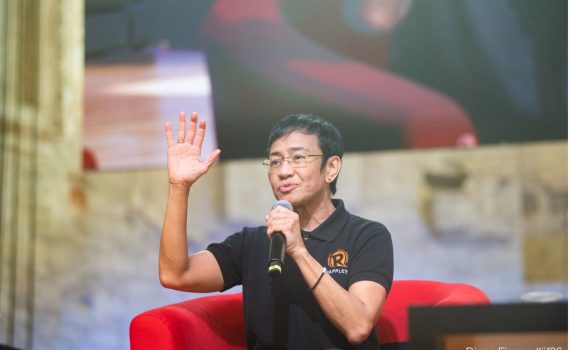
Democratic decline is unfolding through a “funnel” driven by online narratives, weakened institutions and rising corruption, Nobel Peace Prize laureate Maria Ressa warned at the Perugia International Journalism Festival on Thursday. Ressa said the pressures facing journalists are intensifying as democratic systems weaken, describing her own experience as one of “PTSD and déjà vu” as she watches developments in the United States. Several attendees said the discussion helped them make sense of an increasingly chaotic media environment. “The ability for these reporters to contextualize the time period that we’re in right now is really inspiring,” said attendee Caroline Chaffiotte, a master’s student from the Erasmus Mundus journalism programme and who said also worked for local media in the US. Ressa herself pointed to those pressures. Co-founder of Philippines independent news outlet Rappler, she rose to prominence for her coverage of former Philippines president Rodrigo Duterte’s anti-drug campaign. She has faced “21 different cases or investigations” that she has described as politically motivated, all but one of which have been dismissed. “Nothing can bring her (Ressa) down. She makes us feel more supported,” said Gabriele Blaschko, a German reporter who is also a master’s student in the Erasmus Mundus journalism programme. “To see them kind of clarify and provide at least the beginnings of a path towards protecting democracy and maintaining the structures that we have in the institution was really inspiring,” said Chaffiotte. Ressa described a “funnel” model of democratic decline. “The top of the funnel is narrative warfare,” she said, referring to how political actions are transformed into “content triggers” and amplified across platforms such as X, Facebook, TikTok and YouTube. She said these systems are shaped by incentives that prioritise emotional engagement. “The distribution system literally prioritize the spread of lives laced with fear, anger and hate,” she …
Anti‑abortion march, pro‑choice protests clash in central Munich
- 2026-04-20
- The Young Reporter
- By: Yu Yan PuiEdited by: LAU Ka Yan
- 2026-04-20
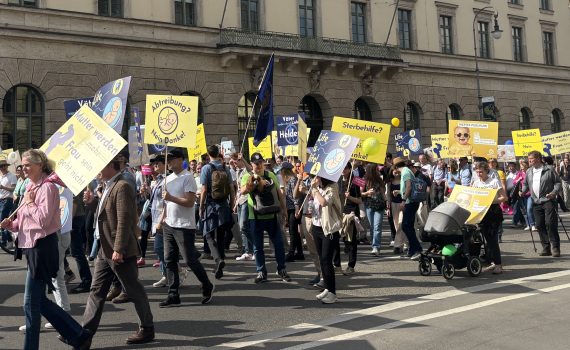
Munich, Germany April 18 – Around 2,500 protesters gathered on Saturday for an anti-abortion rally, March for Life, at King’s Square, with counter-protests supporting pro-choice unfolding along the route. Under Sections 218 and 218a of the German Criminal Code, abortion is technically a criminal offence punishable by fines or up to three years in prison. It is permitted within the first 12 weeks under certain conditions, including state approval from a counselling centre. Organised by a Munich group Voice of the Silent, the rally promoted messages like “protect life” and “every person is wonderful.” Event speaker Mathias von Gersdorff said broader abortion access overlooks what he described as “the killing of children” and fosters a “culture of death.” “Don’t give up on protecting the privileges of the unborn, and reject attempts to legalise abortion,” US Catholic bishop Robert Barron said in a video message. “Keep on praying for the blessing from God when living in a secular environment,” he said. “It is my responsibility to speak up for unborn babies in the womb who have no voice of their own to say they don’t want to die,” Fritz, 38, a participant whose brother has Down syndrome. “My brother is a full and valued human being who is living a happy life even though he is sick. But if abortion is promoted, many babies with the same condition may not be born in the future as people would be influenced by eugenics,” she said. Fritz called for more financial support for pregnant women, restrictions on organisations funding abortions and options for doctors to opt out. “If public attitudes toward permitting abortion shift, that could directly influence individual decisions, given that the current legal restrictions are disregarded in practice,” Fritz added. Christina Karmann, 21, a promoter from the partnering organisation Sunday for …
Residents return to fire-hit Wang Fuk Court since deadly blaze
- 2026-04-20
- The Young Reporter
- By: Chun Lim LEUNGEdited by: SIU Tsz Hang
- 2026-04-20
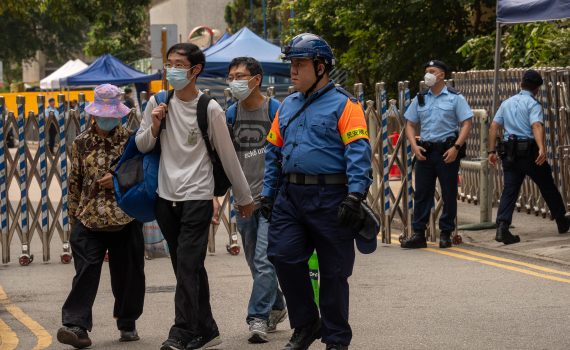
Wang Fuk Court residents returned to their fire-ravaged homes for the first time on Monday, months after the deadly blaze broke out in November 2025. About 270 residents from 78 flats in Wang Sun House were among the first group allowed back, with visits arranged in morning and afternoon sessions on the first day. Deputy Chief Secretary Warner Cheuk Wing-hing said residents could make multiple trips within the three-hour window, excluding time spent on stairways. Cheuk added that up to four household members could enter at a time. Authorities and counsellors were deployed on site to provide support for the residents. Residents were required to wear helmets, masks, and gloves for safety when entering their flats. A man surnamed Chan, said he was glad to be back home. “I had only seen the photo before, and my flat looked completely charred,” he said. “I want to check if any valuables, such as gold, are still there,” Chan added. Meanwhile, 58-year-old Kwan, who lived in Wang Tao House came to the site to observe the arrangements. Kwan said he may leave behind some cameras, but hopes to retrieve photos of his parents. “I lived on the 31st floor, the top floor. I started practising climbing a week ago and now need to rest every nine floors,” he added. A woman surnamed Cheng, who grew up living in Wang Sun House, said the three-hour window was enough for her to say goodbye. “You won’t feel disappointed if you have no expectations,” she said. After returning home, she described her flat as one-third covered in ashes. “I’ve already taken out important documents and my valuables,” Cheng said. The Young Reporter observed taxis were allowed into the restricted area, with many residents carrying suitcases and bags to collect belongings. The current round of returns …

50th HK Sevens opens with some 30,000 spectators
- 2026-04-18
- Culture & Leisure
- The Young Reporter
- By: LIU Rui Reena、LEUNG Chi NgaiEdited by: CHAN Hiu Ying
- 2026-04-18
The annual mega event Hong Kong Sevens returns to Kai Tak Stadium on April 17, marking its 50th anniversary and drawing some 30,000 spectators on its opening day. The three‑day tournament features 30 teams competing in 72 matches, with more than 100,000 spectators expected to attend. The opening ceremony featured a dragon dance and a performance by robots, cheerleaders, and singers from South Korea and the Philippines. Laser projections across the pitch showcased all past participating nations and regions, as well as the names of rugby sevens legends, as part of the 50th anniversary celebration. On the first day, the Hong Kong team faced Denmark and China. The men’s team secured a 36–14 win over China, while the women’s side staged a comeback to draw 14–14 with Denmark. Local based rugby fans Heidi Gysler and her husband Andre Gysler have attended matches in several countries and returned to Kai Tak Stadium for the second consecutive year. Gysler described this year’s event as noticeably better organised than last year, with more staff on hand to help spectators. She added that people had seemed quite lost during last year’s tournament, but the experience felt much smoother this time. “It's a really good atmosphere. The emotion that flows is unbelievable. Everyone is calling, chanting for Hong Kong,” she said.
InnoEX 2026: Hong Kong ramps up AI spending, but industry warns adoption still lags
- 2026-04-16
- Business
- By: TANG Siqi、Zhou XinyingEdited by: ZHONG Xinyun、ZHOU Yun
- 2026-04-16
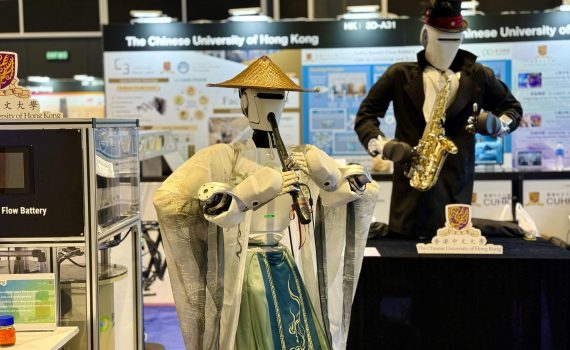
The Hong Kong government is ramping up its artificial intelligence (AI) development through massive new computing capacity and funding, but industry players raised concerns that AI adoption levels in the city remain too low. Lillian Cheong Man-lei, Under Secretary for Innovation, Technology and Industry of the Hong Kong SAR Government, said at a thematic seminar during InnoEX 2026 on Tuesday that AI is a key driving force for industrial transformation. Hong Kong has been taking a multi-pronged approach to building its AI ecosystem, she said, covering research and development (R&D), computing power, data infrastructure, talent and funding. She mentioned that to accelerate the R&D and commercialization of AI workflows and drive industry empowerment in AI, Hong Kong is moving forward with the establishment of a dedicated AI research and development center. On the data infrastructure front, the city plans to build a data center cluster in Sha Ling, which is expected to boost total computing power from the current 5,000 petaflops to 180,000 petaflops by 2032, a 36‑fold increase. Furthermore, an array of key funding programs has been launched to bolster the AI ecosystem, including the HK$3 billion AI Subsidy Scheme, which assists local institutions, R&D centers and enterprises in advancing AI research and applications. Henry Mak, the Assistant Marketing Manager of Ricoh Hong Kong Limited, a provider of workplace technology, said the HK$3 billion government subsidy is a source of sales opportunities for technology providers like his company. He explained that amid economic uncertainty, clients such as businesses and schools rely on government funding to adopt technology solutions. Anthony Ribout, a French startup Founder and CEO of ARSK in Hong Kong, also highlighted the value of government support, noting that Hong Kong’s AI support policies are more efficient than those in France, with clearer funding schemes and stronger financial …

“Too big and too difficult”: fire officers defend response as Tai Po Fire hearing continues
- 2026-04-14
- The Young Reporter
- By: Dake LiuEdited by: LAI Uen Ling
- 2026-04-14
Senior firefighters testified Monday at the Tai Po Fire public hearing, describing how the rapid spread of the blaze and the absence of working building alarms created major challenges in coordinating rescues during the inferno that killed 168 people. Senior Station Officer Hui Kin-on, the first commander on the scene from Tai Po Fire Station’s B Team, told the committee he arrived at 2:56 p.m., just five minutes after the initial call reported scaffolding fire and explosions at Wang Cheong House. He said the flames spread “extremely fast", shooting straight to the roof with loud explosions and collapsing bamboo scaffolding. “When we arrived at the scene, we did not see any property management staff, nor did we hear the fire alarm bells ringing,” Hui said. The public's reliability of on-site firefighting information systems has also been concerned. Hui said it is a common practice to install the mobile data terminal on every fire engine, which displays real-time incident details, including specific building information. “During this fire, however, I cannot recall whether the terminal indicated exactly which fire safety installations had failed,” Hui said. “In every other incident I have attended, the terminal would always specify the faulty equipment.” Hui said when he arrived on spot, he saw all exits were blocked by falling debris and bamboos, which prevented firefighters from entering to activate the internal alarm system. “The entire building was surrounded by thick smoke and fire,” he recalled. The team attempted to activate the fire alarm bells in nearby buildings but none of them were functioning properly, Hui added. Hui also said firefighters had to rely on police assistance for evacuation and on radio communications with the control centre, while the committee counsel noted that there was no specific guidance for the estate’s pre-arranged fire plan for situations where the alarm failed to activate. As fire alarm upgraded to fourth level in an hour, the Fire Services Department was in effort to arrange more manpower. Wong King-man, Deputy Director of Fire Services in New Territories North, said the command centre received over 300 help …
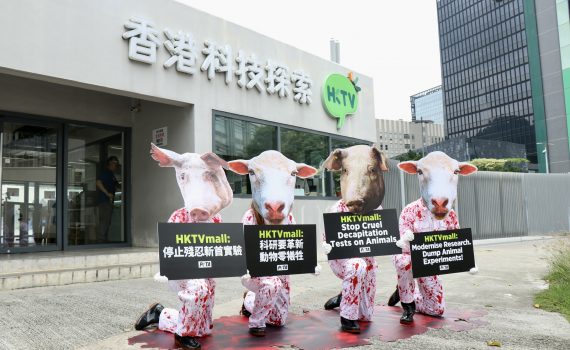
Animal rights activists protest HKTVmall’s parent firm over animal experimentation projects
- 2026-04-10
- Society
- The Young Reporter
- By: YAM Long Hei JamieEdited by: LAU Ka Yan
- 2026-04-10
People for the Ethical Treatment of Animals Asia, an international animal rights group, staged a protest outside HKTVmall’s parent company in Tseung Kwan O on Friday, demanding the firm halt all animal experiments linked to its life sciences project. According to Hong Kong Technology Venture Company’s 2025 annual report, the firm has conducted 38 animal experiments since 2022 to keep organs – including heads and limbs – for extended periods after removal, aiming to develop new technology for long-term human organ preservation. The organisation called on HKTV to adopt non-animal testing alternatives and urged the public to boycott its product over what it described as animal cruelty. Four protestors who dressed in bloodstained clothes and wore pig and lamb masks stayed in a “pool of blood” outside the headquarters of HKTVmall for about an hour from noon. Jackie Tang, the campaigner and social media coordinator of PETA Asia said such visuals expose the “bloody reality” of animal testing. He said HKTV has been experimenting with “zero transparency,” as there is no way to oversee how the experiments were conducted, nor any indication that ethical alternatives were considered or how many animals were killed. “They claim that there is no cruelty involved, saying the animals are killed after being put into amnesia and decapitated, but they are still sentient beings, they feel terror and pain,” he said. Louis Ng Wai-mei, an advocate who represented Animal Rights Education by Non-profit Making Veterinary Services Society, said medical techniques and drugs used today were undeniably developed through animal testing. But she argued that scientific progress does not necessarily rely on animal testing. “Scientific and technological progress comes from challenging outdated practices and striving for better,” Ng said. She hopes that animal testing will eventually be abolished. HKTV has invested over HK$44.5 million in this …
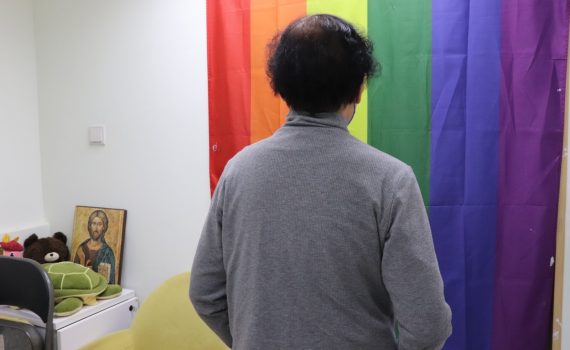
LGBTQ couples in Hong Kong face difficulties securing legal protection
- 2026-04-08
- Society
- The Young Reporter
- By: Lan Xinbei、ZHOU ShiqingEdited by: Ye Enyi
- 2026-04-08
Ah Moon, 55, who does not want to reveal her real name, initially had no intention of making decisions about legal safeguards for herself and her same-sex partner related to end-of-life matters. She began to consider these issues more consciously during a hospital stay in 2002, while she was in a relationship with her ex-girlfriend. “I was afraid of what would happen if I never woke up again, so I drafted a few pages of plans on blank paper myself after discharge,” she said. Hong Kong does not legally recognise same-sex marriages. Ah Moon said because her family does not care about her relationship, she worries that her wishes after death will not be honoured. In September, the Legislative Council rejected a bill to legally recognise same-sex partnerships by a large majority, leaving same-sex couples to rely on fragmented legal documents and personal requests to protect end-of-life decisions such as inheritance, medical choices and funeral arrangements. Rufina Ng, a senior associate at Hastings & Co, a law firm that offers free legal consultation for the LGBTQ community, said same-sex partners are highly recommended to plan in advance for end-of-life, though they still face limitations. Ng said the most common end-of-life legal challenges faced by same-sex couples in Hong Kong are claiming the body and inheritance, particularly if there is no will or there is conflict between the surviving partner and the deceased’s family. “Same-sex couples lack the legal status of spouses or family members under Hong Kong’s legal framework. When one partner dies without a will, the surviving one currently has no inheritance rights and other relatives may also oppose their handling of funeral arrangements,” she said. Hong Kong’s current inheritance laws only recognise spouses and a few other relatives. Unmarried partners, whether same-sex or not, receive no legal protection. …

Chops, sidekicks and smashes: Professional wrestlers wreck the ring at Chai Wan
- 2026-04-08
- Culture & Leisure
- The Young Reporter
- By: LEUNG Chi NgaiEdited by: CHAN Hiu Ying
- 2026-04-08
On the night of April 5, Ricky Marvin, a Mexican professional wrestler, knelt in a corner of a wrestling ring at Chai Wan Youth Square, trembling as he looked towards the three other wrestlers surrounding him. This was a fatal four-way match, in which professional wrestlers compete simultaneously, though three of them had teamed up against Marvin. Marvin swore and shouted at his opponents. The three wrestlers smirked and stamped on him as the audience burst into laughter. Across two nights, April 5 and 6, 18 professional wrestlers exchanged blows and kicks at an event organised by the Hong Kong Pro Wrestling Federation, which has staged wrestling events since 2009. Titled “Shin Squared Circle Vol.2: World Wide Wrestling”, the event featured three international wrestlers, Ricky Marvin from Mexico, Katsuhiko Nakajima from Japan and Elijah Blum from Germany. The two-night event included nine matches, including singles, tag team (2 vs 2) and fatal four-way matches and attracted around a hundred audiences. For Blum, it was his first time wrestling in Hong Kong. He has pursued his professional wrestling career in Germany since 2021, and said the setting in Hong Kong is quite similar to that in Germany. “In Germany, it is hard to entertain the audience in the cities as they have already seen so much wrestling. I feel the people in Hong Kong are really up for being entertained. They love the whole show, which is amazing,” he said. He said he would like to wrestle in Hong Kong again if HKWF invites him back. Danny Freer, 49, is a school teacher in Hong Kong from the United States. He and his wife have followed professional wrestling for 12 years and have attended several World Wide Entertainment events before. The married couple were there to support Owen, a local wrestler. …

Art Basel Hong Kong logs seven-figure deals and crypto sales amid global market rebound
- 2026-04-06
- Business
- By: ZHOU YunEdited by: Wang Yunqi
- 2026-04-06
Art Basel Hong Kong recorded multiple seven-figure transactions and completed its first Ether-denominated sales through a new digital art sector, as the global art market ended a two-year sales decline. The five-day fair at the Hong Kong Convention and Exhibition Centre drew 91,000 visitors and featured 240 galleries from 41 countries and regions, including Gagosian, David Zwirner, and Tang Contemporary. David Zwirner sold a 2006 Liu Ye painting for $3.8 million and a 2002 Marlene Dumas work for $3.5 million, according to the fair's website. The fair's strong results came amid a broader market rebound. According to the Art Basel and UBS Global Art Market Report 2026, global art market sales rose four percent to $59.6 billion last year, with the U.S., U.K., and China accounting for a combined 76 percent of revenue. https://playful-khapse-3e93c2.netlify.app/ Auction sales climbed six percent to $24.8 billion, driven by high-value works. Transactions above $1 million rose 21 percent year-on-year, while those above $10 million gained 30 percent. Dealer sales rose two percent to $34.8 billion, constrained by rising operating costs. Zero 10, Art Basel's global digital art initiative, made its Asian debut at the fair, featuring 14 institutions presenting works using artificial intelligence, algorithms, and immersive technology. Korean digital artist DeeKay Kwon's work I WANNA RUN sold multiple editions at 6 Ether (ETH), approximately $13,000 each, according to his gallery, AOTM. The gallery said the transactions reflect growing collector demand for digital art. Digital, film, and video art represented three percent of total dealer sales in 2025, up two percentage points from 2024 but still below the five percent peak recorded in 2022, the report said. Reporters: Zhou Yun, Hui Tsun Ka, Li Ka Yu, Gu Chun Kai Editor: Wang Yunqi