
The Hong Kong government and the Securities and Futures Commission (SFC) will continue to drive high-quality development of the Real Estate Investment Trust (REIT) market, with a view to securing the early inclusion of REITs in the Mutual Market Access Scheme, as announced by Financial Secretary Paul Chan Mo-po in the 2026 Budget Speech.
To facilitate the privatization or restructuring of REITs, the government plans to introduce an amendment bill this year to further refine the market ecosystem.
“Lowering the investment threshold, increasing trading liquidity, and boosting participation are the core objectives of this policy,” said Dong Ding, Professor from the Department of Accountancy, Economics and Finance, at Hong Kong Baptist University.
There are currently 11 REITs listed on the Hong Kong Stock Exchange, according to HKEX data. Among them, Link REIT is the largest, with a market capitalization of approximately HK$100 billion as of February.
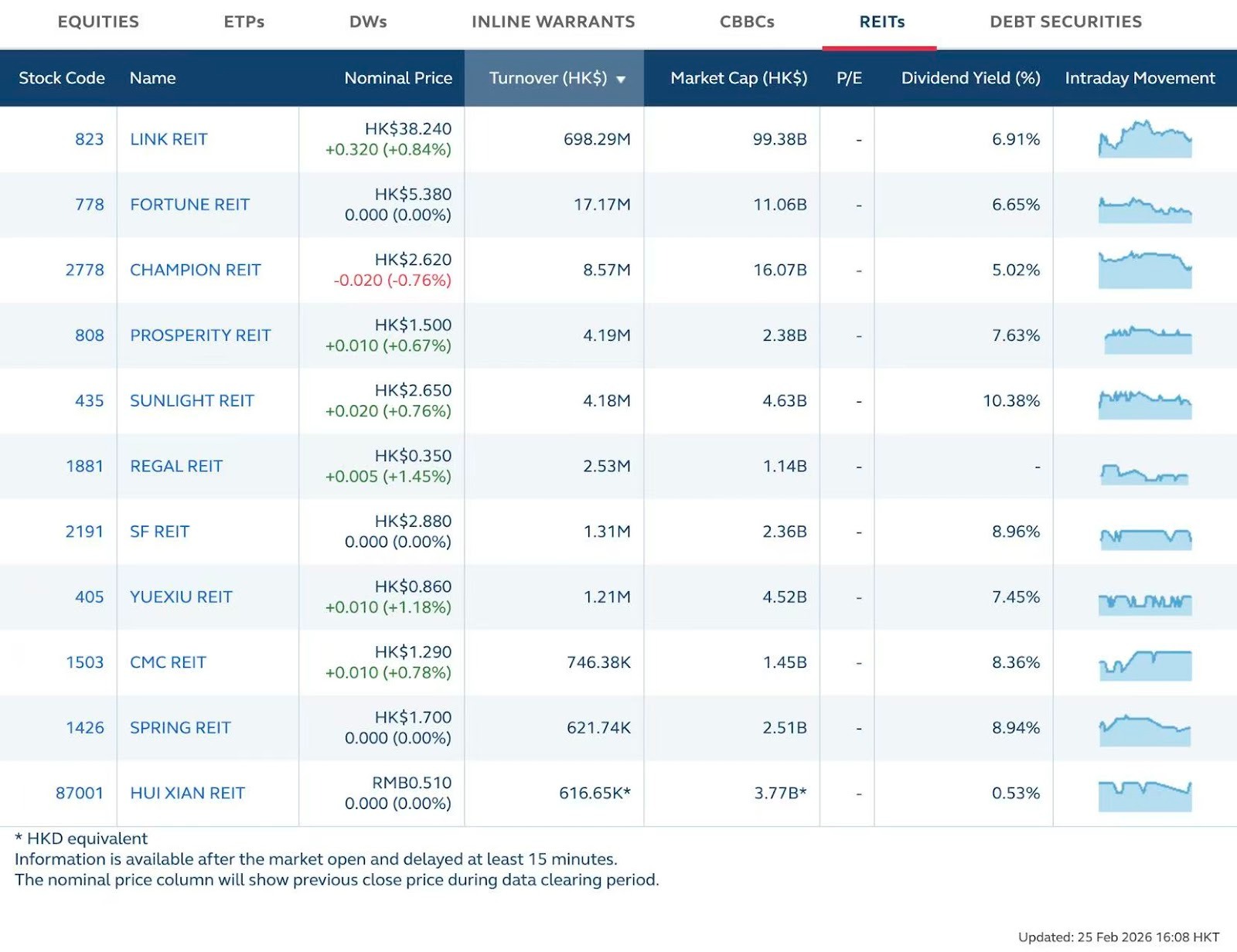
Most REITs posted varying gains by the close of trading on the budget announcement day.
According to the Q4 2025 Hong Kong investment figures published by CBRE, total investment volume in Hong Kong commercial real estate in 2025 reached HK$44.5 billion, while REIT activity was confined to a single fourth-quarter transaction worth HK$206 million by CMC REIT, the first such deal since Q1 2023.
“REITs are still relatively small in scale,” Dong said. “Yet it [the property sector] does play a truly important role in Hong Kong’s overall economy.”
However, Dong also mentioned potential risks concerning REITs.
He said that by packaging real estate assets and introducing leverage and borrowing, the market as a whole becomes more vulnerable to uncertainties over global monetary policy and interest rates, as well as geopolitical risks.
In addition, REITs also transfer a larger part of rental return risk from developers to ordinary investors.
“If weak consumer demand in Hong Kong leads to a decline in rents, it will cause investors to suffer losses, which will then be transmitted from the financial sector to the real economy and household consumption through financial channels,” Dong added.
To better support the development of REITs, Paul Chan also announced that the government will waive stamp duty on transfers of non-residential properties into REITs seeking a listing, a measure that will significantly lower the costs of asset injection for such REITs.
The relevant amendment bill will be introduced in the first half of next year.
《The Young Reporter》
The Young Reporter (TYR) started as a newspaper in 1969. Today, it is published across multiple media platforms and updated constantly to bring the latest news and analyses to its readers.
Budget 2026: Budget fails to meet grassroots housing needs, NGO says
Budget 2026: Paul Chan addresses concerns in press conference


Comments