
People

Hong Kong Government Land Confiscation Scheme Forces Closure of Popular Farmers Market at Mapopo Community Farm
- 2021-07-19
- Society
- The Young Reporter
- By: Jayde CheungEdited by:
- 2021-07-19
After more than a decade in operation, Mapopo Community Farm held its last farmers market on Sunday before permanently closing due to the Hong Kong government’s Land Resumption Ordinance. The farmers market sells locally produced vegetables, mainly from the northeastern part of Hong Kong’s New Territories, including Ping Che (Fanling), Tsiu King (Sheung Shui) and Kwu Tong (Sheung Shui). At two in the afternoon, about 15 people lined up outside Mapopo Community Farm to snatch up locally grown fruit and vegetables, including winter melons, pumpkins, longan and dragon fruits. Most products were sold out within the first hour. Chatting and laughing during their visit to the market, customers filled shopping bags with green vegetables and fruits. Some visitors brought their pets and kids to the market, to witness the decline of Hong Kong local agriculture. People expressed gratitude to the farmers by leaving messages and colorful drawings in the farmer markets’ autograph book. “The villagers are exhausted fighting for their lands,” said 26-year-old Ms. Wong, who withheld her first name. She said she has heard of the land resumption scheme since she was a student. The scheme, officially announced in 1998, allowed the government to claim the land for residential purposes, in order to handle the growing population in Hong Kong. Farmlands in Kwu Tong North, Fanling North and Ping Che/Ta Ku Ling have been identified by the Hong Kong government to be new development areas.The rural areas in northeast New Territories will be used for commercial and residential land. However, the development plan was rejected by the farmers. They worried that the residential and commercial land development would reduce the amount of farmland, thus deteriorating the farmer’s livelihood. Following several legal challenges by residents of Ma Shi Po Village, …

Few books with “sensitive” content on sale at HK Book Fair 2021
- 2021-07-14
- People
- The Young Reporter
- By: Jayde CheungEdited by: C.K. Lau
- 2021-07-14
Books that contain politically sensitive content can hardly be found at the Hong Kong Book Fair 2021, the first such event held after the Hong Kong National Security Law was introduced last year. Publishers say fears about breaching the law, which bans acts of secession, subversion, terrorism and collusion with foreign forces, have discouraged them from pubishing some titles. Hillway Press is the only publisher that has released books whose content may possibly be regarded as sensitive, including The Journey Through the Brick Wall and 21 July 2019. The first book is an autobiography of Raymond Yeung Tsz-chun, a liberal studies teacher who was shot in the eye in a protest on 12 June in 2019 during the anti-extradition bill movement. The second is written by Ryan Lau Chun-kong, one of the victims in the so-called 721 incident, who offers his account of what happened in the evening of July 21, 2019, when a number of people deemed to be sympathetic to the anti-extradition bill protests were attacked by alleged gangsters in the Yuen Long MTR station. Mr Yeung, who has since quit teaching to start Hillway, also revealed that the company was prepared to publish three other books that contain sensitive content, but no printers were willing to print them. He did not disclose what those three books were about. Jimmy Pang Chi-ming, president of the publishing house Subculture, said fears over the “white terror” of unintentionally violating the national security law now pervaded the whole publishing industry. “Under the vague standards of the national security law, we have abandoned some books that only contain cultural content,” said Mr Pang. “For example, Liu Xiaobo (the 2010 Nobel Peace Prize winner who was jailed on the mainland for inciting subversion of state …

Parents Happy to See Schools Return to Full Capacity
- 2021-05-24
- Society
- The Young Reporter
- By: REN Ziyi DavidEdited by: Robin Ewing
- 2021-05-24
All local schools and kindergartens returned to face-to-face teaching today for the first time in six months after the relaxation of Covid pandemic restrictions. Classes are at full capacity on a half-day basis. “I am happy to have my kid back to school,” said Manto Hong, a 43 year-old father with a daughter at a primary school in Kowloon Tong. Mr Hong said he wishes the schools could be allowed to open up longer. “She will be able to meet more friends,” he said. “Learning in the classroom might be more effective.” Kelley Mang, a 42 year-old mother with two daughters studying in a primary school in Kowloon Tong, said full-time school might not be a good idea right now since the vaccination rate is too low. “It is good to send my kids back to school,” she said. “I am still a little bit worried about the close contact problem.” The Hong Kong government is considering expanding vaccine eligibility, following the US decision last week to open up Pfizer-BioNtech shots to age 12 and up. The number of fully vaccinated Hongkongers is close to 900,000, or 12% of the population.
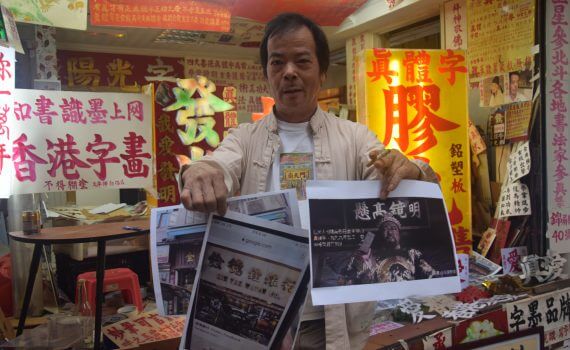
A Hong Kong Calligraphy Master
- 2021-04-14
- Society
- The Young Reporter
- By: POON Hiu LamEdited by: CHAN Wing Yee
- 2021-04-14
Every corner, wall and even the floor of King Wah Signboards in North Point is covered with the calligraphy of Au Yeung Cheong. There are also photos of his visitors, both local and from overseas. It’s a kind of creative mess with ink, plastic boards and paper all over the floor. The shop has been around for 30 years but recently relocated to Kam Ping Street after the State Theatre building was sold. The 65-year-old Chinese calligraphy master is well known for his remarkable and unique real script Mr Au Yeung has created more than a thousand signboards in Hong Kong, starting from writing, text carving to installing lightboxes. He started when he first arrived in Hong Kong in the 1970s and later set up his shop King Wah Signboard. “The real script was created and used by emperors as the official typeface since the Tang Dynasty,” Mr Au Yeung claimed. He described the strokes as Guan Yu’s blade, clean-cut, awe-inspiring, which is different from the Song Ti font and regular script typeface. “The Real script shouldn’t look as if they don’t have heads or tails. The characters are tightly structured and as sharp as a knife cutting a watermelon,” he explained. As Mr Au Yeung demonstrated his calligraphy, he almost threw himself into a trance, savouring the connotation his work seemed to bring him. He then compared his work with the calligraphy of Wu Zetian, the only empress of China. “Don't you think mine is more beautiful than hers?” he asked. It might be a common misconception that expensive brushes and ink are needed for the artform. But Mr Au Yeung revealed that his brushes and inks were bought from a hardware store nearby. “What matters most is the skill you have in handling the brushes and how familiar …

Hong Kong tailor designs light wedding dress on a growing craze
- 2021-01-27
- Society
- The Young Reporter
- By: Bowie TseEdited by: Cherry Lee
- 2021-01-27
Apart from long trail and princess-like cake wedding gowns, a young local designer -tailor designs and produces simple but sophisticated dresses, known as the “light wedding dress.” Despite the complex and difficult process in producing wedding dresses, Ms Lai dreams to bring the craze of light wedding dress to light and produce aesthetic wedding dresses for each bride. According to the Hong Kong Trade Development Council, the size of the creative industry has increased by 5.3% steadily since 2018. In spite of the growing industry, Ms Lai has faced hurdles along and questioned the support for the creative industry by the government.

Mainlanders facing racism in workplace
- 2020-12-30
- Society
- The Young Reporter
- By: Moon Lam、Nicole KoEdited by:
- 2020-12-30
Mainland migrants in Hong Kong face racism in the recruitment process. Since 1997, there have been 1.5 million mainland Chinese moving to Hong Kong. About 20 percent of Hong Kong's population are migrants from the Chinese mainland. But their cultural background, language, and sometimes education level makes integration into Hong Kong tough.

My day in Chungking Mansions: Disconnected "country" in Hong Kong
- 2020-12-30
- Politics
- The Young Reporter
- By: Zhu Zijin Cora 朱子槿Edited by: Moon Lam
- 2020-12-30
The elevator in this 17-storey behemoth of a building with more than 4,000 residents and hundreds of small businesses, can only hold five people. Waiting for an uncrowded one needs both patience and luck. After 10 minutes, I give up and enter the stairwell to walk six numbers of flights downstairs. The walls are covered with graffiti. Through the window, I can see nothing but pipes with black stains. Nearly half a century ago, Chungking Mansions was one of the most upscale buildings in Tsim Sha Tsui. But now, this complex has become a low-priced gathering place for minority groups and asylum seekers. Before the pandemic, it used to see about 10,000 visitors every day. They come here for authentic food, affordable rooms, drugs, and prostitutes. For decades, some local people have viewed the complex filled with crimes and violence, as another "Kowloon Walled City," which was known for its high density and lawlessness. But fewer visitors amid the pandemic have made this building further disconnected from the outside world. I'm here to spend 24 hours, to get inside the look of this building and its people. It's 5 pm on Sunday. Outside the stairwell on the ground floor, about 10 Africans are drinking beer and watching football on the television with loud music. I feel nervous in this unfamiliar place with so many corners and aisles, which are like scattered puzzle pieces. So I choose to stand still and look around to figure out the direction. Luckily, someone is waving at me. I tell him that it is my first-time visit and ask for his advice. This 37-year-old Indian grocery shop owner, Muddassar Ahmed, is keen to give me an introduction. This five-block complex has more than 3 hundred stores. Most are run by African and Indian migrants and …

Hani Halal – The Award-winning business making Hong Kong Halal-conscious
- 2020-12-29
- Society
- The Young Reporter
- By: Shameel IbrahimEdited by: Jay Ganglani
- 2020-12-29
From Halal lollipops to gelatine sheets, Hani Halal's online shop sells anything Halal as the name suggests. With no artificial colours, the shop's fan favourite sweet rose lollipop is hand-decorated for its customers. In October 2020, the business won an award for its Medjoul dates at the LOHAS Expo cum Vegetarian Food Asia 2020. The term Halal is an Arabic word that means "permissible." In the context of food, it refers to the dietary requirements of Muslims based on their Islamic faith. Muslims cannot eat pork and have special procedures for the slaughtering of meat, according to their religious rites. Hani Halal, officially known as 3 Hani Enterprises Limited, started two years ago, in 2018, to bring a viable option for consumers of Halal food. Ms Leung, together with two other partners and the Incorporated Trustees of the Islamic Community Fund of Hong Kong, the official body for Muslims in Hong Kong, helped make her vision become a reality. "Food is the most easy way to connect with people, especially in Hong Kong. We talk business through food. So, food is something that is easy to connect with people," she said. She added that her business sells products globally, but mainly focuses on Hong Kong and Macau. The award-winning business has also won a Manpower Development Award for 2020 from the Employment Retraining Board (ERB) for training both Muslims and non-Muslims on the dietary requirements of Halal food. There is a considerable demand for Halal food in Hong Kong, with 65% following a strict halal diet, according to research conducted by the Worcester Polytechnic Institute. The city has 300,000 Muslims from various backgrounds, making up 4.6% of the city's population, according to the Hong Kong Special Administrative Region's Home Affairs Bureau. Muslims first came to the city during the British …

Islamic content in textbooks spurs discussion on religious education in Hong Kong
- 2020-12-28
- Society
- The Young Reporter
- By: Shameel IbrahimEdited by: Jay Ganglani、Han Xu
- 2020-12-28
When Adeel Malik, an English teacher at a local school in Kwai Chung, saw messages on social media linking terrorism with Islam, he was upset. "They are basically explaining a social issue, but then they are connecting [terrorism] to Islam in a way which [the] Islamophobes know best," Mr Malik said. Screenshots of the two books, Journey Through History: New Topic-based Series and the Liberal Studies (LS) Advanced 2020, have been circulating in Muslim WhatsApp groups. The liberal studies book said some Muslims wanted to "safeguard" Islamic doctrines and cultures and they "started wars and attacks" against Western cultures. That ignited discussions on Islamic education among members of the Muslim community in Hong Kong. More disturbing for Muslims living in Hong Kong was that a history textbook contained false information about Islamic history. The book, among other things, claimed that Prophet Muhammad's face was shown in several paintings in the 15th century, but were discarded later to prevent idol worship of the Prophet and to focus on Allah [God in Arabic]. That's false, according to Islamic teachings. Islam prohibits drawings of any image of human beings. Raza Nasir Razi, an LS teacher at the Islamic Kasim Tuet Memorial College, is not surprised by what's in the books. During his career as a teacher in Canada, similar misunderstandings of the religion were common in the school curriculum. He found that misunderstanding of Islam to be "universal," referring to the common misconceptions of Islam in the West. "A primary mistake is that the textbook author [said] that Prophet Muhammad is the founder of Islam," Mr Nasir said. "Muslims believe that Prophet Muhammad was the final prophet and believe in all the prophets mentioned in the Abrahamic faiths." But, Mr Malik is optimistic about the city's effort towards including Islamic education in …

Mandy Lee: A Pioneer in Escapism Cooking
- 2020-12-16
- People
- The Young Reporter
- By: Jasmine TseEdited by: CarineChow
- 2020-12-16
Using a finger to make a well in the flour, Mandy Lee poured in the beaten egg yolks. She added water and salt to the mix and aggressively manoeuvred it, kneading and tearing it until a silky dough was formed. She carefully flattened it through a pasta machine and unwaveringly incised it to create uniform strands. Staring at the finished product in front of her, Ms Lee found her suppressed anger and anguish briefly consoled via the exhaustive pasta-making session. Spellbound by this sensation, she did not leave her apartment until she perfected the tonnarelli recipe two weeks later. "Without knowing it yet, I became what I would like to call later on – an escapist cook," Ms Lee wrote in her blog Lady and Pups. The Taiwanese-Canadian, 40, moved to Beijing in 2010, where she struggled living under China's communist regime. She began cooking as a form of escapism from the torture of her reality. This later evolved into her writing an "angry food blog" and the cookbook The Art of Escapism Cooking. Ms Lee was born in Taiwan in 1980 and spent her teenage years in Canada. She dropped out of University of British Columbia after a year to pursue art school in New York. Graduating from Parsons School of Design, she then worked at an architecture firm before starting her own dog food business with a friend. Reflecting on her seven and a half years in New York, Ms Lee said the city complemented her personality the most. "I love New York for the kind of city it is and the kind of energy it has and the kind of freedom it provides," she reminisced. However, such a lifestyle was quickly uprooted when her husband had to move to Asia for a job, finding herself living in …