
Society

17-year-old Hong Kong student found alive after missing for a week
- 2023-10-12
- Society
- By: Yau To LUMEdited by: Tsz In Warren LEUNG
- 2023-10-12
Matthew Tsang Hin-chit, the 17-year-old teen who was missing for a week, was found alive by rescue teams at Ma On-shan Country Park on Wednesday. Firefighters found the Diocesan Boys’ School’s pupil in a bush near Lo Shue Tin Hang in Wong Tai Sin, Kowloon. Tsang was found unclothed but was not injured. Firefighters also gave him a bottle of energy drink. According to the police, no suspicious circumstances were detected. He was conscious while being taken to the Eastern Hospital for further treatment. Chow Cheuk-fung, the station commander of Sha Tin Fire Station, said in a press briefing that the rescue teams, including the Mountain Search team and other supporting forces, had mobilised 28 fire trucks, and nine ambulances, with 122 firefighters and 24 ambulance men. Cheung Tin-yu, senior station officer, said in the same briefing that the search had covered 28.8 square kilometres, adding that the rescue team even faced immense obstacles due to the limited information and extreme weather conditions, such as the Black rainstorm signal and typhoon Koinu that hit the city. “The rescue team did not know the exact route Tsang had headed, as he did not carry any communication devices, so they could not track his location,” Cheung said. “The terrain was dangerous, and we have been facing Typhoon Koinu and rainstorms in the last week.” The station officer also said the results team used technology like drones for taking pictures, and that the photos were analyzed by artificial intelligence to narrow down the search areas. Amy Chan, the rescued pupil’s mother, expressed gratitude on social media after realizing that her son was found alive. “Although it had been eight days, No. 9 Increasing Gale or Storm signal and black rainstorm signal, we never give up, and it was a miracle that my son …
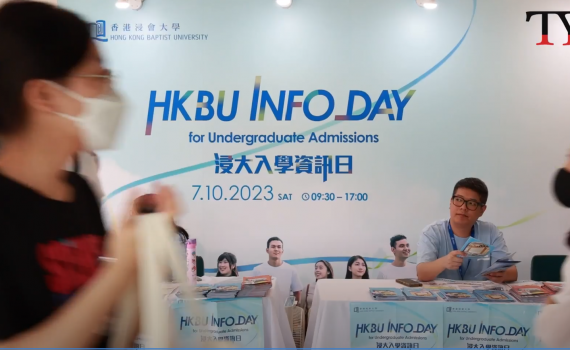
Information Day 2023 at Hong Kong Baptist University
- 2023-10-09
- Society
- By: Yi Yin CHOW、Chi On LIUEdited by: Ka Ki FUNG
- 2023-10-09
The Information Day of the Hong Kong Baptist University is held on Oct. 7. It is the first year after pandemic restrictions have been relaxed to hold the Information Day. Many visitors come to get more information on what they are interested in.

Full STEAM ahead in Hong Kong schools
- 2023-10-08
- Society
- By: Wai Sum CHEUNG、Yee Ling TSANGEdited by: Kei Tung LAM
- 2023-10-08
During recess, a group of primary students excitedly rushed out of the classroom and could not wait to meet their “cute little friends” in the school’s STEM room. STEM stands for science, technology, engineering and maths. The children have been breeding butterflies in boxes as part of a STEM project. “I love butterflies. As one of the Butterfly Conservation Ambassadors, I’ve learned a lot about the creatures,” said Kan Chan, a Primary Six student from Stewards Pooi Kei Primary School. Stewards Pooi Kei Primary School attaches importance to inspiring students to think, allowing them to learn through STEM subjects in class by integrating subjects and encouraging them to participate in inter-school competitions. Butterfly Conservation Ambassadors is one of the events. Students can nurture butterflies from caterpillars to adults and share the importance of butterfly conservation with their schoolmates. Through this, they help to raise biodiversity around the school. In 2018 -19 school year, Stewards Pooi Kei Primary school won First Runner-up and the Most Popular Award in the Butterfly x Stem Expo organised by Green Power. However, a new educational approach, “STEAM”, has become more influential in recent years. It is a model of STEM, but adding the Arts along with Science, Technology, Engineering, and Mathematics subjects. Chief Executive John Lee has proposed to enrich STEAM education in public-funded schools by 2024-25 through implementing enriched coding education at the senior primary level. The government will “step up the promotion of STEAM education for all, for fun and for diversity” in primary and secondary schools by incorporating more IT learning elements into the curriculum and enhancing professional training on STEAM, according to the Policy Address 2022. To align with the STEAM trend, Stewards Pooi Kei Primary School started attaching the “Arts” aspect in recent years. The school’s STEM department has collaborated …

Migrating bird draws crowd at Kwun Tong Promenade
- 2023-10-07
- Society
- By: James Ezekiel Kalaw MODESTOEdited by: Tsz Ying CHEUNG
- 2023-10-07
A group of photographers gathered under the beating sun at Kwun Tong Promenade on Friday, all for a picture of a lone Eurasian Hoopoe. The Eurasian Hoopoe is a medium-sized bird from the Upupidae family and native to parts of Africa, Asia and Europe. They often appear alone and are known for their distinct "hoo-poo-poo" call. “It made me stop to take a look,” said Fred Kwok Yuen-po, who took a moment from his routine jog to photograph the bird. He had never seen so many photographers at one spot since he started running along the promenade in 2019. "I'm not familiar with birds myself, but it's nice to see special ones," Kwok said. Seemingly unfazed by the people around it, the Eurasian Hoopoe remained active and pecked at the ground, looking for soil-dwelling slugs and worms to eat. While it is of "least concern" on the list of the International Union for Conservation of Nature, the population of the Hoopoe is declining in parts of Asia and Europe as a result of hunting, habitat loss and climate change, according to BirdLife International, a global network of non-governmental organisations specialising in bird conservation and research. Daniel Yu Shun-cheung, 66, is a bird watcher with over a decade of experience. "It's my first time photographing a bird here," he said. Yu said the Hoopoe is a great find for the local bird watching community. While the promenade gets visits from local birds, such as the widespread Eurasian Tree Sparrow and Black-collared Starling, there have been no reports of migrating birds around the area. "I never thought it could show up in such a busy environment," said Yu. Despite being an “uncommon and irregular visitor” during autumn and winter, the Eurasian Hoopoe has been recorded in open farms and grasslands, with some …

Tai Hang Fire Dragon dances for the first time in four years
- 2023-10-05
- Society
- By: Lisheng CHENG、Ji Youn LeeEdited by: Yu Yin WONG
- 2023-10-05
The Tai Hang Fire Dragon danced for the first time in four years during the Mid-Autumn Festival. This year’s performance from Sept. 27 to Sept. 30, is part of the government's efforts to revive Hong Kong’s entertainment and tourism sectors after a long stretch of pandemic lockdowns. As festive season kicks off, people from across the world are back in the city, some specifically for the fire dragon. Alex Grion, 16, is a tourist from France. “I enjoy the strong traditional Chinese culture atmosphere here,” he told The Young Reporter. The Tai Hang Fire Dragon Dance has a rich 180-year history. It originated from a folk story about a buddhist monk who was told to create a burning dragon out of incense to ward off pestilence. Nowadays, residents of the area create a dragon out of incense sticks and burn it during the three day Mid-Autumn festival celebration to wish for good luck. The ritual has been recognised as a national heritage by the mainland and Hong Kong in 2011 and 2017 respectively, John Lau, a 50-year-old Tai Hang resident, was so excited and kept cheering. “I have participated in this activity since I was a child. The dragon is a symbol of peace and happiness for us,” said John. The 67 metre dragon is traditionally carried by 300 of Tai Hang’s current and past residents, and stretches about the length of two blocks. Michelle Cheung, 60, runs a souvenir booth for the dragon dance. HIs products range from T-shirts to commemorative dolls holding incense sticks. The shop owner is glad to see the dragon’s comeback. “After so many years of the epidemic, seeing so many people come to participate this year is actually a reflection of Hong Kong's renewed vitality. Because everyone had to stay at home and not …

K-Market brings life to Kennedy Town during Mid-Autumn Festival
- 2023-10-02
- Society
- By: Hanzhi YANG、Xiya RUIEdited by: Ming Min AW YONG
- 2023-10-02
Since Friday, strings of lanterns have lit up Belcher Bay Promenade in Kennedy Town to welcome the Mid-Autumn Festival. Many of the visitors also brought their own lanterns. Compared with last year's Mid-Autumn Festival, when Kennedy Town was quiet amid the pandemic, this year’s K-Market has brought life back to the district.l. Coinciding with the Mid-Autumn Festival and National Day, the K-Market will run from September 29 to October 2 from 3pm to 11pm. Entrance is free. Jointly organized by the Development Bureau, Sketch Culture and SlainteHK, the fair is also known as the "Night Market and Music Festival". Several local bands and DJs transformed it into a music town from 4pm to 10pm. The festival includes around 60 retail booths, offering dry goods and food stalls, free activity booths, handicraft workshops, and more. At around 9:30 PM, Hong Kong Chief Executive John Lee Ka-chiu arrived to inspect and feel the festive spirit. "I'm so happy to hear that there is something to buy and eat," said Lee. He asked visitors about their views on the K-Market and hope each place to be unique and popular. Lin Caiying, a mother of four from Foshan in Guangdong, chose Hong Kong as their family’s destination during the Mid-Autumn Festival. "I have always wanted to travel to Hong Kong, but I was unable to cross the border before," said Lin. "But when the border reopened this year, and we have seven days off because of the Mid-Autumn Festival and National Day, my husband and I decided to bring our children to see," she said. "My kids made flower knots in a craft workshop and they love it. It’s the best Mid-Autumn Festival holiday for us," she said. Both kids were holding lanterns as souvenirs. With local bands and DJs taking turns to perform …

More than 1500 Join Petition to Demand Clarity on Rosaryhill School
- 2023-09-27
- Society
- By: Lisheng CHENGEdited by: Yixin Gao
- 2023-09-27
The number of parents, teachers, students and alumni who signed a petition to demand an explanation on the expected closure of Rosaryhill School on Stubbs Road reached 1525. They accused the school’s sponsoring body, Dominican Missions of failing to consult and respect them before an announcement on Sep. 19 to merge the kindergarten and primary school of Rosaryhill School with Dalton School Hong Kong and abolish the secondary department after two years. An internal notice of the Merger and Abolishment Plan was reportedly released to students and teachers without prior consultation. The principal was informed on Sep. 14, and parents and students were informed on Sep. 15. A parent meeting was then held less than 24 hours after the release of the notice. “It was released so late that many parents and students didn't see,’’ said Param Verma, 15, a secondary student from the school. Parents had insufficient time to attend and discuss the possibilities of better student arrangements”. Aaren Sapra, 15, a year three secondary student, said that parents were forced to look for other schools and were concerned that the government secondary school Central Allocation system may not be the best option for their kids, and they were worried that their children could not adapt to a new school and may lose their friends. “I will consider transferring our child to another school. We hope to give our child a fresh start sooner rather than waiting here for an uncertain future,” said Tracy Lo, 32, a secondary student’s mother. “Switching to another school means sacrificing the elective courses crucial for my future career aspirations,” said Param. With the school facing an uncertain future, alumni expressed profound disappointment and heartbreaks. "I have spent one-third of my life at Rosaryhill, forging valuable relationships with educators and peers and igniting my …

iPhone 15 resale premium drops; Pro Max 1TB Natural Titanium Color stays HK$2,451 more in resale market
- 2023-09-26
- Society
- By: Yi Yin CHOW、Runqing LI、Chi On LIUEdited by: Mei Ching LEE、Ka Tung NG
- 2023-09-26
On Sept. 22, many people were inside the Apple Store in Shatin New Town Plaza to pick up their new iPhone 15. Some scalpers waited outside the Apple Store to buy iPhones from the customers at a premium price. The price of the iPhone 15 Pro Max, with a storage of 1TB, costs HK$13,599. On the first day of sale, the premium price for a new phone in the Natural Titanium color was listed by one resale outlet as an extra HK$2,401, according to the iPhonePriceHK. In the resale market, more profits were made compared to the past few years, some said. Kris Tsang, 30, bought two iPhone 15 Pro Max with 1TB storage in the Apple Store, one for personal use and the other for selling to the resale market. "I saw that the maximum profit for reselling is HK$2,000," said Tsang. “iPhone 15 series are better selling than the iPhone 14 series,” said Nadjib, 35, an Indian reseller outside Sincere Podium. He bought six iPhones and planned to sell them in India at a higher price. Derek Chung, 34, a reseller, bought two iPhones and earned HK$6,000 from reselling. "Prices are speculated to reach a new high due to the factors of titanium," said Chung. The latest iPhone series included a titanium shell, making the handsets the lightest the company has ever made and the case more durable. "I heard that titanium production capacity is relatively low. Prices are speculated to be high due to the low supply," said Chung. Those who want to buy the new iPhone 15 from Apple can only do so after pre-ordering online.

Hong Kong Disneyland pushes prices to record high with new ticketing system
- 2023-09-20
- Society
- By: Junzhe JIANG、Yuqi CHUEdited by: Bella Ding
- 2023-09-20
Hong Kong Disneyland Resort has revealed price increases in certain ticket categories while rolling out a new tier of day passes for its most popular periods, effective from Wednesday. Disney created a four-tier ticketing system. The newly added Tier 4 day pass costs HK$879 for adults and HK$659 for children, a 15.8% hike over the previous highest "Peak Plus Days". “Select days that historically see high demand will be tiered as Tier 4 days. The Tier 4 days will start to kick in during the coming Christmas season,” said a spokesman, according to the press release. Tiers 2 and 3 tickets, or what used to be “Peak Plus Days” and “Peak Days”, now cost HK$799 and HK$719 respectively. The price of Tier 1, original “Regular Days”, remains the same. Prices for annual passes including silver, gold and platinum cards have also gone up. Students will no longer pay the same price as children and instead will pay an extra 15% for passes. Adult and children tickets have gone up by around 9%, while senior tickets remain unchanged. Local people and magic annual pass holders can renew their passes at the current prices before Nov. 15. Hong Kongers can also purchase annual passes at current prices before the date. Some mainlanders decided to buy annual passes ahead of the price hike. Summer Xia, a 23-year-old mainland student and her friends spent more than 45 minutes online before they could buy their tickets. During the process, Disney’s official page was overloaded and paralyzed several times. “Disney is going to launch its new Frozen-themed zone,” said Xia, “We were waiting for the Magic Access Group of 3 Special Offer but decided to purchase now to save money.” According to the Resort, the new tiered-pricing structure aims to effectively manage visits and market demand. …

Local street dancer Bobby wins chance to represent Hong Kong in international competition
- 2023-09-19
- Society
- By: Sze Kei WONGEdited by: Ka Ki FUNG、Ming Min AW YONG
- 2023-09-19
A local street dancer beat out 15 other hopefuls on Sunday afternoon, winning the chance to represent Hong Kong for the first time in an international dance competition in Germany. Lam Yuet Wing, 32, who performs as Bobby, won a majority of audience votes at the Red Bull Dance Your Style competition at the Hong Kong Cultural Centre. He will compete against 29 international dance groups in Frankfurt in November. The audience selected the winner using different colored fans to show their vote. The outdoor competition was open to the public with a free after party for both dancers and registered audience members. Lam started dancing in 2006 and is known for the dance style “popping”—a category of street dance that involves rapid contraction and relaxation of muscles, giving the dancer a pop feeling to match the beat. "My first competition was held at the Hong Kong Cultural Centre. I didn't even make it into the audition,” he said. “The second time I attempted battle in the venue was today, and I got the award." “Since I just injured my leg, now I will heal my wounds and equip myself to go to Germany for exchange," Lam said. He also added, ”No matter if I lose or win, I will experience more abroad and bring more knowledge to Hong Kong”. “The event was fun and we saw a lot of exciting battles today,”said Chu Yung Chuen, 25, an audience member who also is a dancer. “The atmosphere of the event was very good. Many people gathered here, and I enjoyed it very much,” said Tsui Tsz Hung, 24, an audience member.