
Politics

Two sentenced under sedition law for handing out leaflets advocating independence
- 2022-02-01
- Politics
- The Young Reporter
- By: Karmen LiEdited by: Malick Gai、Jayde Cheung、Jenny Lam
- 2022-02-01
Former school clerk Cho Suet-sum, 45 was jailed for 13.5 months at the District Court yesterday. Her co-defendant, 17-year-old Wong Chun-wai, will undergo nine months of rehabilitation. The pair pleaded guilty to one count of conspiracy to print, publish and distribute seditious materials. The court heard how they handed out leaflets that included the slogan “Hong Kong people, build an army. Establish a state.” The withered bauhinia covered in red paint on the leaflet, mimicking the regional emblem, was intended to provoke violence, according to the judgement. National security law judge, Kwok Wai-kin ruled that the defendants incited others to commit violence to attain Hong Kong independence, which is very close to incitement to secession under national security law. Judge Kwok said Cho manipulated the naivety of Wong and incited others to use violence to achieve her political purpose, making her offense more serious. Cho is the second defendant convicted and sentenced under the sedition law since 1997. Property manager Chiang Chung-sang, 41, was sentenced to eight months in prison at West Kowloon Court on the same day. During the 1967 leftist riots, the sedition law was used to ban propaganda materials from communist forces against the colonial British government. The clause was used again recently against Apple Daily and Stand News after national security law came into effect. Cho was denied bail seven times and has been remanded in custody since June last year, while the teenager was granted conditional bail in August last year. Kwan Man-wai, counsel for Cho, said that the prosecution has overstated the wordings of the slogans. He added that calling others to change the existing political structure is not necessarily inciting violence. Ronny Leung, counsel for Wong, said that Wong wishes for early discharge in order to resume his studies and take the Diploma …

Police officer sentenced to four weeks in jail for upskirting
- 2022-01-26
- Politics
- The Young Reporter
- By: Jayde CheungEdited by: Clarice Wu
- 2022-01-26
An off-duty traffic police officer was sentenced to four weeks in jail for taking photos up women’s skirts. The crime took place in the chain store Don Don Donki in Tsim Sha Tsui on Jan 21 last year. So Yin-ho, 38, was charged with committing an act outraging public decency. He remained calm as Magistrate Jacky Yip Kai-leung meted out the sentence. The Magistrate ruled that upskirting is a serious and formidable crime that upsets women. So denied the charge despite security cameras recordings from the store and eye witness statements presented in court. “It was premeditated and abhorrent,” said the Magistrate. “You do not feel guilty and denied all the accusations, including refusing to admit owning the phone to sneak the photos, even claiming that the safety guards at the store were biased against you.” A psychological report stated that So was likely to repeat the offence. He also showed no remorse while remanded in custody. So plans to appeal and has been released on a bail of HK$25,000 with conditions. "Upskirting" is against the anti-voyeurism law which came into effect on October 8 last year. It prohibits "unlawful recording and observation of intimate part". Francis Kong, a social work supervisor of Caritas Specialised Treatment and Prevention Project of Sexual Violence, said that most people do not grasp the magnitude of the problem due to the absence of explicit legal accusation and punishment. “Clear legislation is important,” said Kong, “the punishment is just a way to compensate the victim. The law should also advocate respect for one another’s will on sexual contact.” Kong believed that upskirting is a form of intrusive sexual violence that neglects other parties’ will. He has called for more education on the issue because heavy penalties, he said, will not prevent similar behaviour in the …

Edward Leung Tin-kei released after six years in prison
- 2022-01-19
- Society
- The Young Reporter
- By: Karmen Li、Jayde CheungEdited by: Jenny Lam
- 2022-01-19
Edward Leung Tin-kei, a former spokesman for Hong Kong Indigenous, was freed from prison after serving four years for his role in the 2016 clashes in Mong Kok . Karmen Li and Jayde Cheung documented Leung’s route to “freedom” and recapped his story before jail.
Lowest ever turnout under revamped LegCo Election system
- 2021-12-20
- Politics
- The Young Reporter
- By: Nick Yang、Kate Zhang、Leona LiuEdited by: Kiki Lo
- 2021-12-20
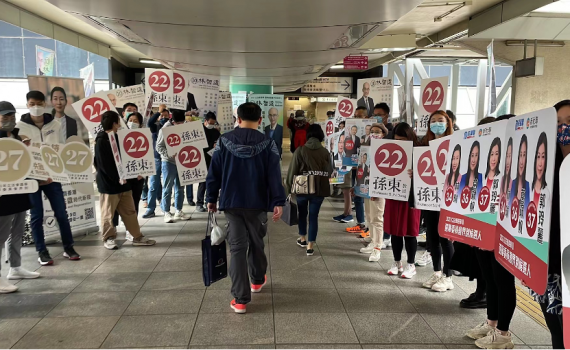
The first Legislative Council election under the revamped electoral system ended last night with a 30.2% turnout rate in the geographical constituency races, the lowest since the handover in 1997. About 1, 350, 680 people cast their ballots in 10 geographical constituencies, a 28% percent decrease from the last Legco election in 2016. The turnout in the Election Committee constituency was 98.5% and 32.2% for the functional constituencies, according to official statistics. Click here to see the voting rates of different districts (made by Grace Koo). “Their votes are not only for choosing their own LegCo members. They are also a show of support for the improved electoral system and their aspirations for effective enhancement of the governance efficiency of the HKSAR as well as the resulting economic development and livelihood improvements,” Chief Executive Carrie Lam Cheng Yuet-ngor said in a press release yesterday. Beijing reformed Hong Kong’s electoral system in March, by creating an Election Committee constituency of 40 seats to be voted on by a body established in September. The electorate is made up of 1500 Election Committee members. The total number of seats in Legco also increased to 90 from 70. “The election committee is composed of elites from all walks of life,” said Allan Zeman, chairman of Lan Kwai Fong Group, and a member of the Election Committee. “I think the new system can really work.” Mr Zeman though failed to secure a seat in the Election Committee constituency. A total of 153 candidates competed for this term of LegCo. For the first time since the handover, there is more than one candidate running for every seat, including the functional constituency seats. Twenty members were directly elected in the geographical constituencies. Voting was changed to a double seat, single-vote system, which means each voter can vote …

Secretary for Education denounces "lying flat" trend, emphasizes values education
- 2021-11-29
- Society
- The Young Reporter
- By: Tracy LeungEdited by: BellaHuang
- 2021-11-29
Secretary for Education, Kevin Yeung Yun-hung, denounced the “lying flat” trend, the attitude of doing nothing popular among young people in the mainland, and highlighted the importance of values education in Hong Kong schools in an online post yesterday The “lying flat” movement started in April when a post on the Chinese popular website Baidu titled “Lying Flat Is Justice” went viral. It refers to young people who strive for nothing more than what is essential for survival. “The recent trend of "lying flat" is even more worrying. A negative life attitude can easily cause depression and hinder social development in the long run,” Yueng wrote in his post. “I am grieved for that, just the same feeling as many parents and teachers who love those kids.” Yeung also said the government will soon release the curriculum framework for the recently proposed values education, which includes moral and ethical education, civic education, and national education. The education bureau said promoting activities related to Chinese history will allow students to learn about the essence of Chinese culture, absorb traditional wisdom, and cultivate moral sentiment. “We must work together to promote values education rooted in Chinese culture together and support students to build positive thinking,” the online article said. “I think the new curriculum has a political agenda and I hope the teachers could be professional enough to tackle this,” said Lau, a local high school teacher who said he is responsible for executing the values education curriculum at his school. He requested anonymity over concerns about his work. In June, Yeung told the Legislative Council that the bureau will send teachers to mainland universities to enhance their understanding of the nation's development. Teachers will also attend training courses related to national affairs, the Basic Law and the National Security Law. The …

Carrie Lam emphasises the central government does not “owe” Hong Kong citizens universal election
- 2021-11-25
- Society
- The Young Reporter
- By: Hamish CHANEdited by: Vikki Cai Chuchu
- 2021-11-25
Chief Executive Carrie Lam Cheng Yuet-ngor said the central government does not “owe” citizens universal suffrage stated in the Basic Law in an enrichment talk to Citizenship and Social Development teachers today. The subject “Citizenship and Social Development” was established last year to replace the core subject “Liberal Studies”, which has been accused of leading to social unrest in 2019. The new subject requires teachers to use “reliable and authoritative sources” to teach. For example, government documents and official quotes. She said some democrats have misled the public to believe that the central government did not approve a universal election which is promised in the Basic Law. Lam said the central government did approve the Hong Kong government to political reform three times. She suggests that the increasing number of members in the election committee of the Chief Executive shows the central government is striving for democracy. Lam said the proposal of “831 decision” allowed the public to have a universal election. The “831 decision” allowed universal suffrage with a “nomination committee”, which is similar to the current election committee, to nominate the candidates for the Chief Executive election before public voting. “It was a very brave move by the central government but sadly it was banned by the opposition in the Legislative Council,” said Lam. She said the governor before the handover was also not elected by the public, and the central government wants to keep the system the same as before the handover which citizens are used to. “The idea that the central government owes citizens a universal election is wrong,” said Lam. “The British government did not give any say to Hong Kong citizens for choosing who is the governor.” Shum Pui-yee, a Secondary 4 student studying Citizenship and Social Development, said the above idea was already …

Government looks into tactics to handle “fake news”, says Chief Secretary John Lee
- 2021-11-18
- Society
- The Young Reporter
- By: Karmen LiEdited by: CHEN Bingyi
- 2021-11-18
Chief secretary, John Lee revealed today that the government is looking at how other countries tackle the spread of disinformation. Speaking on RTHK, Mr. Lee said a legal study is underway on how to deal with the problem and he has not ruled out the possibility of new legislation. The move comes after the government introduced new laws earlier to clamp down doxxing and hate speech. “The fake news legislation can stop destructive rumors from spreading in Hong Kong. Freedom must be exercised under law, which allows people to enjoy more freedom,” Mr. Lee said. Another proposal to manage fake news is to require publishers to self-regulate. Where information is not verified or fact-checked, publishers would be required to make a statement, Mr. Lee said. He added that he preferred to act on content management first to seek a balance between controlling misinformation and freedom of the press. Tang Tak-shing, chairman of Politihk Social Strategic, a local political organisation, believes it is necessary to introduce a fake news law because of the rise of online news media and unchecked reporting. “We prefer legislation since it is difficult to ask online media with low credibility to be self-regulated. The bill can make the boundaries clear toward news media,” said Mr Tang. A survey released by the Foreign Correspondent Club earlier this month found that 75.8% of the 99 respondents including correspondents and journalist members were very concerned about the possible introduction of a “fake news” law in Hong Kong. The chairman of the Hong Kong Journalist Association (HKJA), Ronson Chan Long-sing, said that the government often claims that news media smear police officers, but “they can clarify this immediately instead of waiting for rumors to spread and blame the media”. “It is hard to self-regulate as proposed by John Lee,” said …

Court of Final Appeal rules joint enterprise inapplicable to unlawful assembly and riot
- 2021-11-05
- Society
- The Young Reporter
- By: Jayde CheungEdited by: CHAN Sze Ching
- 2021-11-05
In view of riot charges against Tong Wai-hung and To Elain in July 2019, The Hong Kong Court of Final Appeal held that defendants absent at the scene of an unlawful assembly or riot cannot be found guilty grounding on the “taking part” element. As the centrally important element of the two offences, “taking part” in criminal assembly is required for conviction to riot and unlawful assembly. While the element cannot be overridden by the doctrine of joint enterprise, the presence of defendants in the criminal scene is not legitimate to convict them with unlawful assembly or riot. According to the judgement, application of the joint enterprise on unlawful assembly and riot will “give rise to duplication and possible confusion” without fulfilling the element of “taking part” in the criminal assemblies. The Court of Appeal also held that people taking part in an unlawful assembly or riot may not share an “extraneous common purpose”, so this is not a legitimate reason to convict defendants of the two offences. However, defendants who are proved to have participated in or encouraged any criminal assemblies by words, signs or actions are counted as “taking part” in the offences. They can be convicted under secondary and inchoate liability offences, applicable to anyone presented or not at the criminal scene. Tong and To were accused of taking part in a riot in the area of Des Voeux Road West in Sheung Wan on 28 July 2019, but found innocent on 24 July 2020. The Department of Justice then asked the Court of Appeal of the High Court of Hong Kong to clarify whether joint enterprise in common law is applicable to riots and unlawful assemblies, in which defendants can be found guilty even if they are absent from the criminal scene. On 25 March 2020, …

Film censorship amendment bill passes, giving government power to ban films ‘contrary to” national security
- 2021-10-27
- Politics
- The Young Reporter
- By: Karmen LiEdited by: Yoyo Kwok Chiu Tung
- 2021-10-27
The Legislative Council passed the film censorship amendment bill on Wednesday, giving the chief secretary the power to ban films “contrary to” national security. Banned screenings will face penalties as high as HK$1 million and three years in prison. “The amendment bill is aimed at striving for a balance between the freedom of artistic expression and national security,” said Ma Fung-kwok, the chairman of this case conference. According to the film censorship ordinance, any action of glorifying violence or inciting hatred towards the country could be grounds for censorship. “The phrase ‘contrary to’ is ambiguous. It is hard for us to define which kind of plots may threaten national security,” said Pao Wai-chung, 55, a local film and television screenwriter. "The amendment bill targets independent or crowdfunded films like Inside the Red Brick Wall,” he said. “The amendment won’t cause any trouble to commercial directors as producers of mainstream movies will never challenge the limit intentionally but comply with the rules so the amendments are not putting them at the risk of bearing losses,” said Pao. The Equal Write Union, an advocacy group for local screenwriters, said that filmmakers tackling sensitive topics, such as political issues, now might be put into jail instead of just being banned. “The article is intended to be unclear for the film producers, which can make prosecution and conviction easier,” said the spokesperson for the Equal Write Union. “It heightens the risk for filmmakers,” said Pao. Councillors said the bill should also regulate cinemas and local streaming media. The movie Ten Years, which won the Best Film at the Hong Kong Film Award in 2016, exhibited in 2015. Leung Mei-fun, a Legco committee member thinks Ten Years was a gulf of hatred towards mainland China and Putonghua; they even romanticized violence such as self-immolation. Also, …

Policy Address 2021 Key Takeaways: developing a metropolis and upholding 'one country, two systems'
- 2021-10-06
- Society
- The Young Reporter
- By: Jasmine Tse、Janice LoEdited by: Simran Vaswani
- 2021-10-06
Chief Executive Carrie Lam Cheng Yuet-ngor’s fifth and final policy address of her current term surpassed last year’s to become the lengthiest address ever. Reading her 80-page policy blueprint over a record span of two hours and 38 minutes, Lam spoke about her government’s commitment to the ‘one country, two systems’ principle and introduced the usual extensive list of economic and social measures. Here are five key takeaways from her speech today: 1.Increasing housing supply Lam said the government identified 350 hectares of land to produce 330,000 public housing units over the next 10 years, a slight increase from last year’s figures. Lam also announced the Northern Metropolis Development Strategy, a project to transform 30,000 hectares of the northern part of Hong Kong into a metropolitan area. Lam said the completion of the project will contain more than 900,000 residential units — including the existing 390,000 — to accommodate about 2.5 million people. However, local advocacy groups were disappointed by the policy address’ lack of plans in addressing housing needs in subdivided flats. 2. Bolstering Hong Kong’s position as an international hub Noting the financial services industry as “an important pillar” of Hong Kong’s economy, Lam aims to better position the city in bridging mainland China’s market with the international market by improving the stock exchange’s listing regime and expanding offshore business to using yuan currency. Lam seeks to further foster the city’s status in international trade by forming closer relations with the Association of Southeast Asian Nations and seeking to join the Regional Comprehensive Economic Partnership. Lam also pushed for Hong Kong to become a leader in legal and dispute resolution within the Asia-Pacific. The Department of Justice will organise the Greater Bay Area’s legal professional exam and allow Hong Kong enterprises registered in Qianhai to adopt Hong Kong …