
This project is part of an independent reporting trip by HKBU journalism students to South Africa this summer to explore animal conservation efforts in the lead up to World Rhino Day on Sept 22.
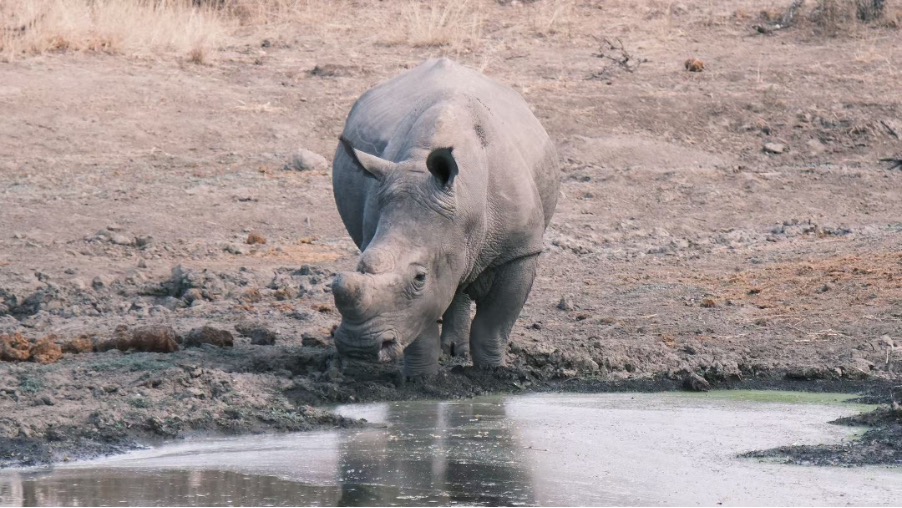
KRUGER NATIONAL PARK, South Africa -- Beneath the harsh African sun this August, the rhino pauses at the edge of a watering hole. Its body is a marvel of strength—thick, leathery hide folded like ancient parchment, dotted with ticks and patches of dried mud that crack when it shifts its weight. Its legs, short but sturdy as tree trunks, carry it forward with a slow, deliberate gait. But as our gaze moved to its face, we were startled to see only a stunted remnant of its rhino horn.
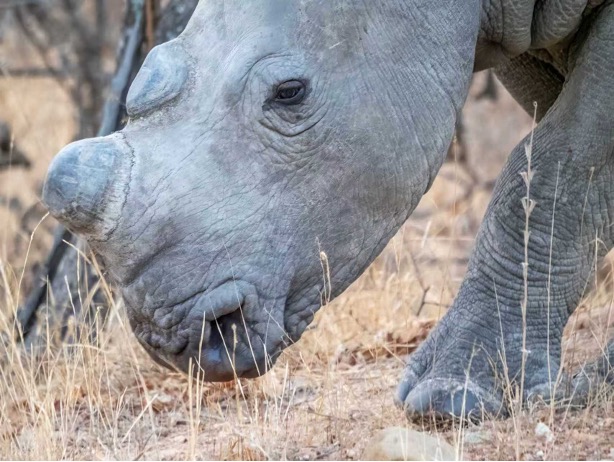
On a safari in Krueger National Park in South Africa, we turned to the guide with questions. Had the horn been poached? No, the guide told us. It was the national park itself that chopped off the rhino's horn. This measure, known as dehorning, aims to protect these creatures from poachers that hunt and kill them for their horns.
South Africa, home to nearly 70% of Africa’s remaining rhinos, remains the epicenter of a violent and escalating poaching war. At least 2,212 rhinos have been killed for their horns since 2020, according to data from Kreuger National Park. Rhino horns are highly valued in wildlife black markets for their use in traditional Chinese medicine and as status symbols in Asia, such as Vietnam.
The South African government, which manages Kruger National Park, has adopted rhino dehorning as its key anti-poaching strategy. And while this has proven effective, poachers have recently started targeting even dehorned rhinos for their remaining stump. And some recent studies have found that rhinos are negatively impacted by the loss of their horns, bringing the practice of the costly and complex strategy into question.
Dehorning has been in practice in Africa since 1989, but the South African government only began implementing a dehorning policy in Kruger National Park in 2021. This practice is credited for the 78% drop in poaching across eight reserves in South Africa's Greater Kruger region, according to July data published in the journal Science.
"Dehorning does not harm the animal. It saves its life," South Africa's Minister of Environment, Forestry and Fisheries, Dion George, said in a speech in July.
Dehorning a rhino is a complex and costly operation. The process involves tracking a rhino from a helicopter, sedating it with a dart from a veterinarian and then using a saw to cleanly remove the horn above its base, said Craig Spencer, the general manager of an anti-poaching team in the Kruger area. The stump is smoothed and coated with tar to prevent infection.
However, the protection is temporary. Like fingernails, “a rhino’s horn can regrow at a rate of up to 7.6 cm per year, meaning the procedure, averaging US$1,000 (HK$7,778) per animal, needs to be repeated every 18 to 24 months,” Spencer said.
Dehorning costs the park up to 6 million rand (HK$2.7 million) annually, Cathy Dreyer, chief ranger of Kruger National Park, said in a 2022 interview with the South African newspaper City Press. “Our teams can dehorn up to 20 rhinos a day—they leave at dawn, return late at night and still have to process collected samples...We cannot keep doing this forever,” Dreyer said in the article.
Rhino horns are important for the animal’s social interactions and territory establishment. A study published in Proceedings of the National Academy of Sciences in 2023 found that dehorned rhinos were 37% less likely to engage in social encounters than horned ones, which may affect reproduction.
The critically endangered black rhino also relies heavily on its horn to forage for food. “We may be creating a biologically intact but behaviorally ‘mutilated’ rhino population that, while surviving, cannot fully perform their natural functions in the ecosystem,” the study said.

While national rhino poaching figures show an overall decline since a peak in 2014, the crisis is intensifying within Kruger National Park itself. Kruger’s data reveals a troubling rebound: in 2024, rhino poaching incidents rose to 88, an increase from the 78 recorded in 2023.
Poaching groups have adopted a new, ruthless strategy: They are now targeting dehorned rhinos for the small stumps that remain, valuing even these remnants enough to kill, according to a recent government report.
Quentin Wesley, a Kruger guide who works at tour company Viva Safaris, said that during typical dehorning procedures, a four-finger-wide stump—roughly 10% of the total horn length—is left intact. Cutting further would damage the rhino’s nerve endings, causing irreversible harm.
"Poachers may spend weeks or even months tracking a rhino’s footprints, but they have no way of knowing if the rhino has been dehorned," Wesley said. "So, when they finally stand before the animal, the only thing they do is kill it and take whatever horn remains."
A large, full African rhino horn can weigh over 5 kilograms, meaning the 10% stump still amounts to more than 500 grams. This amount can fetch as much as US$6,727 (HK$$52,325) on the black market, according to 2021 data from the Wildlife Trade Monitoring Network which estimates the price of a rhino horn as US$ 13,455 per kilogram.
As the sun began to set over Kruger, casting long golden shadows across the watering hole, the dehorned rhino lifted its head. For a moment, it stood perfectly still—its powerful body mirrored in the calm surface, its ears twitching with delicate awareness, rotating subtly to catch every distant sound: the call of a bird, the rustle of grass, the hum of the bush settling into dusk. Then it turned and melted back into the deepening shadows with a calm elegance that belied its enormous size.
《The Young Reporter》
The Young Reporter (TYR) started as a newspaper in 1969. Today, it is published across multiple media platforms and updated constantly to bring the latest news and analyses to its readers.

Nepali people protest and pay tribute at Copenhagen’s City Hall and Nepal Embassy

Policy Address 2025: Hong Kong develops tourism economy to revitalise retail industry



Comments