

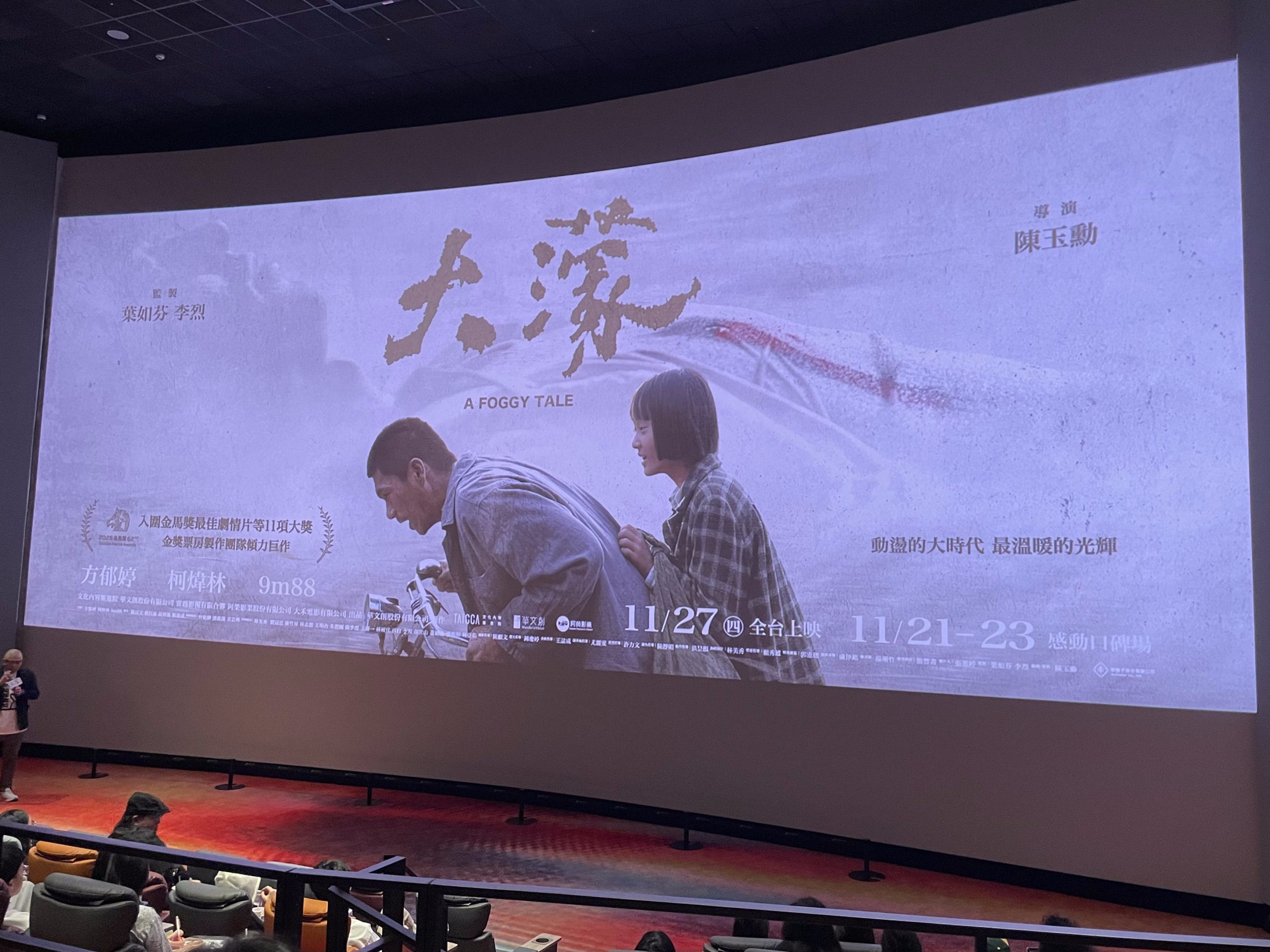
TAIPEI, Taiwan – Taiwan’s President Lai Ching-te attended the screening of A Foggy Tale, a Taiwanese film about the era under authoritarian rule, in the Xinyi District on Friday.
The historical drama is about Taiwan’s White Terror period, the political suppression from the 1950s to 1990s when Taiwan was ruled by the Kuomintang.
The film follows a girl from Chiayi, who travels to Taipei alone to collect her brother’s remains and meets a former soldier, now working as a rickshaw driver.
After the screening, Lai said to the audience that he was deeply moved by the film, set in 1951, the year he was born.
“In that era of the White Terror, many people might have had nothing at all, except courage, they only wanted to step out of the thick mist and see a bright future, they had no conditions, no resources—only courage,” Lai said.
“Back then it was 1954, and now it is 2025. We have come this far through the sacrifices and dedication of many people,” Lai said. “I truly hope that everyone who watches this film can understand how difficult the past was, and that we must all cherish the achievements of today as we move toward a better future.”
“White Terror” refers to the political suppression of dissidents carried out by the Kuomintang from 1949 to 1992, which included mass arrests, interrogations, trials and imprisonments and even executions of suspected communist spies or independence advocates, according to the National Human Rights Museum of Taiwan.
The Kuomintang lifted the Martial Law in 1987 with the “Temporary Provisions Effective During the Period of National Mobilisation the Communists Rebellion” repealed in 1991, according to the National Human Rights Museum, putting an end to the era of political suppression and the restriction of civil and political rights in Taiwan.
Lai added that he deeply admired the director for telling Taiwan’s stories through film, and said this effort allows the people of this land to better understand themselves, to face the past and to strive for Taiwan’s future.
Li Lieh, the film’s producer, said that Taiwan’s film industry is struggling in a difficult environment, making fundraising especially challenging. Because the story is set 70 years ago, recreating each scene caused a fortune. She added that past governments had neglected to preserve historical records, further complicating the process of bringing this film to life.
With Taipei Golden Horse Film Festival approaching on Saturday night, the movie has received the award of audience choice and leads with 11 nominations, including narrative feature and director.
The movie will be officially released on Nov. 27 in Taiwan.
《The Young Reporter》
The Young Reporter (TYR) started as a newspaper in 1969. Today, it is published across multiple media platforms and updated constantly to bring the latest news and analyses to its readers.
Exhibition by Hong Kong’s Press Photographers Association cancelled after host venue orders “emergency repairs”
Super Typhoon Ragasa: How Hong Kong looks from different viewpoints


Comments