
When K-pop boy group Seventeen announced it was holding two concerts in Hong Kong in September, devoted fan Tsai Oi-wai, 20, knew it was an opportunity she couldn’t miss. But by the time she was online, tickets were sold out.
Tsai scrolled endlessly on Instagram until she came across a second-hand ticket reseller who seemed trustworthy. “I even checked his profile, which had photos of everyday life—scenery, food, and other pictures—so I didn’t suspect anything,” Tsai said.
Tsai’s ideal seat was priced at HK$2,099 on the official website, and the seller asked for HK$2,599. “I think the price was still within a reasonable range, so I transferred the money to him without further hesitation,” she said.
The entire conversation and transaction took place over WhatsApp.
“The seller told me that all payments and refunds had to go through a third-party partner company, which required additional verification procedures,” she added. “The scammer then asked me to enter a verification code, and I did so,” said Tsai.
“Ever since then, I’ve never heard from that person again, nor any updates about my ticket.”
She was scammed out of HK$42,034.
Tsai’s experience is far from unique. According to the Hong Kong Police, fraud cases have surged dramatically, rising from 15,553 cases in 2020 to 444,480 in 2024, representing an increase of nearly thirtyfold, with the upward trend continuing in the first half of 2025.
Students are easy targets for scammers. As of September, university students have reported 1,711 scam cases with total losses of HK$180 million, according to the Hong Kong police’s Anti-Deception Coordination Centre. Phone scams accounted for HK$16 million in losses among local students, while mainland students suffered significantly higher losses at HK$87 million.
“Students are an ideal target for scammers, as their limited life experience and lack of familiarity with legal procedures and police investigation processes make them more susceptible to fraudsters' professional appearance,” said Chen Guo-ping, 47, a retired policeman who previously served in the cybersecurity team.
Zhou Run-ci, 19, a second-year student from mainland China studying in Hong Kong, got caught up in an elaborate phone scam.
“A call displaying the title of Hong Kong Immigration Department came through and told me that my entry and exit rights would be restricted because I was listed as a deception suspect by Shanghai police,” he said, saying that he thought it was authentic at the time.
Zhou said that the fake department directly transferred his call to the “Shanghai public security bureau.
In mainland China, each province and municipality has its own area codes, which will be displayed during calls. Zhou said his scammers somehow used some special technical means to keep their numbers and area ID consistent with Shanghai
“The fraudster had my exact personal details, like my name and my ID number,” Zhou said, adding that he doesn’t know how his data was leaked.
According to a press release from China’s Ministry of Public Security, data breaches often occur, including customer information stolen from express delivery services and fake companies that gather and sell job seekers’ information.
Zhou said the video call with scammers completely earned his trust. They wore police uniforms, and he even showed what looked like a police ID card during the call.
“The office was full of his colleagues who wore police uniforms,” he said.
“He [the scammer] insisted that audio surveillance is part of the investigation protocol. I must remain on the line for the entire 24 hours, no matter what I am doing. This surveillance lasted for over 20 days, and I couldn’t hang up,” said Zhou.
Zhou added that he had to report every detail of his routine during the surveillance period. He said that he attended a 30 minute interrogation every day, and a fake policeman regularly updated him on his case.
According to a report by China Central Television, genuine police communication for cases must be completed within a police station, with full audio and video recording, followed by signing and fingerprinting for confirmation.
“On the seventh day after I accepted their investigation, the fake policeman said they had tracked a bank account with 5 million yuan under my name, with 4 million of the income belonging to money laundering and the other 1 million was from human trafficking,” Zhou said.
“I completely lost my faith in my innocence when I heard the scammer announce that the court had approved my arrest warrant,” Zhou said.
The scammer told Zhou that they were willing to help him apply for bail. A person Zhou thought was a policeman from the Beijing Public Security Bureau said he would be released after paying a deposit of $750,000 yuan.
“I was ordered to transfer money to an officer from the Independent Commission Against Corruption. I have doubts about the authenticity of all this, but in the end, I still completed the transfer,” Zhou said.
Bail money shall be deposited into the designated public security organ account, not to any individual, according to the Regulations on Bail Pending Trail.
“Fraudsters will exploit victims’ urgent need and launch psychological tactics, coercing them to make irrational decisions under great intense pressure,” said Chen, who used to serve in the police cyber-security team.
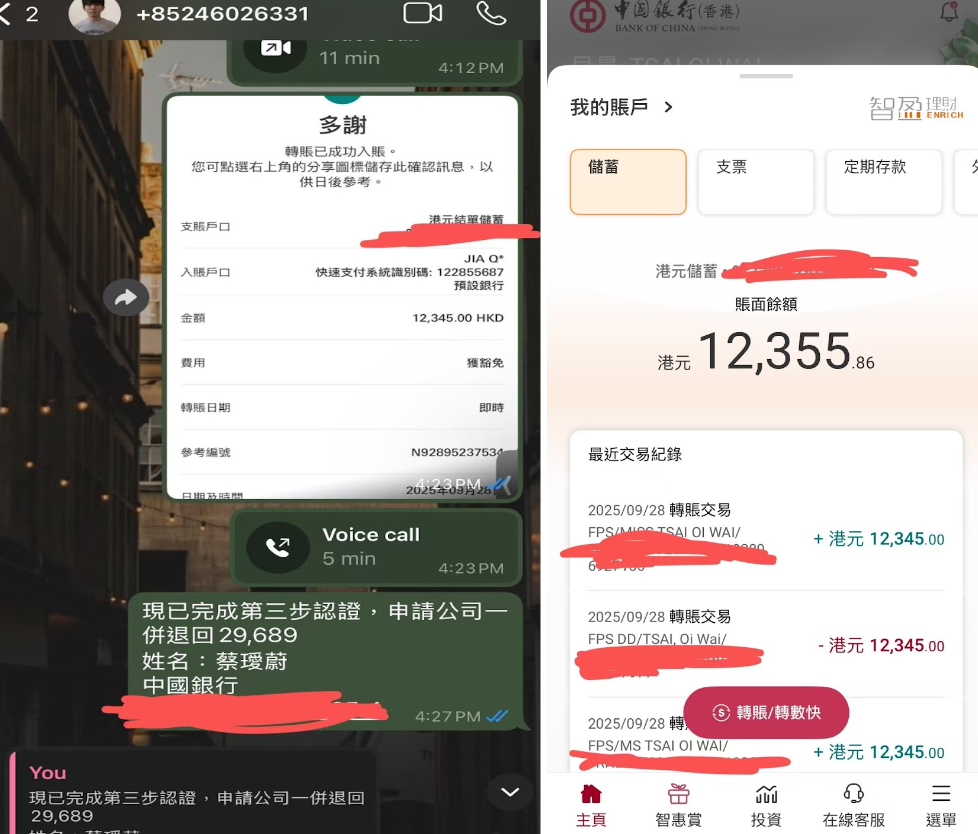
The anti-Deception Coordination Centre warned that concert ticket scam will use excuses such as “lack of remarks for payment transfer” and verification process to trick buyers into making multiple transfers.
Tsai said after she made two transfers for the concert tickets, more than HK$40,000, she began to feel uneasy. The seller repeatedly assured her that “the ticket’s on the way,” but kept delaying, which raised her suspicions.

“In the evening, I went to the Tsuen Wan Police Station near my home and filed a report. But the police told me that the scammer’s IP address was overseas, so my money was unlikely to be recovered. Left with no other options, I could only accept the loss,” Tsai said.
Lawyers say that while difficult to get money back, it’s not impossible.
“Police and relevant authorities are responsible for criminal investigations and prosecuting suspects, while monetary recovery requires victims to engage lawyers through civil proceedings under Hong Kong law,” said Tang Chi-wing, Principal of Tang Lawyers, a Hong Kong-based law firm.
Tang said lawyers will apply for bank account disclosure and fund freezing measures to help recover the disputed funds.
“If funds have been transferred overseas, cross-border recovery remains legally possible; however, this requires initiating relevant legal proceedings in the corresponding jurisdiction,” said Tang.
In addition, Chen noted that since most fraud schemes are operated by transnational criminal syndicates, recovering the stolen money becomes even more difficult.
“Due to jurisdictional constraints, coordinated multinational police operations may be an effective way to combat such crimes,” Chen added.
Scam centres in Myanmar are one source of scam phone calls. Recently, 1,178 Chinese nationals who engaged in fraudulent operations in Myanmar’s Myawaddy region were arrested and repatriated to China under the joint operation of China, Myanmar and Thailand police forces, according to China’s state media.
A former participant in the fraudulent operation, who worked as a security guard at a scam compound for three months and requested not to disclose his name, told TYR that he went to Myanmar from mainland China because the job advertisement was twice his salary.
He said the job posting was ambiguous, but he was tempted by the salary. After accepting the offer, he was provided with detailed instructions, including a map for crossing the China-Myanmar border, and prepared excuses in order to deal with possible inspections by police or immigration.
“The fraud company was made up of several divisions. As a member of the security department, we have more freedom; sometimes we even have the opportunity to organize field trips,” he said.
According to Hong Xing News, a news outlet run by Chengdu Economic Daily, the entrances of the scam compound are guarded by armed security personnel.
The former guard added that the scam organisations systematically improve their fraudulent strategy and methods to match changing trends or social events.
Zhou felt both angry and helpless when he heard It’s hard to retrieve his money.
“Imagine there are hundreds of people who got scammed just like me; the total scam money could reach more than a million, but there’s nothing we can do about it,” Zhou said.
Residents or tourists who receive suspicious calls in Hong Kong should contact the Anti-Deception Coordination Centre's 24-hour hotline 18222 for assistance in fraud cases.
《The Young Reporter》
The Young Reporter (TYR) started as a newspaper in 1969. Today, it is published across multiple media platforms and updated constantly to bring the latest news and analyses to its readers.

After the crowds go home: Can Kai Tak turn mega events into lasting growth?
IPO regulation reform in the hot market burns winning spaces for retail investors


Comments